Every planted-tank forum eventually hosts the debate: do aquarium plants really need CO2, or is it an upsell? The honest answer is “it depends on the plants” — which sounds like a dodge until you understand why. This guide gives you the diagnostic framework: which plants genuinely need injected CO2, the signs your tank is carbon-limited, and how to decide without wasting money.
The Short Answer
All plants need carbon — it’s non-negotiable chemistry. The question is whether your tank’s natural CO2 (2–5 ppm from fish, bacteria, and surface exchange) suffices, or whether your plants need the 25–35 ppm that injection provides. That depends entirely on species and goals:
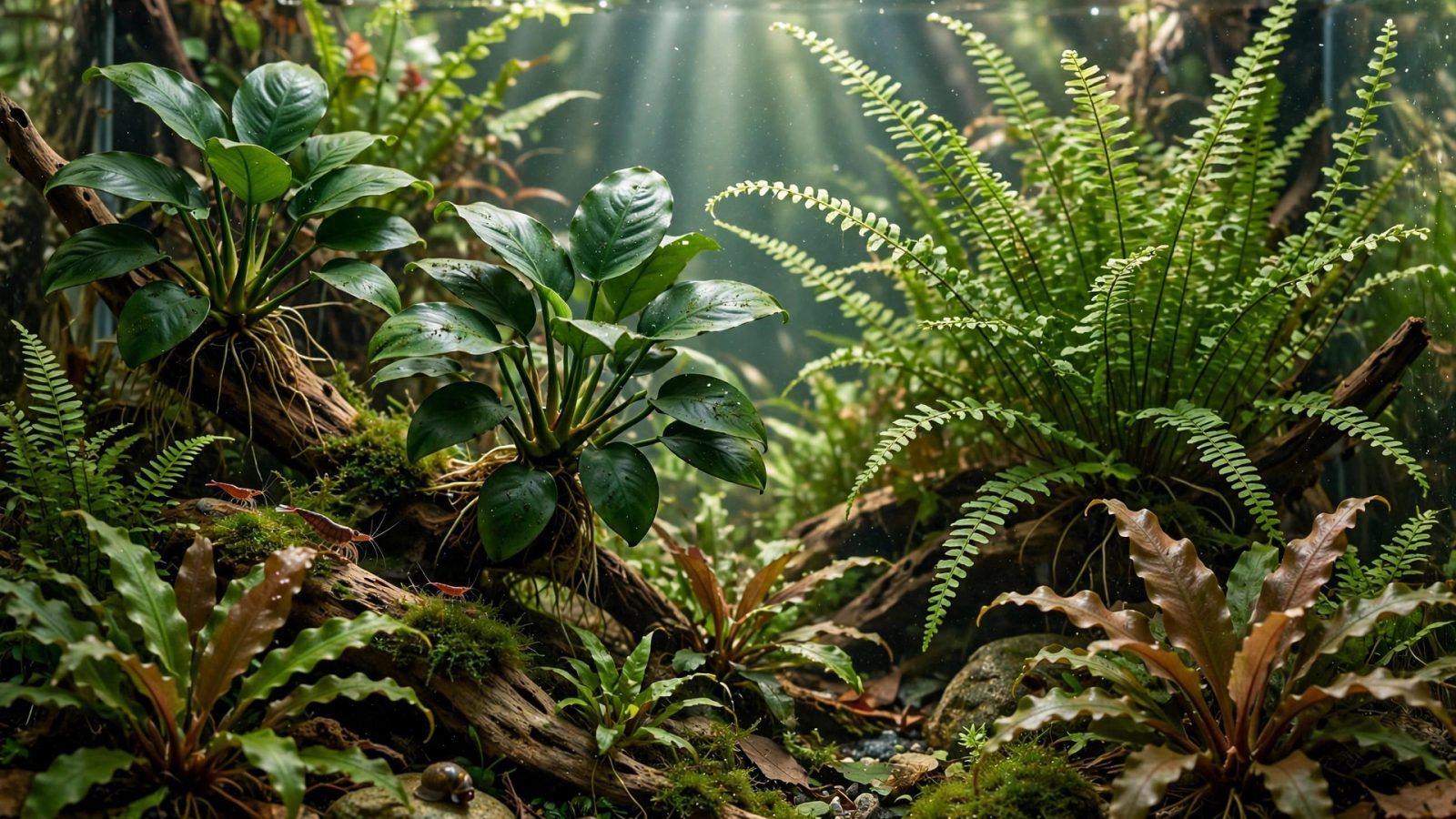
- Don’t need injected CO2: anubias, java fern, bucephalandra, mosses, crypts, vallisneria, most swords, floating plants. These evolved for low-carbon environments and thrive without injection. Our low-light plants guide is essentially the no-CO2 plant list.
- Benefit from CO2 but survive without: most stem plants (rotala, ludwigia, hygrophila), dwarf hairgrass, Monte Carlo. They’ll grow — slowly, leggier, less colorful — without it.
- Genuinely need CO2 to thrive: HC Cuba (dwarf baby tears), UG (utricularia graminifolia), tonina species, most intense red stems, and high-density carpets. Without injection these melt, stall, or never color up.
5 Signs Your Plants Want More CO2
1. New growth is small and pale
Carbon-limited plants produce undersized new leaves — the plant rations carbon to the growing tips, and there’s not enough to go around. If new leaves are consistently smaller than mature ones on the same plant, carbon is suspect number one (after light — check light requirements first).
2. Stem plants grow up but not out
Leggy vertical growth with long internodes and sparse side shoots often means the plant is stretching for better conditions. With adequate CO2, the same species grows bushier with side shoots. Note: low light causes identical symptoms — diagnose light first, since it’s the cheaper fix.
3. Carpeting plants won’t spread
The classic CO2-deficiency signature. Dwarf hairgrass or Monte Carlo that sits as planted plugs for months, growing slowly upward but never sending runners, is almost always carbon-limited (assuming light is adequate). Carpets are the single best argument for CO2 injection.
4. Red plants stay green
Anthocyanin production (red pigment) ramps with photosynthetic rate, which ramps with CO2. A ludwigia that’s green under good light with complete fertilizer is usually waiting on carbon.
5. Algae wins despite “doing everything right”
If light is moderate, fertilizer is complete, and maintenance is consistent but thread or staghorn algae persists, carbon limitation is the remaining variable. Plants that can’t photosynthesize efficiently leak organics that feed algae — the cruel feedback loop of the carbon-starved tank.
The Decision Framework
Ask yourself three questions:
1. What do I want to grow? If your dream tank is anubias on driftwood with crypts — skip CO2, invest in hardscape and fish. If it’s a red-stem Dutch scape or an HC carpet — CO2 is mandatory, budget for it before buying plants.
2. How much maintenance do I want? CO2 accelerates everything, including trimming. A high-tech tank needs weekly attention; a low-tech tank needs monthly. Be honest about your lifestyle — the no-CO2 low-tech method is a legitimate, beautiful path, not a consolation prize.
3. What’s my budget? Effective CO2 starts around $60 (citric DIY) to $150+ (budget pressurized). If that’s not in the cards, design around no-CO2 plants rather than fighting carbon limitation with plants that need it.
The Middle Paths
It’s not binary. Between “full high-tech” and “no carbon at all”:
- DIY CO2 on small tanks delivers meaningful results for minimal money — see our DIY guide.
- Liquid carbon gives a mild boost plus algae-fighting utility — our honest comparison sets expectations.
- Low-tech optimization — moderate light, complete fertilizer, good flow — grows stunning tanks with easy plants. Most award-winning “low-tech” aquascapes are just well-executed easy-plant designs.
- Soil substrates release CO2 as they decompose, giving dirted tanks a natural carbon subsidy for the first year.
Common Myths
- “CO2 is unnatural/cheating”: natural streams have far more CO2 than aquariums (soil respiration, decomposition). Injection partially restores what glass boxes lack.
- “CO2 will kill my fish”: at proper levels with a drop checker, no. Millions of community tanks prove it.
- “I need CO2 because my plants are dying”: maybe — but check light, fertilizer, and water parameters first. CO2 is the expensive fix; rule out the cheap ones.
- “More CO2 is always better”: beyond ~35 ppm, returns diminish and fish stress rises. Target the band, don’t chase the max.
The Bottom Line
Don’t ask “do plants need CO2” — ask “do my plants need CO2.” Match the method to the species list and the maintenance level you actually want. A thoughtfully stocked low-tech tank beats a neglected high-tech tank every time — the best CO2 system is the one that fits your goals, not someone else’s idea of a proper planted tank.
Plant-by-Plant CO2 Needs Reference
- Anubias (all): no CO2 needed. Grows slowly regardless; CO2 speeds it modestly.
- Java fern: no CO2 needed. The care guide confirms it’s a low-demand classic.
- Bucephalandra: no CO2 needed; benefits slightly.
- Mosses (java, christmas, flame): no CO2 needed.
- Crypts: no CO2 needed; CO2 accelerates establishment after planting.
- Vallisneria: no CO2 needed (and avoid liquid carbon — it melts vals).
- Amazon swords: no CO2 needed; heavy root feeders instead.
- Rotala rotundifolia: survives without, thrives with. The classic “try it low-tech first” stem.
- Ludwigia repens: grows without CO2; reds up with CO2 + strong light.
- Hygrophila polysperma: practically unkillable either way; CO2 makes it a weed.
- Dwarf hairgrass: survives without but carpets dramatically better with CO2.
- Monte Carlo: the most forgiving carpet; creeps without CO2, carpets with it.
- Staurogyne repens: grows without CO2 but stays compact and carpets only with it.
- HC Cuba / dwarf baby tears: needs CO2. Don’t attempt without injection.
- Tonina / Eriocaulon: need CO2 and soft water. Expert plants.
- Red stems (Rotala H’ra, Ammania): need CO2 for color; grow green without.
Two Tanks, Two Philosophies: A Comparison
Tank A — Low-tech 29-gallon, no CO2: anubias on driftwood, crypts in aquasoil, vallisneria background, frogbit cover. Medium light, 7-hour photoperiod, weekly liquid fertilizer. Maintenance: 30 minutes weekly. Result after a year: lush, mature, algae-minimal. Total equipment beyond basics: ~$60 (light + timer).
Tank B — High-tech 29-gallon, pressurized CO2: Monte Carlo carpet, red rotala background, buce on hardscape. High light, 8-hour photoperiod, CO2 at 30 ppm, EI fertilizer dosing. Maintenance: 2–3 hours weekly (trimming, dosing, testing). Result after a year: dense, colorful, competition-grade. Total equipment beyond basics: ~$350.
Neither is “better.” Tank A suits a busy professional who wants beauty without chores; Tank B suits the hobbyist who finds trimming meditative. The mistake is building Tank B’s plant list with Tank A’s equipment — or buying Tank B’s equipment for Tank A’s goals. Decide the philosophy first, then buy.
What If You Already Have CO2-Hungry Plants and No CO2?
Options in order of practicality:
- Swap the plants. Trade demanding species for easy ones at a local club. No shame — matching plants to your setup is good husbandry.
- Add DIY CO2. A citric generator (~$70) transforms what’s possible on small tanks. See our DIY guide.
- Optimize everything else. Moderate light, complete ferts, good flow, and patience grow “difficult” plants better than most expect — just slowly and greenly.
- Commit to pressurized. If the plant list is non-negotiable, the budget CO2 guide keeps entry affordable.
What doesn’t work: keeping HC Cuba alive on wishes and liquid carbon. Respect the plant’s needs or change the plant.
CO2 and Algae: The Paradox Explained
Beginners encounter a paradox: “CO2 helps plants” but also “my CO2 tank has algae.” Both true. CO2 grows plants fast — and fast-growing plants in an unbalanced system still lose to algae. The resolution:
- Stable CO2 + balanced light + complete ferts → plants dominate, algae starves. This is the goal state.
- Fluctuating CO2 (DIY swings, timer errors) → plants stressed by instability, algae (especially BBA and staghorn) exploits it. Stability matters more than the absolute level.
- High CO2 + excessive light → you’ve raised the ceiling for everything, including algae. Light must match the system’s capacity.
- CO2 without increased fertilizer → faster growth exhausts nutrients in weeks, then deficiencies weaken plants and algae moves in.
CO2 doesn’t prevent algae by itself — it enables the fast, healthy plant growth that prevents algae. The distinction matters because it tells you where to look when a CO2 tank still has problems: stability, light level, and nutrition, in that order.
The “No-CO2 But Optimized” Tank: How Far Can It Go?
Skeptics ask whether low-tech has a ceiling. Honestly assessed, a well-run no-CO2 tank achieves roughly 60–70% of a CO2 tank’s visual density — which is to say, beautiful by any normal standard. What it can’t do: dense HC Cuba carpets, intense red stem fields, or the manicured Dutch look. What it does brilliantly: lush green aquascapes, dramatic hardscape with epiphytes, breeding-friendly natural tanks.
The optimization checklist for maximum no-CO2 results:
- Moderate (not low) light — 30–45 PAR, the top of the no-CO2 safe zone
- Complete liquid fertilizer + root tabs — non-negotiable; growth is nutrient-limited, not light-limited
- Nutrient-rich substrate (aquasoil) — the single biggest no-CO2 upgrade
- Heavy initial planting — 70%+ substrate coverage from day one
- Floating plants for nutrient export and light moderation
- Consistent 7-hour photoperiod, good flow, regular water changes
Follow this with easy-plant species and the result surprises CO2 skeptics regularly. Our no-CO2 method guide is the full playbook.
Final Decision Worksheet
Score yourself:
- My must-have plants include carpets or red stems (+2 for CO2)
- My tank is 30+ gallons (+1 for CO2 — DIY struggles at scale)
- I enjoy weekly maintenance rituals (+1 for CO2)
- My budget has $150+ for setup (+1 for CO2)
- I want the lowest-maintenance tank possible (+2 against CO2)
- My favorite plants are anubias, ferns, crypts, mosses (+2 against CO2)
- I keep sensitive shrimp I prize highly (+1 against CO2)
Positive score: CO2 will serve you well — start with the complete guide. Negative score: embrace low-tech proudly — it’s a complete philosophy, not a compromise. Zero: try DIY for six months and let experience decide.
CO2 and Water Changes: The Interaction
Water changes and CO2 interact in ways worth knowing:
- Tap water contains CO2 (often 5–15 ppm from pressurized pipes). A large water change temporarily spikes tank CO2 — harmless, and it’s why plants sometimes pearl after water changes.
- Don’t adjust CO2 on water-change day. The temporary tap-water CO2 skews drop checker readings for hours. Tune on non-water-change days.
- Large water changes degas injected CO2 briefly — levels recover within the hour via the diffuser. No action needed.
- Consistent water changes matter more in CO2 tanks — fast growth accumulates organics fast. The 50% weekly change of EI dosing isn’t arbitrary; it resets the system that CO2 accelerates.
Parting Thought: The Best Tank Is the One You Maintain
Every CO2 decision is really a lifestyle decision. The stunning high-tech tank you neglect becomes an algae farm; the modest low-tech tank you tend becomes a mature aquascape. Choose the system you’ll actually maintain — the daily glance at the drop checker, the weekly trim, the monthly cylinder check — and your plants will thrive at whatever technology level you chose. The hobby rewards consistency over equipment, always.