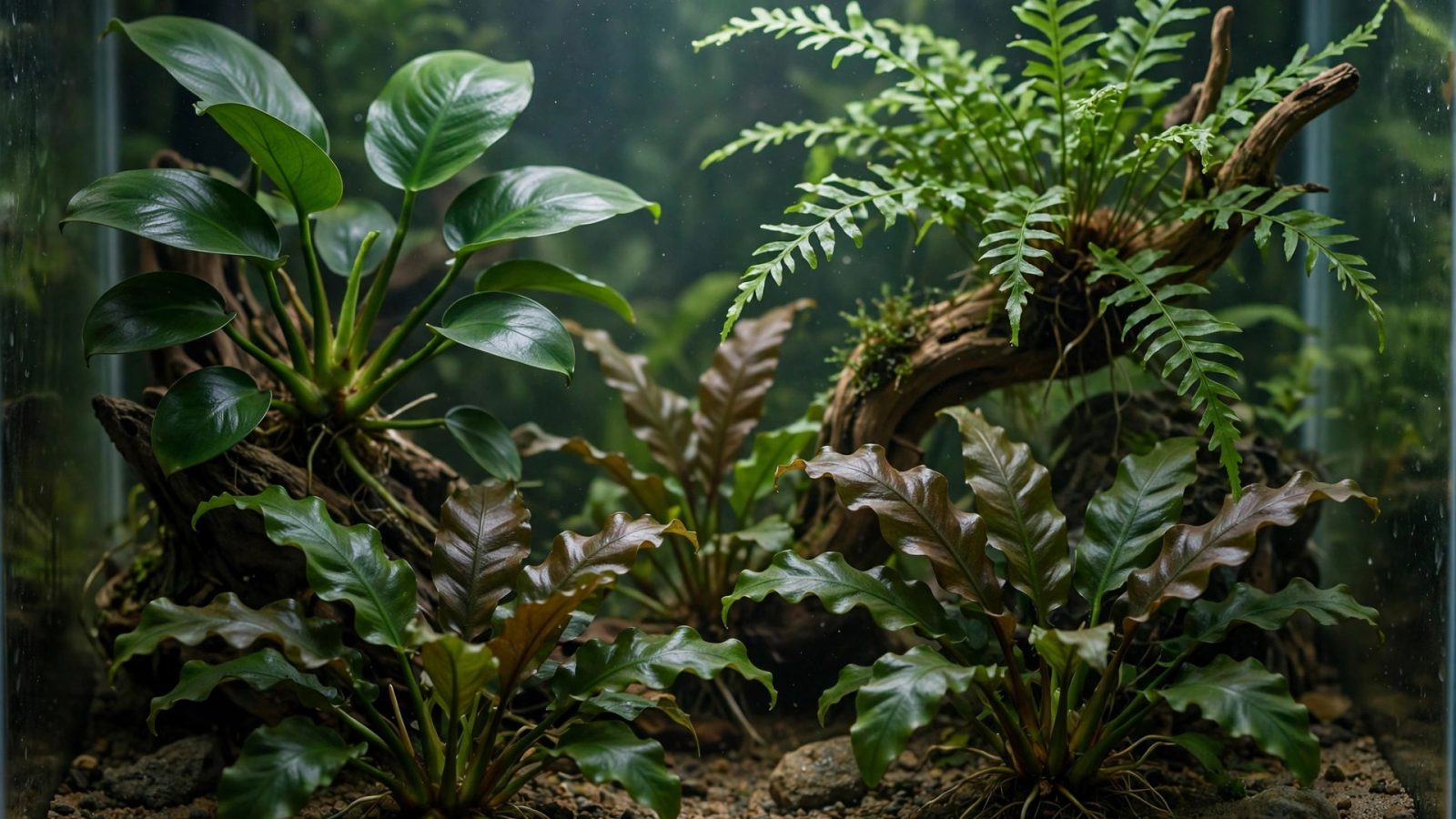
Low-light aquarium plants are species that grow and stay healthy under modest lighting — typically the stock LED strip that comes with most beginner kits — without needing high-powered fixtures or injected CO2. For beginners, that makes them the easiest route into a planted tank: you can get lush, green growth with the equipment you already own, while your fish benefit from the shelter, oxygen, and natural water filtration that live plants provide.
The seven plants below were chosen because they genuinely tolerate low light rather than merely surviving it for a few weeks. Each one is widely available, affordable, and forgiving of the small mistakes every new aquarist makes — inconsistent fertilizing, a missed water change, or a dimmer-than-expected lamp. If you’ve been growing aquarium plants without CO2, this list fits that approach perfectly.
Before we get to the plants, it helps to know exactly what “low light” means in aquarium terms, so you can tell whether your own tank qualifies.
What Counts as Low Light?
In planted-tank terms, low light means roughly 15–30 PAR (photosynthetically active radiation) at the substrate — the intensity most stock LED hoods and clip-on lights deliver. You don’t need a PAR meter to recognize it: if your tank came with its own light lid, or you’re running a single basic LED bar over a standard 10–20 gallon tank, you’re almost certainly in the low-light zone.
Two other pieces complete the picture. First, keep a consistent photoperiod of 6–8 hours per day — a plug-in timer makes this effortless, and a regular on/off rhythm does more for plant health than leaving the light on all evening. Second, remember that ambient room light doesn’t count: the glow from a nearby window won’t drive photosynthesis in any meaningful way, and it often just feeds algae. Judge your lighting by the aquarium lamp alone.
The 7 Best Low-Light Aquarium Plants for Beginners
1. Anubias barteri var. nana (Anubias Nana)
Anubias nana is the classic beginner plant for a reason: it grows slowly but almost unstoppably, with thick dark-green leaves that algae and even nibbling fish mostly leave alone. It’s an epiphyte, meaning it anchors to wood and rock rather than rooting in the substrate.
- Light: Low (15–30 PAR)
- Temperature: 72–82°F (22–28°C)
- pH: 6.5–7.8
- CO2: Not required
- Growth rate: Slow
- Placement: Foreground to midground, attached to hardscape
Planting tips: Tie the rhizome (the thick horizontal stem the leaves sprout from) to driftwood or rock with cotton thread or a dab of cyanoacrylate gel superglue — never bury it in substrate, or it will rot. The plant is slow-growing, so give new leaves a month or two to appear. If older leaves start to fade, read up on anubias leaves turning yellow before assuming the plant is dying; the cause is usually fixable.
2. Java Fern (Microsorum pterotoides)
Java fern is another rhizome plant that’s nearly indestructible, with wavy, lance-shaped leaves that sway gently in the current and give tanks a natural, wild look. Like Anubias, it feeds through its rhizome and leaves rather than true roots, and it reproduces by sprouting tiny plantlets on old leaf tips that you can detach and replant.
- Light: Low (15–30 PAR)
- Temperature: 68–82°F (20–28°C)
- pH: 6.0–7.5
- CO2: Not required
- Growth rate: Slow to moderate
- Placement: Midground, attached to hardscape
Planting tips: Attach it to wood or rock just like Anubias, keeping the rhizome fully exposed. It tolerates slightly cooler water than most tropical plants, making it a fine pick for unheated tanks with white cloud mountain minnows or similar species. For deeper detail on lighting, nutrients, and propagation, see our full Java fern care guide.
3. Cryptocoryne wendtii (Wendt’s Crypt)
Cryptocoryne wendtii is one of the few rosette plants that genuinely thrives in low light, sending up ruffled, bronze-to-green leaves from a crown at the substrate level. It comes in green, bronze, and red-brown varieties, so a single species can give you real color variety without any extra equipment.
- Light: Low (15–30 PAR)
- Temperature: 72–79°F (22–26°C)
- pH: 6.0–8.0
- CO2: Not required
- Growth rate: Slow to moderate
- Placement: Foreground to midground, rooted in substrate
Planting tips: Plant the crown (where leaves meet roots) just at the substrate surface — buried too deep, it rots; sitting too high, it floats away. Push one root tab into the substrate near the plant every couple of months, since crypts feed heavily through their roots. Expect “crypt melt” in the first 1–2 weeks: the old leaves dissolve as the plant adapts to your water. Leave the roots alone — new leaves almost always follow.
4. Java Moss (Taxiphyllum barbieri)
Java moss is the utility player of the planted tank: a soft, branching moss that will attach itself to almost any surface and create the fuzzy green carpets, moss walls, and breeding shelters that shrimp and fry love. It’s cheap, nearly impossible to kill, and a single golf-ball portion multiplies steadily under basic conditions.
- Light: Low (15–30 PAR)
- Temperature: 59–86°F (15–30°C)
- pH: 5.5–8.0
- CO2: Not required
- Growth rate: Slow to moderate
- Placement: Anywhere — foreground carpet, walls, hardscape, breeding tank cover
Planting tips: Spread it thin over the surface you want covered and tie it down with thread or fine mesh; clumping it into a ball blocks light from the inner portions and causes die-off. Trim it with scissors every month or two to keep it dense and to stop loose strands from clogging your filter intake. Rinse new moss well before adding it, since it sometimes carries hitchhiker snails.
5. Anacharis (Egeria densa)
Anacharis is a fast-growing stem plant that soaks up excess nutrients like a sponge, which makes it one of the best algae-prevention tools a beginner can buy. Its bright green, whorled leaves look great swaying in the background, and it works either planted in the substrate or left floating.
- Light: Low to moderate (tolerates 15–30 PAR)
- Temperature: 50–78°F (10–26°C)
- pH: 6.5–7.5
- CO2: Not required
- Growth rate: Fast
- Placement: Background (planted or floating)
Planting tips: Strip the lower inch of leaves and push the bare stem into the substrate, spacing stems about an inch apart so light reaches the lower leaves. It grows fast enough that you’ll trim it regularly — replant the cuttings to thicken the background for free. Note that it’s illegal to buy or possess in some regions because it’s invasive in the wild, so check your local rules and never release aquarium plants into waterways.
6. Vallisneria spiralis (Italian Vallisneria)
Vallisneria spiralis sends up long, ribbon-like leaves that arc gracefully across the water surface, instantly giving a tank height and movement. It’s a hardy root feeder that spreads by runners, so one pot can colonize an entire background over a few months.
- Light: Low (15–30 PAR)
- Temperature: 68–82°F (20–28°C)
- pH: 6.5–8.5
- CO2: Not required
- Growth rate: Moderate to fast
- Placement: Background, rooted in substrate
Planting tips: Give it a substrate at least 2 inches deep and place a root tab under each cluster, since it feeds mainly through its roots. Plant individual crowns a few inches apart along the back glass and let the runners fill in — resist the urge to plant densely on day one. Trim overlong leaves at the base rather than mid-leaf, as cut tips brown and don’t heal.
7. Bucephalandra (Buce)
Bucephalandra is the premium-looking option on this list: tiny, iridescent leaves in greens, blues, and purples that grow on rhizomes like a miniature Anubias. It’s slow and a bit pricier per portion, but it stays compact, making it perfect for nano tanks and for adding jewel-like detail to hardscape.
- Light: Low (15–30 PAR)
- Temperature: 72–82°F (22–28°C)
- pH: 6.0–7.5
- CO2: Not required
- Growth rate: Very slow
- Placement: Foreground to midground, attached to hardscape
Planting tips: Treat it exactly like Anubias: rhizome tied or glued to rock or wood, never buried. Because it grows so slowly, buy enough portions to look full from the start — one small pot in a 20-gallon tank will look sparse for a year. Keep it out of the brightest spot under the light; in low-light tanks it actually colors up better with a little shade.
How to Plant and Arrange Them
The single most common beginner mistake is burying rhizome plants. Anubias, Java fern, and Bucephalandra all grow from a thick horizontal rhizome that must stay exposed to the water — tie or glue it to driftwood, rock, or even the tank’s filter housing, and let the roots dangle or grip the surface on their own.
Root feeders are the opposite: Cryptocoryne wendtii and Vallisneria draw most of their nutrition through the substrate, so they need root tabs — small fertilizer capsules pushed into the gravel or sand near the plant every 2–3 months. A basic liquid all-in-one fertilizer dosed weekly covers the water-column feeders (Anacharis, Java moss, and the rhizome plants).
For a natural layout, think in three layers. Put low growers (Anubias nana, Buce, crypts) in the foreground and midground, medium plants (Java fern, Java moss on wood) in the midground, and tall growers (Vallisneria, Anacharis) along the background. Odd-numbered groupings — three crypts, five Anacharis stems — look more natural than even rows. Leave some open swimming space in front; a tank that’s wall-to-wall plants from day one usually just grows algae.
Low-Light Tank Care Basics
Photoperiod: Run your light 6–8 hours daily on a timer. If algae appears, shorten to 6 hours before changing anything else — excess light duration is the number-one algae trigger in low-tech tanks.
Fertilizer: Dose a liquid all-in-one fertilizer once or twice a week at half the label dose to start, and add root tabs for the crypts and Vallisneria every 2–3 months. In low light, plants grow slowly and need less food than the bottle suggests; overdosing feeds algae, not plants.
Water changes: Change 25–30% of the water weekly. This removes the organic waste that algae thrives on and replenishes the trace minerals plants use. Consistency matters more than perfection — a regular small change beats an occasional big one.
Algae watch: Some algae on glass and old leaves is normal. Wipe the front glass weekly, prune badly affected leaves rather than scrubbing them, and make sure your light isn’t on longer than 8 hours. If you’re keeping a betta, floating plants for betta tanks can also help by shading the water and soaking up excess nutrients.
Frequently Asked Questions
Can aquarium plants really grow without CO2 injection?
Yes. All seven plants on this list grow fine on the CO2 naturally present in aquarium water from fish respiration and surface gas exchange. They’ll grow more slowly than they would with injected CO2, but they’ll be healthy and green — CO2 injection is an accelerator, not a requirement, for low-light species.
How many hours of light do low-light plants need?
Six to eight hours per day is the sweet spot. Less than six and growth stalls; more than eight and you’re mostly growing algae. Use a cheap plug-in timer so the schedule stays consistent even when you’re not home.
Why are my new plants melting after I planted them?
Melting — old leaves turning transparent and dissolving — is usually the plant shedding leaves grown in different conditions (often emersed at the farm) and regrowing leaves suited to your tank. Cryptocoryne is famous for it. As long as the roots and crown or rhizome are firm, leave the plant alone and new growth should appear within a few weeks.
Do I need special substrate for low-light plants?
Not necessarily. Rhizome plants and mosses don’t use the substrate at all, and root feeders like crypts and Vallisneria do fine in plain gravel or sand as long as you add root tabs. Nutrient-rich aquasoil helps but is optional — save the money for more plants.
Can I keep these plants with a betta fish?
Absolutely — bettas love planted tanks, and broad-leafed plants like Anubias give them resting spots near the surface. Just avoid anything sharp (not an issue with this list) and keep the water calm, since bettas dislike strong flow. Pair these with floating plants for the shaded, sheltered environment bettas prefer.
How fast will low-light plants fill in my tank?
Expect a slow start: most low-light plants take 2–4 weeks to settle in and then grow steadily but unhurriedly. Anacharis and Vallisneria will show obvious progress within a month, while Anubias and Buce may take several months to look lush. Plant a little more densely than you think you need on day one — patience is the real fertilizer in a low-tech tank.
Starting with low-light plants takes most of the stress out of your first planted tank. Pick two or three species from this list that fit your layout, give them consistent light and weekly water changes, and let them settle in — you’ll have a green, living aquarium long before you’d expect, with no CO2 system or expensive lighting required.