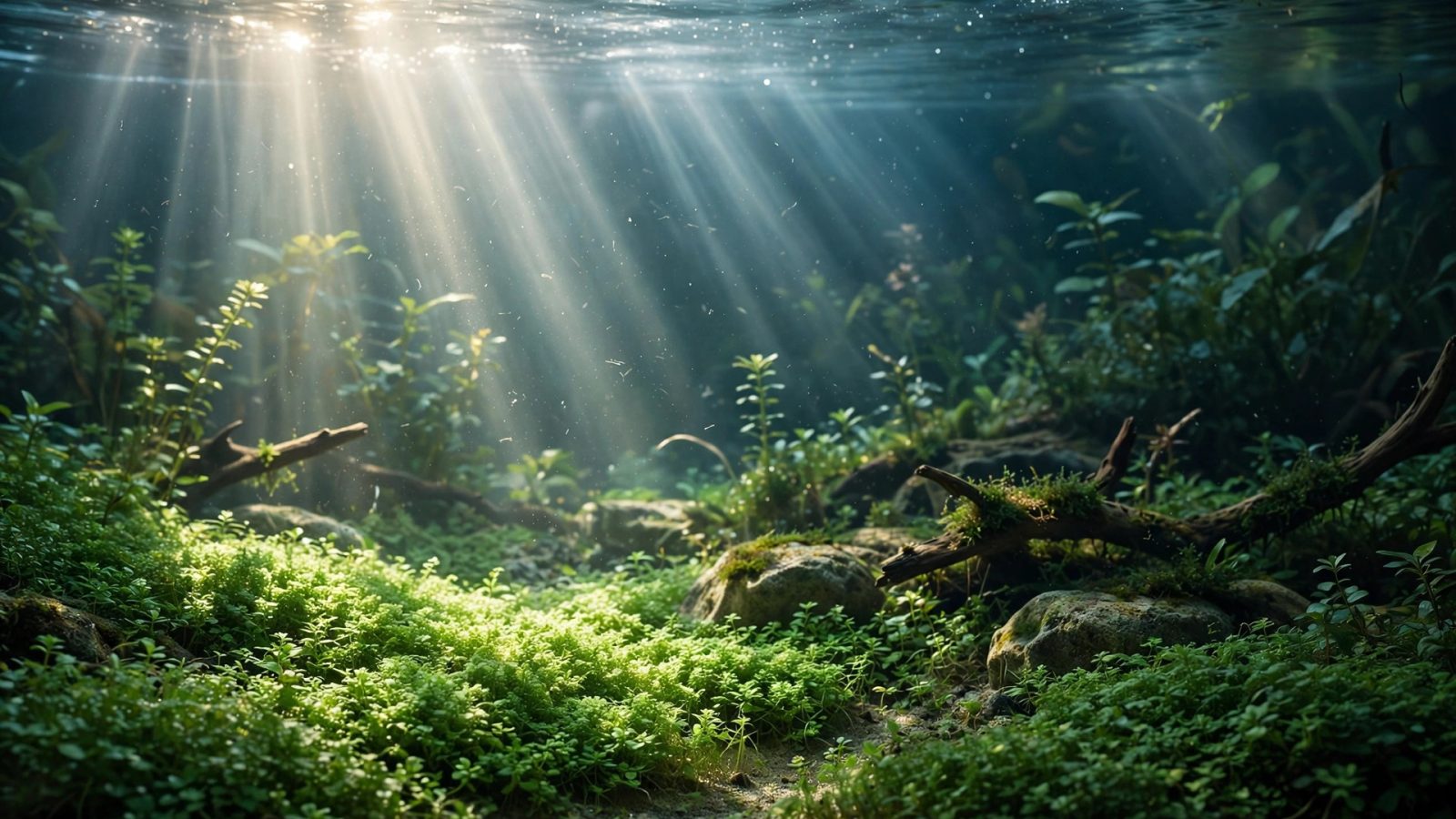
“How much light do my aquarium plants need?” is the foundational question of the planted tank hobby — and the most common source of confusion, because the answer depends on your plants, your CO2, and what “a lot of light” actually means in measurable terms. This guide gives you concrete numbers: PAR ranges for low, medium, and high light plants, how photoperiod factors in, and how to assess your current setup without expensive meters.
PAR: The Number That Matters
Forget watts and lumens. PAR (Photosynthetically Active Radiation) measures the photons plants can actually use for photosynthesis, in micromoles per square meter per second (μmol/m²/s). It’s the standard unit across the hobby, and every lighting decision traces back to it.
The accepted PAR bands at substrate level:
- Low light: 15–30 PAR. Stock LED hoods, basic clip-ons. Anubias, java fern, mosses, crypts, and most floating plants thrive here. This is the low-tech zone — minimal algae risk, minimal maintenance.
- Medium light: 30–60 PAR. Dedicated planted-tank LEDs at moderate settings. Most stem plants, swords, and red plants with CO2 support grow well. The versatile middle ground — the majority of successful planted tanks live here.
- High light: 60+ PAR. Premium fixtures near full power, usually hung close to the water. Demanding carpets (HC Cuba, dwarf baby tears), intense red stems, and fast Dutch-style growth. Requires CO2 injection and disciplined fertilizing — high light without CO2 is an algae guarantee.
These are substrate-level numbers. Light intensity falls with distance, so a fixture producing 100 PAR at 12 inches might deliver 45 PAR at an 18-inch substrate — always evaluate at your tank’s actual depth.
Photoperiod: The Other Half of the Equation
Total light energy is intensity × duration. A medium light run 10 hours delivers more energy than a strong light run 6 hours. The standard photoperiod for planted tanks is 6–8 hours daily:
- 6 hours: new tanks, algae battles, or low-tech setups. The safe starting point.
- 7–8 hours: established tanks with balanced CO2 and ferts. The long-term sweet spot.
- 10+ hours: rarely beneficial — plants saturate, and the extra hours mostly feed algae.
Consistency matters more than duration. Plants adapt their photosynthetic machinery to a rhythm; erratic timing stresses them. Put the light on an outlet timer and never think about it again. Our light schedule guide covers timing strategy including the siesta debate.
Light Needs by Plant Category
Epiphytes and mosses (low light)
Anubias, java fern, bucephalandra, and mosses evolved in shaded streams. 15–25 PAR grows them perfectly; more light mainly grows algae on their slow-growing leaves. Our Java fern guide details one classic example. If these plants are your focus, you barely need to think about lighting — any daylight-spectrum LED works.
Rosettes and swords (low to medium)
Amazon swords, crypts, and vallisneria want 25–45 PAR. They’ll survive lower but grow fuller and faster with moderate light. Root feeders — pair with root tabs rather than more light.
Stem plants (medium to high)
Rotala, ludwigia, hygrophila, and bacopa span the range: 30 PAR keeps them alive, 50+ with CO2 makes them bushy and colorful. Leggy, upward-stretched stems with wide gaps between leaf nodes (large internodes) are the classic too-little-light signal.
Carpeting plants (medium to high)
Dwarf hairgrass carpets at 35–50 PAR with CO2; Monte Carlo similar. HC Cuba (dwarf baby tears) wants 60+ and is the poster child for high-light, high-CO2 demands. Without enough light, carpets grow upward instead of spreading — the opposite of what you want.
Red plants (medium-high to high)
Red pigmentation is a sunscreen response — plants produce anthocyanins under intense light. Most reds need 50+ PAR plus CO2 to color up; under low light they revert to green. Light is necessary but not sufficient: iron and nitrate limitation also play roles.
How to Assess Your Current Light (No Meter Needed)
PAR meters cost $200+. Instead, read your plants:
- Too little light: stems stretch tall with sparse leaves, lower leaves drop, carpets grow vertically, new growth is pale and small. Plants “reach” for the surface.
- Just right: compact growth, tight internodes, rich green (or red) color, steady new leaves, minimal algae.
- Too much light: algae on leaves and glass within days of cleaning, plants pearl excessively then stall, leaf edges burn or go transparent. See our 7 signs of too much light for the full diagnostic.
Also check the manufacturer’s PAR chart for your fixture at your substrate depth — reputable brands publish these. No chart? Search hobbyist forums; someone has measured most popular fixtures.
The Light–CO2–Fertilizer Triangle
Light determines how fast the engine can run; CO2 and fertilizer determine whether it does without breaking down. The iron rule:
- Raise light → you must raise CO2 and ferts to match, or algae fills the gap.
- Low light → CO2 and fert demands stay modest; the system is forgiving.
- Never run high light without CO2. This single mistake causes more algae disasters than everything else combined.
When in doubt, start with less light than you think you need. You can always increase intensity once the tank is stable — but recovering from an algae bloom costs weeks. Our lighting roundup helps you pick a dimmable fixture so “less” is always an option.
Quick Reference: Matching Light to Goals
- “I want easy and low-maintenance”: 15–30 PAR, 6–7 hour photoperiod, no CO2 needed. Hardy plants only.
- “I want a lush aquascape with some reds”: 40–60 PAR, 8 hours, CO2 injected, complete fertilizer. The classic high-tech-lite setup.
- “I want a competition-grade carpet”: 60–80+ PAR, 8 hours, pressurized CO2 at 30 ppm, rich aquasoil, weekly trimming. Maximum input, maximum result.
Start where your current setup is, adjust one variable at a time, and let the plants tell you what’s working. Light is the most powerful lever in the hobby — and the most forgiving when you respect its limits.
Understanding DLI: The Complete Light Picture
PAR measures intensity at an instant; DLI (Daily Light Integral) measures total light energy delivered over the full photoperiod — intensity × duration, expressed in moles of photons per square meter per day. Two tanks can have identical PAR but very different DLI if their photoperiods differ.
Rough DLI targets for planted tanks:
- Low-tech: 5–10 mol/m²/day (e.g., 25 PAR × 7 hours)
- Medium-tech: 10–20 mol/m²/day (e.g., 45 PAR × 8 hours)
- High-tech: 20–30+ mol/m²/day (e.g., 70 PAR × 8 hours)
DLI explains why a medium light run long can equal a strong light run short — and why cutting photoperiod is such an effective algae intervention. You don’t need to calculate DLI daily, but understanding it prevents the common error of treating intensity and duration as independent variables. They’re two dials controlling one quantity.
Phone Apps and Budget PAR Estimation
Professional PAR meters (Apogee) cost $200+. Alternatives:
- Lux meter apps: smartphones can approximate lux (not PAR). Rough conversion for white LEDs: divide lux by ~70–80 for approximate PAR. Inaccurate (±30%) but useful for comparing spots within your tank — finding dim corners and hotspots.
- Hobbyist PAR databases: forums and YouTube reviewers have measured most popular fixtures at standard depths. Search “[your light model] PAR test” before buying.
- The plant bioassay: honestly the most reliable — grow a fast stem plant (e.g., rotala) and observe internode length over 3 weeks. Tight nodes = enough light. It’s slow but free and measures what matters: plant response.
Plant-by-Plant Quick Reference
- Anubias / Java fern / Bucephalandra: 15–25 PAR. More grows algae on leaves, not faster plants.
- Crypts / Vallisneria: 20–40 PAR. Flexible; adapt to a wide range.
- Amazon swords: 30–50 PAR. Big plants want real light to fill out.
- Rotala / Ludwigia (green): 35–55 PAR for bushy growth; survives at 25.
- Red stems (Rotala H’ra, Ludwigia super red): 50–70+ PAR plus CO2 for color.
- Dwarf hairgrass: 40–60 PAR with CO2 for carpeting; survives lower as a clump.
- Monte Carlo: 40–60 PAR with CO2; the most forgiving carpet.
- HC Cuba: 60–80+ PAR with CO2. The high-light benchmark plant.
- Floating plants: they sit at the surface — whatever your light puts out is “high” for them. They often need shading, not more light.
Adjusting Light as Your Tank Evolves
Light needs change over a tank’s life. New tanks want less (immature biology); mature densely-planted tanks can handle more (plant mass consumes the energy). Seasonal room-light changes, plant mass doubling, and CO2 additions all shift the optimum. Reassess quarterly: if growth is compact and algae minimal, don’t touch anything. The best light level is the one you stop thinking about.
Light and Tank Depth: The Inverse Square Reality
Light intensity drops with the square of distance — double the depth, quarter the intensity. Practical implications:
- A fixture rated “high light” for a 12-inch-deep tank delivers medium light at 18 inches and low-medium at 24 inches.
- Tall tanks (24″+ deep) need disproportionately powerful fixtures. This is where budget lights fail — they can’t punch deep.
- Shallow tanks (12″ or less, like 20-longs) need less fixture than you’d think. A medium light on a shallow tank is effectively high light at the substrate.
- Raising the fixture 6 inches on a hanging kit cuts substrate PAR roughly 30–40% while improving spread — the standard trick for taming strong lights.
Substrate Color and Light Efficiency
Dark aquasoil absorbs light; light sand reflects it back up to lower leaves. The difference is modest but real — bright-sand tanks can run slightly lower fixture intensity for equivalent plant response, while dark-substrate aquascapes may need a touch more. It’s a fine-tuning variable, not a primary decision factor, but it explains why two identical fixtures perform slightly differently over different substrates.
When Plants Tell You to Change Light: A Decision Tree
- Leggy stems + dropping lower leaves → increase light (or check CO2 first — identical symptoms).
- Algae on leaves + slow growth → decrease light. The plants can’t use what you’re giving.
- Good growth but no red color → increase light with CO2 support. Light alone won’t do it.
- Carpet growing upward → usually too little light at substrate; sometimes too much (see diagnostics).
- Everything fine but slow → that’s low-tech working as designed. Don’t fix what isn’t broken.
Change one variable, wait three weeks, observe. The hobby rewards patience more than equipment.
Light Acclimation: Introducing New Plants
Plants grown emersed (in humid air at the nursery) or under different light must rebuild their photosynthetic machinery for your tank — a process taking 2–4 weeks. During acclimation:
- Run the lower end of the plant’s light range. New arrivals under blast light melt faster.
- Expect old leaves to decline — judge by new growth only. Fresh leaves adapted to your light look different (often smaller, thicker) than nursery leaves.
- Tissue-culture cups acclimate fastest (sterile, pest-free, already transitioning); potted emersed plants take longest.
- Don’t move struggling new plants around the tank “seeking better light” — every move resets acclimation. Plant once, wait a month.
The “One More Hour” Trap
The most common photoperiod error isn’t dramatic — it’s the slow creep from 8 to 9 to 10 hours because “plants seem fine.” They are, until algae’s slower colonization catches up weeks later. Photoperiod increases should be deliberate, single-hour steps with a month of observation — never casual. And the reverse is equally true: if 8 hours works, 8 hours is the answer. More light is not more love; it’s more energy the system must process. Respect the balance you’ve built.
Quick-Start Summary
If this guide was a lot, here’s the 60-second version: figure out your plants’ PAR band from the reference above, check (or estimate) your fixture’s PAR at substrate depth, set a 6–8 hour photoperiod on a timer, and make sure CO2 and fertilizer match your light level. Start dim, observe for a month, adjust once. Light is the most powerful lever in the hobby — and the most forgiving when you change it gradually and let the plants tell you what’s working.
Master your tank’s light and you’ve mastered the hobby’s biggest variable. Everything else — CO2, fertilizer, plant choice — builds on the foundation of appropriate, consistent illumination. Get the photons right, and the rest follows.