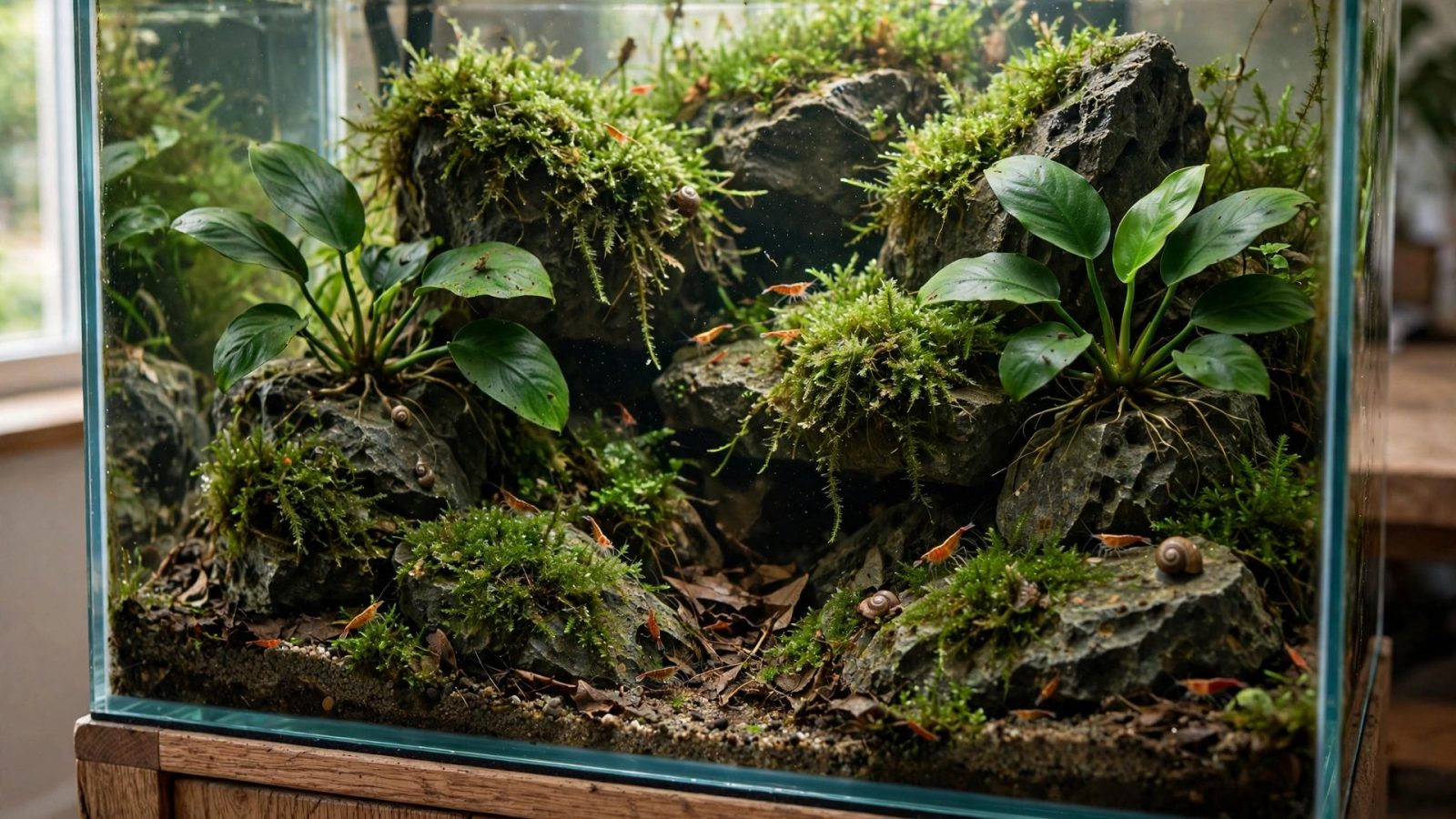
Yes — you can grow a lush, thriving planted aquarium without injecting CO2. Thousands of hobbyists run beautiful “low-tech” tanks that never see a CO2 cylinder, and many of the most forgiving aquarium plants actually prefer these simpler setups. A low-tech tank simply means one without pressurized CO2 injection: you rely on the CO2 already dissolved in your water from fish respiration, surface gas exchange, and natural decomposition. No regulators, no diffusers, no refill schedules — just plants, water, light, and fish working together.
The trade-off is speed, not success. Without injected CO2, plants photosynthesize more slowly, so growth is measured in weeks and months rather than days. Stems that would race to the surface in a high-tech tank stay shorter and bushier here, and leaves may grow a little smaller. But the flip side is real: less trimming, fewer algae battles, lower equipment costs, and a tank that practically takes care of itself once it finds its balance. If you set up the foundation correctly — the right plants, modest lighting, and steady nutrition — a no-CO2 tank can look every bit as green and alive as a high-tech one.
Low-Tech vs High-Tech: What Changes Without CO2
The single biggest difference is growth speed. In a high-tech tank with injected CO2, intense light, and heavy fertilization, plants can double their size in a week or two and demand trimming every seven days. In a low-tech tank, that same plant might take a month to put on meaningful growth. Expect roughly one-quarter to one-third of high-tech growth rates — and plan your aquascape accordingly, because that foreground won’t fill in by next weekend.
Plant selection matters more, too. CO2-hungry species like baby tears (Hemianthus callitrichoides) or red stem plants that need intense light and carbon to stay colorful will usually wither without injection. The good news is that a huge roster of hardy, attractive species evolved for exactly these conditions — they’re often the same plants recommended for beginners. Stick with them and you’ll skip most of the frustration that drives new hobbyists away from planted tanks.
Finally, your lighting has a ceiling. In high-tech setups, more light plus more CO2 plus more fertilizer equals more growth. Without CO2, cranking up the light does not speed growth — it just feeds algae. Low-tech lighting is deliberately modest: enough for plants to photosynthesize comfortably, not so much that algae outcompetes them for the available nutrients.
Step 1: Choose the Right Plants
Success without CO2 starts at the plant shop. These species are proven performers in low-tech tanks, forgiving of beginner mistakes and perfectly happy with ambient CO2 levels:
- Anubias — near-indestructible rhizome plant; tie or glue it to wood and rock rather than burying the rhizome. Watch for yellow anubias leaves, which usually point to a nutrient gap.
- Java fern — another rhizome plant that thrives in low light and anchors beautifully to driftwood; see our full Java fern care guide for details.
- Cryptocoryne (crypts) — slow-growing rosette plants with rich colors; expect a “crypt melt” after planting, then strong regrowth.
- Vallisneria — a fast runner that creates lush background curtains and spreads readily even in basic setups.
- Java moss — hardy moss that attaches to any surface and gives shrimp and fry perfect cover.
- Anacharis (Egeria densa) — a classic beginner stem plant that grows quickly, absorbs excess nutrients, and helps outcompete algae.
- Bucephalandra — small, slow-growing rhizome plants with stunning leaf colors; perfect for nano tanks and rockscapes.
- Other mosses — Christmas moss, peacock moss, and flame moss all do well without CO2 and add texture to hardscape.
- Water wisteria (Hygrophila difformis) — a fast, undemanding stem plant that adapts its leaf shape to submerged growth.
- Amazon sword (Echinodorus) — a big, bold centerpiece plant that is a heavy root feeder; pair it with root tabs and it will thrive without CO2.
When in doubt, browse lists of low-light aquarium plants for beginners — low-light and no-CO2 requirements go hand in hand.
Step 2: Get the Lighting Right
Lighting is the gas pedal of your tank, and without CO2 you want to drive at a sensible speed. Aim for low to medium light: a basic full-spectrum LED rated for planted tanks, running 6–8 hours per day. Put it on a timer so the photoperiod is consistent — plants adapt to routine, and algae loves irregularity.
Resist the urge to “fix” slow growth by adding more light. In a low-tech tank, light beyond what plants can use (because CO2 is the limiting factor) is simply an open invitation to algae. If algae appears, the first dial to turn down is almost always light intensity or duration — try six hours for a couple of weeks and watch the difference. Start low, and only increase slowly if plants show they need it. If your LED has a dimmer, that is even better than cutting hours — lower intensity over the same 6–8 hours gives plants a long, gentle photosynthetic window without the midday spike that algae exploits.
Step 3: Substrate and Root Feeding
You have two solid paths here. The first is inert substrate — plain gravel or sand — paired with root tabs (fertilizer capsules pushed into the substrate near heavy root feeders). This is cheap, simple, and works beautifully for rhizome plants like anubias and Java fern, which feed from the water column anyway.
The second path is an active aquasoil, which comes pre-loaded with nutrients and a lower pH that many plants love. Aquasoil gives you a head start but costs more and needs replacing after a year or two as its nutrients deplete. Either way, remember the split: root feeders like Amazon swords, crypts, and Vallisneria want nutrition at their roots (tabs or soil), while rhizome plants, mosses, and floating plants draw theirs from the water itself.
Step 4: Liquid Fertilizer (Low and Steady)
Without CO2, your plants still need the full menu of nutrients — nitrogen, potassium, iron, trace minerals — just in smaller doses. An all-in-one liquid fertilizer is the simplest answer: one pump or capful, dosed after your weekly water change, done.
Dose lean and watch. Because low-tech plants grow slowly, they consume nutrients slowly, and excess fertilizer that sits unused is algae food. Many successful low-tech keepers dose a fraction of the bottle’s recommendation — the high-tech “Estimative Index” method, stripped down to a fraction of its strength, is essentially the same idea: give the plants everything they need in small, steady amounts rather than feast-or-famine spikes. Pale new growth or yellowing older leaves are your signals to nudge the dose up, not a reason to double it overnight.
Step 5: Stocking, Water Changes and Balance
Your fish are part of the fertilizer system. Fish waste breaks down into nitrates that plants absorb as food, which is one reason planted tanks and fish make such a good pair. Stock lightly at first — a handful of small community fish — so the young plants aren’t overwhelmed by waste before they’ve rooted in. Add more fish gradually as the plant mass grows and the tank matures.
Change 20–30% of the water weekly. Regular water changes reset dissolved organics and algae-promoting waste that accumulates between changes, and they replenish minerals plants use up. In a low-tech tank, consistency matters more than any additive: the same day, the same amount, week after week. That rhythm is what a balanced low-tech tank runs on.
Algae Control in Low-Tech Tanks
Algae control in low-tech tanks comes down to one principle: never give algae light or nutrients the plants can’t use. Keep the photoperiod short, dose fertilizer lean, don’t overfeed your fish, and address new algae early — a small patch scrubbed today saves a tank-wide battle next month.
A cleanup crew makes an excellent backup force:
- Amano shrimp — relentless algae grazers that polish leaves and hardscape without harming plants.
- Nerite snails — unmatched glass and hardscape cleaners; their eggs won’t hatch in freshwater, so no population explosion.
- Otocinclus catfish — tiny, peaceful shoalers that specialize in soft algae on plant leaves.
Adding floating plants for betta tanks (or any tank, really) is another smart move: floaters grow fast with unlimited access to atmospheric CO2, shading the tank below and starving algae of excess light.
Frequently Asked Questions
Do I need liquid carbon instead?
Liquid carbon products (glutaraldehyde-based) are marketed as a CO2 substitute, but they are not the same thing and they are not necessary. They can help marginally with some algae and may benefit a few plants, but they won’t replicate injected CO2, and in sensitive tanks they can melt certain plants like Vallisneria and mosses. A well-balanced low-tech tank does fine without them.
Which carpeting plant works without CO2?
Most traditional carpeting plants struggle without CO2, but dwarf sagittaria (Sagittaria subulata) and Marsilea hirsuta are the reliable exceptions. Both spread by runners in low-tech conditions — slowly, but steadily. Plant densely from the start to shorten the wait, and keep lighting consistent over the foreground.
How fast will plants actually grow without CO2?
Expect roughly one-quarter to one-third of high-tech growth rates. A stem plant that doubles weekly with CO2 might add noticeable growth every three to four weeks in low-tech. Rhizome plants like anubias put out a new leaf every few weeks rather than weekly. Patience is part of the method.
Can I keep red aquarium plants without CO2?
Most red plants need high light and injected CO2 to stay red — without them, they typically revert to green or grow poorly. A few exceptions like red tiger lotus and some Cryptocoryne varieties hold color in low-tech tanks, so choose those if you want red tones.
How long does a low-tech tank take to establish?
A low-tech tank usually takes two to three months to fully settle in, since slow plant growth means slow biological balance. Don’t panic at a little algae in weeks two to six — it’s normal as the tank finds equilibrium. Keep up water changes and short photoperiods, and it typically resolves as the plants gain mass.
Do I still need to fertilize if I have lots of fish?
Fish waste covers nitrogen and some minerals, but it’s an incomplete diet — it lacks potassium, iron, and trace elements in the ratios plants need. Even heavily stocked low-tech tanks benefit from a lean dose of all-in-one liquid fertilizer; think of fish waste as the base and the fertilizer as the multivitamin.
Low-tech planted tanks reward patience more than spending. Pick hardy plants, keep the light modest and consistent, feed roots and leaves lightly, and let the system find its rhythm. Within a few months you’ll have a green, balanced aquarium that grows on its own schedule — no CO2 cylinder required. And once you’ve tasted that effortless green, you may never feel the pull of a high-tech setup again.