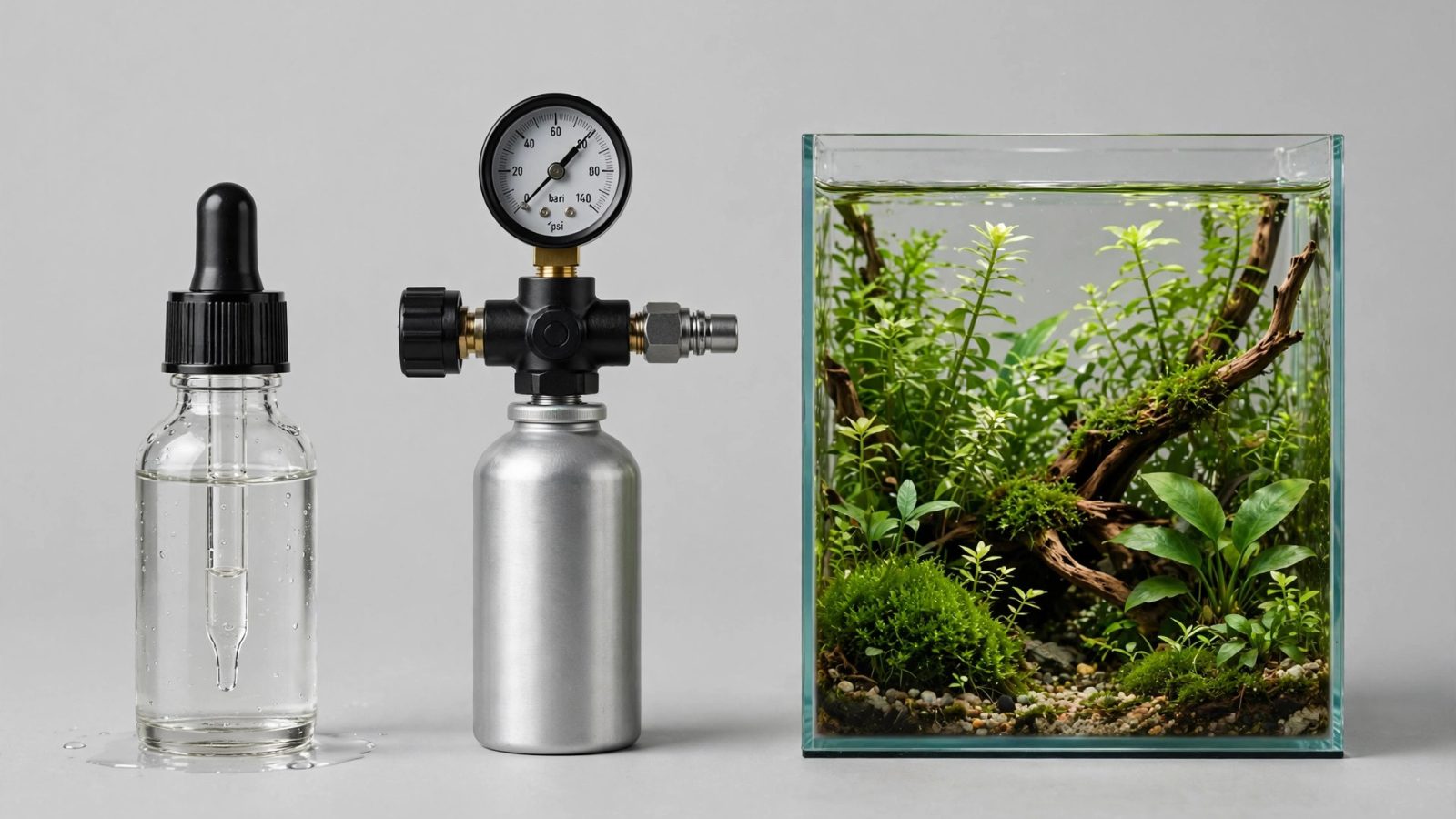
Walk into any fish store and you’ll find bottles labeled “liquid CO2” promising planted-tank results without cylinders or regulators. Meanwhile, CO2 veterans insist nothing replaces pressurized gas. Both sides are partly right — and the marketing is doing heavy lifting. This is the honest comparison: what liquid carbon actually is, what it can and can’t do, how costs compare, and which one belongs on your tank.
What “Liquid CO2” Actually Is
Let’s be blunt: there is no liquid CO2 in those bottles. The active ingredient is glutaraldehyde (or a related compound), a disinfectant that happens to break down into carbon compounds some plants can metabolize as an alternative carbon source. It’s not dissolved CO2 gas, and calling it “liquid CO2” is marketing, not chemistry.
This matters because the mechanism is entirely different. Injected CO2 raises dissolved CO2 to 30 ppm, directly feeding photosynthesis. Glutaraldehyde provides a trickle of usable carbon through a metabolic side door — helpful, but not equivalent. Expecting Excel to replace a cylinder is like expecting a vitamin to replace a meal.
What Liquid Carbon Actually Does Well
Credit where due — liquid carbon has genuine uses:
- Algae treatment: glutaraldehyde is an effective algaecide. Spot-dosing black beard algae or staghorn with a syringe kills it directly. This is liquid carbon’s killer app, and many hobbyists keep a bottle purely for this.
- Mild growth boost: in low-tech tanks, daily dosing produces visibly better growth than nothing — maybe 20–30% improvement. Undemanding plants respond best.
- No equipment: a bottle and a cap. Nothing to install, refill, or maintain. For a 5-gallon desk tank, the simplicity argument is strong.
- Transition aid: useful when setting up a new tank before the CO2 system arrives, or as a supplement in tanks where injection is impractical.
The Downsides Nobody Puts on the Label
- Toxicity to certain plants: vallisneria, some mosses, and delicate crypts can melt with regular dosing. If your vallisneria is struggling, the “CO2” bottle is the prime suspect.
- Invertebrate sensitivity: shrimp and snails tolerate normal doses, but overdoses — easy with the “just a squirt” method — stress or kill them. Dosing precision matters.
- It’s a daily chore, forever: miss days and the benefit evaporates. A cylinder runs itself for months; a bottle demands you every morning.
- Marginal on demanding plants: carpets, red stems, and other CO2-hungry species barely respond. It won’t grow HC Cuba — nothing but gas will.
- Ongoing cost: ~$15 per 500ml bottle, roughly one bottle every 6–8 weeks on a 40-gallon tank. That’s ~$90–120/year, forever, for partial results.
Head-to-Head: The Real Comparison
- Growth results: pressurized CO2 delivers dramatically better growth — faster, denser, better color. Liquid carbon gives a modest boost. Not close.
- Algae control: liquid carbon wins as a direct treatment (spot-dosing kills algae on contact). Pressurized wins as prevention (healthy fast-growing plants outcompete algae systemically).
- Year-one cost (40 gal): liquid ~$100; budget pressurized ~$230. Pressurized costs more.
- Year-three total cost: liquid ~$300; pressurized ~$330. Nearly even — and pressurized delivered 3 years of superior growth.
- Convenience: pressurized wins after setup (months of automation vs daily dosing).
- Safety margin: liquid wins — you can’t gas fish with Excel (though you can poison shrimp by overdosing). Pressurized demands the drop checker discipline.
- Plant compatibility: pressurized suits everything; liquid harms vallisneria and some mosses.
Can You Use Both?
Yes — and many experienced hobbyists do. Pressurized CO2 as the foundation, liquid carbon as the algae spot-treatment weapon. The combination covers both systemic growth and tactical algae warfare. What you shouldn’t do is double-dose carbon expecting additive growth — once CO2 is at 30 ppm, extra glutaraldehyde adds toxicity risk without meaningful benefit. Use each for what it’s good at.
Who Should Choose Which
Choose liquid carbon if: your tank is under 15 gallons, your plants are all undemanding species, you want algae spot-treatment capability, or you need something today with zero installation. It’s also the right call for shrimp-only tanks where CO2 sensitivity is a concern.
Choose pressurized CO2 if: you want carpets, red plants, or fast Dutch-style growth; your tank is 20+ gallons; or you’re tired of daily dosing. The budget CO2 roundup shows entry paths under $150.
Choose DIY CO2 if: you want real gas results on a small tank for minimal money and don’t mind the maintenance rhythm. Our DIY guide covers both methods.
The Bottom Line
“Liquid CO2” is a useful product with a dishonest name. Buy it for what it is — a convenient mild growth aid and an excellent algae spot-treatment — not for what the label implies. If your goal is the lush, fast-growing planted tank in your head, budget for real CO2 injection; the complete CO2 guide shows you how. The bottle is a supplement, not a substitute.
Liquid Carbon Dosing Guide
If you use liquid carbon, dose it right:
- Standard dose: follow the bottle — typically 1 ml per 10 gallons daily, or 5 ml per 10 gallons after water changes (the “loading dose”). Don’t eyeball it; use the cap or a syringe.
- Dose in the morning before lights-on. Glutaraldehyde breaks down in light and with organic load — morning dosing maximizes active time during the photoperiod.
- Dose near filter outflow for distribution. Don’t squirt directly on plants or livestock.
- After water changes: the larger post-water-change dose replaces what was removed. Don’t stack it with the daily dose — it’s instead of, not in addition to.
- New tanks: start at half dose for the first two weeks. Young plants and immature biofilters are more sensitive.
Spot-dosing algae
Turn off filters for 15–20 minutes (keeps the chemical on target), then syringe-dose directly onto algae patches at 2–3x the standard concentration for that volume. BBA turns pink/red within 48 hours (it’s dying), then gray and disintegrates. Resume filtration after 20 minutes. Don’t spot-dose more than ~1/3 of the tank’s volume worth of chemical in one session — the total dose still counts toward livestock safety.
Safety Data: What the Label Doesn’t Emphasize
- Shrimp: neocaridina tolerate standard doses; caridina (crystal shrimp) are more sensitive. Never exceed the labeled dose in shrimp tanks, and skip the post-water-change loading dose.
- Snails: generally tolerant, but mystery snails show stress (retracted, inactive) at 2x+ doses.
- Scaleless fish: no specific contraindication at labeled doses, but they’re the canary — if anyone reacts, it’s them first.
- Plants to watch: vallisneria (melts), some mosses (browning), anacharis/elodea (sensitive), and newly planted tissue-culture cups (acclimating). If a plant declines after starting liquid carbon, the bottle is suspect #1.
- Human safety: glutaraldehyde is a sterilant — avoid skin contact with concentrate, don’t inhale the fumes, keep away from children and pets. It’s dilute in the bottle, but respect it.
The “Excel Method” for Algae: Full Protocol
The combined approach many hobbyists use for persistent BBA or staghorn:
- Manually remove as much algae as possible (trim, scrub, siphon).
- Fix the underlying cause — usually too much light or fluctuating CO2. See too-much-light signs.
- Spot-dose remaining patches daily for 7–10 days (filters off, 20 min).
- Maintain standard daily dosing throughout as a systemic suppressant.
- After 2 weeks, stop spot-dosing; continue daily dosing only if you want the growth supplement.
This treats the symptom aggressively while you fix the cause. Algae control without addressing the cause is mowing weeds — they’ll be back.
Cost Optimization
- Buy the largest bottle: per-ml cost drops 30–40% at 2L vs 500ml.
- Generic glutaraldehyde: some hobbyists buy metricide/activator-free glutaraldehyde (2.5%) and dilute — dramatically cheaper, but you’re handling concentrated sterilant. Only for the careful and experienced; the aquarium products’ premium is largely a safety/convenience markup.
- Don’t dose what you don’t need: if you bought it for algae and the algae’s gone, stop. Daily dosing “just because” on a healthy tank is money for minimal benefit.
Frequently Asked Questions
Is liquid CO2 safe for shrimp?
At labeled doses, neocaridina (cherry shrimp) tolerate it well. Caridina species (crystals, Taiwan bees) are more sensitive — use half dose or skip it. Never exceed the label in any shrimp tank; the safety margin is real but not generous.
Can liquid carbon replace CO2 in a high-tech tank?
No. If you’re running high light with demanding plants, liquid carbon is a supplement at best. The growth gap between 30 ppm gas and daily glutaraldehyde is enormous — they’re different leagues, not different brands.
Why did my vallisneria melt after dosing?
Vallisneria is famously sensitive to glutaraldehyde. Some vals adapt after initial melting (new leaves emerge tolerant), but many don’t. If you keep vals, skip liquid carbon entirely — it’s the most commonly reported plant casualty.
How long does a bottle last?
A 500ml bottle at standard daily dosing: ~3 months on a 20-gallon, ~6–8 weeks on a 40-gallon. The post-water-change loading doses consume extra. Buy the 2L bottle if you’re committed — the per-ml savings are substantial.
Can I overdose to kill algae faster?
Tempting and dangerous. 2–3x spot-dosing on algae patches (filters off, brief) is the accepted aggressive use. Whole-tank overdosing risks livestock and sensitive plants. The algae will die at sane doses with repetition — patience beats concentration.
Does liquid carbon expire?
Glutaraldehyde degrades slowly once opened — roughly 12–18 months of full potency. An old bottle that’s lost its slight chemical smell has lost its punch. Date your bottles when opening.
Making the Final Call
Reframe the question from “which is better” to “what’s my tank’s trajectory”:
- Staying low-tech forever: liquid carbon is a fine permanent supplement. Cheap, simple, effective enough for easy plants.
- Exploring CO2’s benefits: start with DIY to experience real gas cheaply, then decide.
- Committed to high-tech: pressurized from the start. Every month on liquid is a month of slower growth you’ll wish you’d spent on gas.
- Fighting algae right now: buy the bottle today for spot-treatment regardless of your long-term CO2 plans. It’s the best $15 in algae warfare.
The most common successful path: bottle for algae emergencies from day one, DIY or budget pressurized when you’re ready for real growth. They’re tools, not tribes — use each where it shines.
Environmental and Practical Notes
- Disposal: empty glutaraldehyde bottles go in regular trash (rinse first); don’t pour concentrate down drains in quantity. Tank water with dosed levels is harmless to plumbing and septic.
- Storage: cool, dark place. Heat accelerates degradation; a bottle stored above a warm aquarium hood loses potency faster.
- Travel: a small bottle is the perfect vacation backup — have your tank-sitter dose daily instead of managing CO2 equipment. Simpler instructions mean fewer disasters.
- Combining with water changes: dose after the water change, not before — you’ll just remove what you added. The post-change loading dose exists for exactly this reason.
Who Actually Needs This Comparison?
If you’re still deciding, you’re likely in one of three camps: the curious beginner (start with the bottle — it’s $15 and teaches you what carbon does), the committed aquascaper (skip the debate and buy pressurized — you already know), or the budget optimizer (DIY citric now, pressurized later — the hybrid path most forum veterans actually took). All three paths lead to good tanks. The only wrong choice is the one that doesn’t match your actual goals — so be honest about what you want, and spend accordingly.