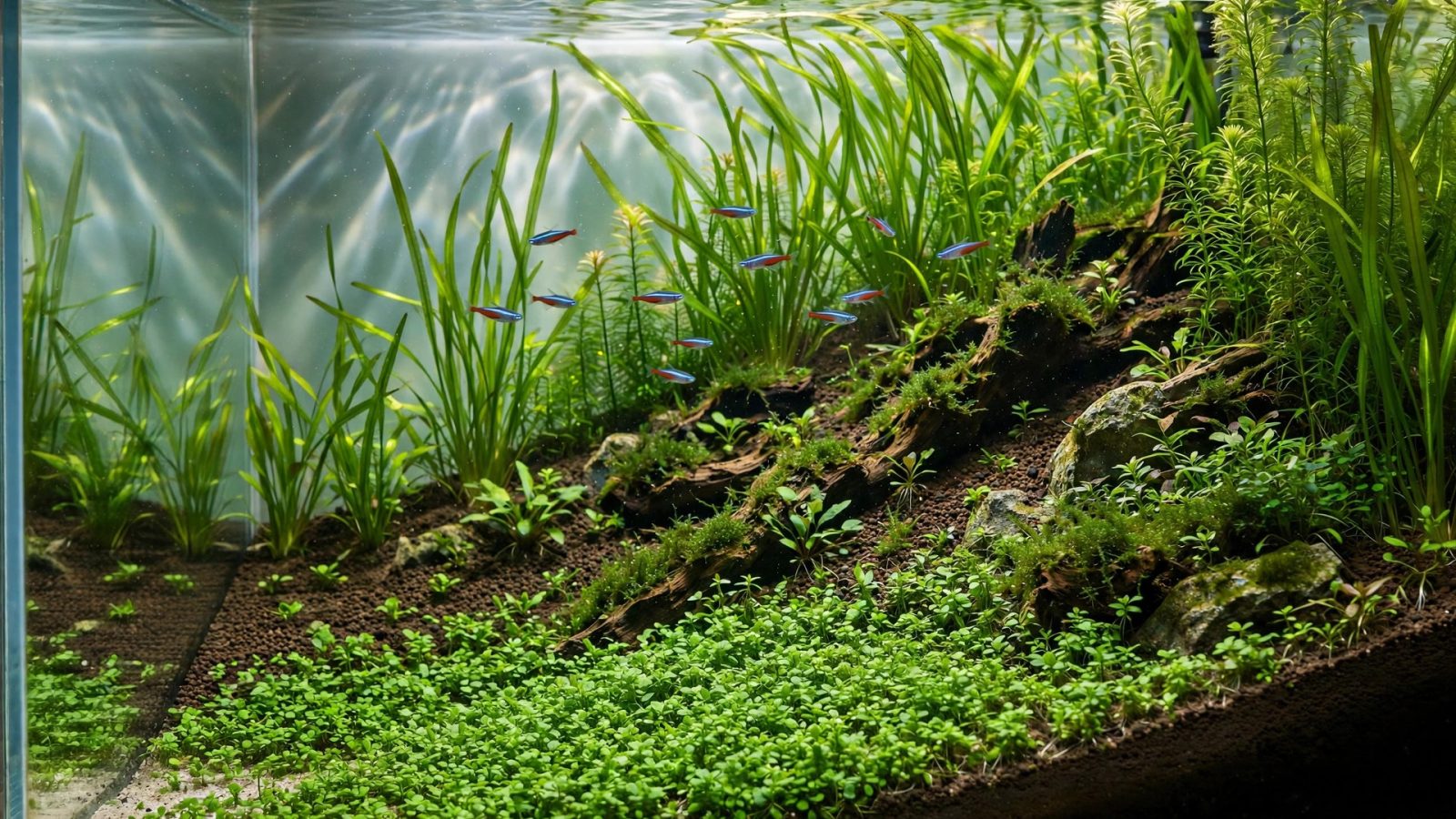
How deep should aquarium substrate be for plants? Too shallow and roots can’t anchor — stems float up, carpets never establish, and heavy root feeders starve. Too deep and you waste money, risk anaerobic dead zones, and make the tank harder to clean. The right depth depends on what you’re growing.
The quick answer: 5–7cm (2–3 inches) across most of the tank, sloping from 3cm in front to 8cm+ in back. But different plants want different depths, and the details matter. Here’s the complete guide.
Why Depth Matters for Plants
Substrate depth serves three functions: anchorage (holding plants upright against buoyancy and current), root volume (space for root systems to develop and forage), and nutrient reservoir (in rich substrates, more depth = more total nutrients; in inert substrates, more room for root tabs). Shallow beds fail on all three — there’s a reason the classic beginner mistake is a sad 2cm dusting of gravel with plants that won’t stay put.
Depth by Plant Type
Carpeting plants (dwarf hairgrass, Monte Carlo, HC Cuba): 3–4cm
Carpets have shallow, fine root systems and actually prefer shallower beds — deep substrate under a carpet just traps detritus where you can’t clean it. 3–4cm of fine-grained substrate (aquasoil powder type or 0.5–1mm sand) is ideal. Anything deeper is wasted under a carpet zone.
Stem plants (rotala, ludwigia, hygrophila): 5–6cm
Stems root at each buried node, so moderate depth gives them plenty of anchorage. 5–6cm holds even tall stems upright in moderate flow. In high-flow tanks, go 6–7cm in the stem zones.
Heavy root feeders (Amazon swords, cryptocorynes, vallisneria, lotus): 7–10cm
This is where depth really pays. A mature Amazon sword develops a root mass the size of a grapefruit — it needs room. Cryptocoryne colonies spread via underground runners that travel horizontally through the bed. Give these plants the deepest zones in your tank, typically the back corners. This is also where root tabs earn their keep — deep beds hold tabs securely away from the water column.
Epiphytes (Anubias, Java fern, bucephalandra): any depth
These attach to wood and rock, not substrate. Depth is irrelevant to them — though their rhizomes must never be buried regardless of bed depth.
The Slope Technique
Flat substrate looks flat. Professional aquascapes slope the bed: 2–3cm at the front glass rising to 8–10cm at the back. This does three things: creates forced perspective (the tank looks deeper than it is), gives back plants the depth they need while keeping the foreground cleanable, and provides visual drama.
Building a stable slope: use substrate supports — lava rock rubble, filter media bags filled with gravel, or commercial slope supports — under the back portion. Piled substrate alone slumps flat within months as you plant, replant, and siphon. The supports hold the contour permanently. Cap the supports with your visible substrate so the cross-section never shows.
Depth by Substrate Type
- Aquasoil: 5–8cm typical. Powder type can run shallower in front (3–4cm). Remember aquasoil compacts ~10–15% in the first months — build slightly proud.
- Sand: 4–6cm maximum in most zones. Sand’s density makes deep beds risky — beyond 7cm, anaerobic pockets become likely without diligent stirring and trumpet snails. See our sand guide for bed-health practices.
- Gravel: 5–7cm. Coarse gravel can go deeper safely (water circulates between large grains), but planting gets harder and detritus falls deep.
- Dirted (soil + cap): 2–3cm mineralized soil + 3–4cm cap. The soil layer must stay thin — thick dirt layers go anaerobic and release excess nutrients. Details in capping soil with sand.
How Much Substrate to Buy
Calculate: tank length (cm) × width (cm) × desired average depth (cm) ÷ 1000 = liters needed. A 60×30cm tank at 6cm average depth needs ~11 liters. Add 25–30% for slopes and mounding — so ~14 liters, i.e., two 9L bags of aquasoil or one generous bag of sand.
For aquasoil vs gravel cost planning, this math is essential — substrate is one area where running short mid-build forces ugly compromises.
Common Depth Mistakes
- The uniform 2cm layer: Looks tidy on day one; nothing stays planted by week two. Minimum 4cm anywhere you plant.
- Deep sand without maintenance: 8cm of fine sand + no snails + no stirring = hydrogen sulfide factory within a year.
- Slopes without support: That dramatic 12cm back mound becomes a 6cm gentle hill by month three.
- Burying hardscape bases too shallow: Rocks and wood need 3–4cm of substrate around their bases for stability — factor this into depth near hardscape.
- Ignoring the front glass: Substrate piled against the front glass looks messy and traps debris visibly. Keep the front 2–3cm and clean — the “clean front line” is a hallmark of professional scapes.
Nano Tank Adjustments
In tanks under 20 liters, scale everything down proportionally but not linearly — a 3cm bed in a nano is proportionally deeper than 6cm in a 200-liter tank. Aim for 3–5cm in nanos, with slopes up to 6–7cm in back. Hardscape proportion matters enormously at small scale; see hardscape for nano aquascapes.
FAQ
Can substrate be too deep?
Yes — beyond ~10cm in most substrates you get diminishing returns and real anaerobic risk, except in deliberately constructed deep beds with porous media (lava rock bases) and strong plant root oxygenation.
Should depth be uniform?
No — sloped is better in almost every case, for both aesthetics and plant needs.
Does deeper substrate mean I can skip fertilizer?
Only with nutrient-rich substrates (aquasoil, dirt), and only for a while. Depth extends the nutrient reserve; it doesn’t make it infinite. Inert substrates at any depth still need root tabs.
Substrate Depth and the Nitrogen Cycle
Depth interacts with filtration in ways beginners don’t expect. A deep, porous substrate bed is a massive biological filter — the surface area of 6cm of aquasoil or coarse gravel hosts a significant fraction of your tank’s beneficial bacteria. This is why deep-substrate tanks are remarkably stable once established: the bed itself buffers ammonia spikes.
But there’s a flip side. Deep beds accumulate organic waste (mulm) in their lower layers. In moderation, this is good — decomposing mulm releases nutrients that roots absorb, which is why old, “dirty” substrates often grow plants better than brand-new ones. Experienced aquarists call this a “mature substrate,” and it’s real. The problem is only excessive accumulation in compacted, oxygen-starved zones, where anaerobic decomposition produces hydrogen sulfide instead of plant food.
The practical balance: deep enough for roots and bacterial colonization (5–8cm), porous enough for water exchange (avoid ultra-fine materials in deep zones), and maintained with gentle surface cleaning that removes excess while leaving the established lower layers alone. When you clean substrate around plants, you’re managing this balance — not sterilizing the bed.
Terracing: Depth With Structure
For dramatic elevation changes — the mountain-valley aquascapes — simple slopes aren’t enough. Terracing uses retaining walls of stone or wood to hold distinct depth levels. Each terrace can have its ideal depth: a 10cm upper terrace for a sword cluster, a 3cm lower terrace for a carpet foreground.
Build terraces with aquascaping stone stacked dry (test stability before adding water), backfill behind each wall with substrate, and plant the retaining wall’s crevices with mosses or small epiphytes to naturalize the joints. The walls prevent the inevitable slumping that flattens unsupported mounds, and the distinct levels create striking visual architecture.
Adjusting Depth in an Established Tank
Need more depth but the tank is running? You have options short of a teardown:
- Adding substrate: Rinse new substrate, turn off filtration temporarily, and pour slowly over a plate onto target areas. Expect temporary cloudiness. Adding aquasoil to an established tank triggers a mild ammonia release — test daily for a week.
- Reducing depth: Siphon out excess during water changes over several weeks — gradual removal avoids disturbing the bacterial colonies and plant roots all at once.
- Reshaping: Use a substrate spatula or old credit card to push substrate into new contours during water changes when the water level is low. Plants tolerate gentle reshaping around their bases.
Depth for Breeding and Species Tanks
Not every tank is a plant showcase. For breeding tanks, shallow bare-bottom or 1–2cm sand is standard — easy egg visibility and cleaning trump plant needs. For biotope tanks replicating specific habitats, match the natural substrate depth: many stream biotopes have thin gravel over rock, while floodplain biotopes have deep silt. Research beats rules here.
For shrimp tanks, 3–4cm of buffering aquasoil is the standard — enough for parameter stability and biofilm grazing surface, shallow enough to spot shrimplets and avoid dead zones. Our aquasoil guide covers which soils buffer longest for shrimp.
Quick Reference Table
- Carpet foreground: 3–4cm, fine grain
- General planting: 5–7cm
- Heavy root feeders (back): 7–10cm
- Sand beds (max safe): 6cm
- Dirted soil layer: 2–3cm + 3–4cm cap
- Nano tanks: 3–5cm
- Front glass line: 2–3cm, kept clean
Get the depth right for your plants, slope it for aesthetics, support the slopes structurally, and your substrate becomes the invisible foundation that makes everything else easier.