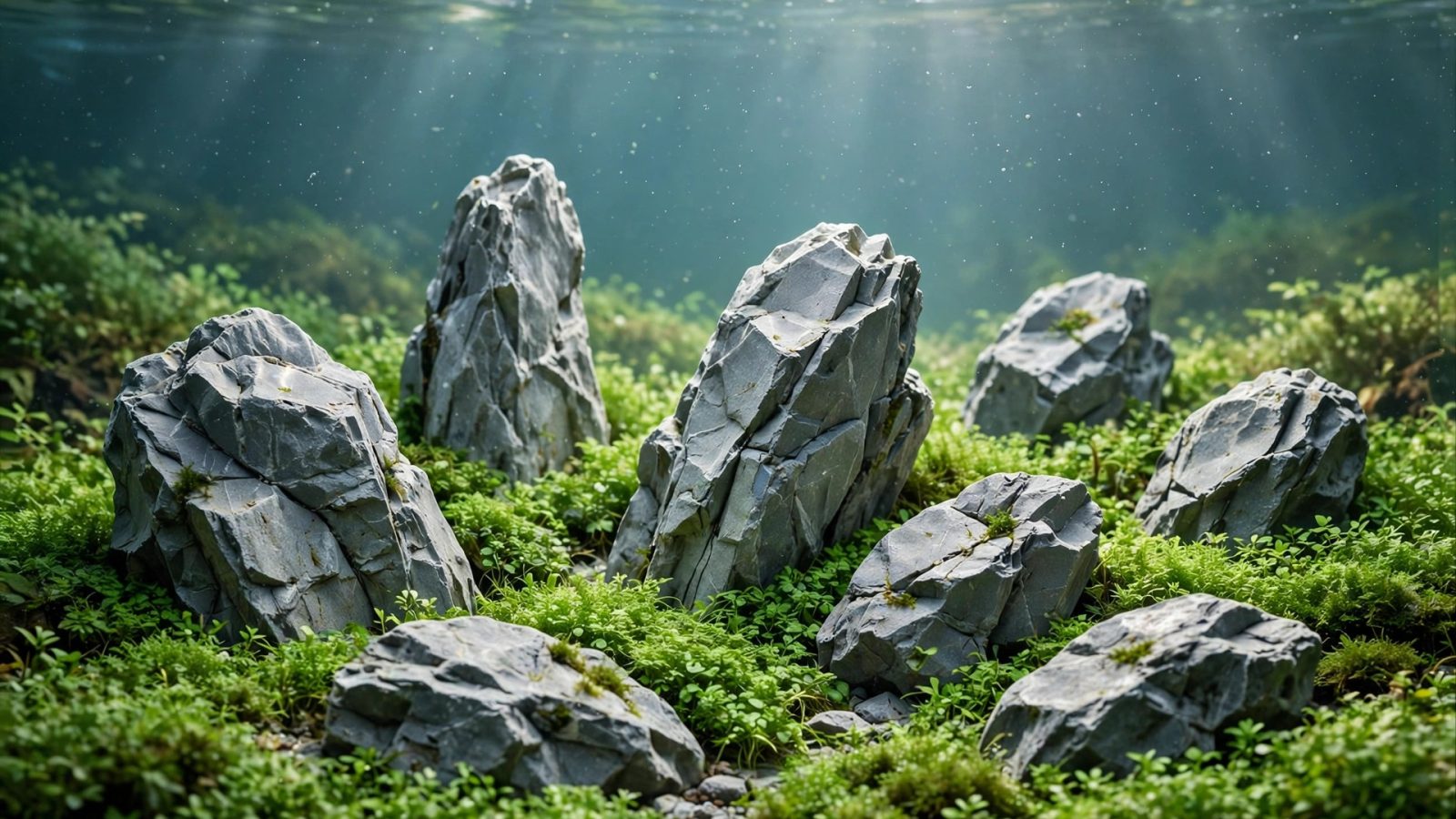
Stone is the permanent architecture of an aquascape — it doesn’t grow, shift, or decay, so every placement decision lasts. The best rocks for aquascaping combine striking appearance with aquarium safety: no harmful minerals, predictable effects on water chemistry, and shapes that compose well. But the most beautiful stone in the shop (Seiryu, we’re looking at you) also raises pH — a tradeoff you must understand before buying.
Here are the 9 best rocks for aquascaping planted tanks, with honest chemistry notes, styling guidance, and preparation.
What Makes a Rock Aquarium-Safe?
- No metal ores: Avoid rocks with metallic veins, rust staining, or suspicious glitter — copper, lead, and zinc are toxic to shrimp and fish.
- Known chemistry: Carbonate rocks (limestone, Seiryu, Texas holey rock) raise pH/KH/GH. Inert rocks (granite, basalt, lava) don’t. Neither is “bad” — but you must match the rock to your water goals.
- Hardness: The rock should be harder than your algae scraper and not crumble. Soft shales and sandstones disintegrate over time.
- Shape: Aquascaping favors stones with character — strata lines, texture, interesting silhouettes. Round river pebbles are safe but visually boring as focal stones.
When in doubt about any rock’s chemistry, the vinegar test takes 30 seconds and answers the carbonate question definitively.
1. Seiryu Stone — The Icon (With a Catch)
Look: Blue-grey with white calcite veining; sharp, mountainous character.
Chemistry: Raises pH/KH/GH — moderately to significantly depending on quantity.
Best for: Iwagumi layouts; the definitive Iwagumi stone.
Seiryu is the most famous aquascaping stone in the world — the jagged grey peaks of countless contest-winning Iwagumi scapes. The white veins and layered texture are unmatched. The catch: it’s a carbonate rock. A full Iwagumi of Seiryu in soft water will push pH toward 7.5–8.0 and add meaningful KH/GH. For hard-water-tolerant plants and livestock this is fine; for caridina shrimp or soft-water purists it’s disqualifying. Many aquarists accept the chemistry shift and choose plants/livestock accordingly — the stone is worth it to them. Know which camp you’re in before buying 20kg.
2. Dragon Stone (Ohko) — The Versatile Favorite
Look: Brownish-red with dramatic holes, crevices, and clay pockets.
Chemistry: Inert — no pH effect.
Best for: Nature-style scapes; the most forgiving stone for beginners.
Dragon stone’s honeycomb texture looks like miniature canyonland, and being chemically inert, it suits any water parameters — soft-water shrimp tanks included. The crevices are natural planting pockets for mosses, Anubias petite, and bucephalandra. Preparation note: the clay-filled holes need thorough cleaning — blast with a hose or pressure washer, dig out loose clay with a screwdriver, or it’ll cloud your tank for weeks. Some pieces are fragile; test-stack dry before committing.
3. Lava Rock — The Cheap Workhorse
Look: Black or red-brown, highly porous, rough texture.
Chemistry: Inert.
Best for: Backgrounds, terraces, moss walls, budget builds.
Lava rock is absurdly cheap (landscaping suppliers sell it by the huge bag), lightweight for its size (easy to stack high), and its porosity is a biological filter bonus — bacteria colonize the vast internal surface. The rough texture grips moss effortlessly; a lava-rock moss wall is a classic technique. Aesthetically it’s less refined than Seiryu or dragon stone — best used as structural/background rock with prettier stones in front, or in jungle/wild-style scapes where ruggedness suits. Red lava rock’s color can look unnatural to some eyes; black is the safer choice.
4. Granite — The Forever Stone
Look: Speckled grey/pink/black; smooth to rough depending on source.
Chemistry: Inert.
Best for: Permanent scapes, large tanks, cold-water setups.
Granite is nearly indestructible, completely inert, and widely available (landscape suppliers, sometimes free as fieldstone). It lacks the drama of Seiryu or dragon stone — granite compositions rely on arrangement skill rather than stone character. For a tank you want to run unchanged for a decade, granite’s permanence is genuinely valuable. Choose pieces with interesting shapes; avoid the bowling-ball rounds.
5. Basalt — The Dark Minimalist
Look: Dark grey to black, often columnar or angular.
Chemistry: Inert.
Best for: Modern/minimalist scapes, dark-substrate compositions.
Basalt’s near-black tone creates striking contrast with green plants — the “black stone, green plant” aesthetic that photographs beautifully. Columnar basalt pieces (natural hexagonal columns) are showstoppers when available. Like granite, it’s permanent and inert. Dark stones show dust and diatoms more visibly in the early months; this passes as the tank matures.
6. River Rock / Cobble — The Natural
Look: Smooth, rounded, varied colors.
Chemistry: Usually inert (test — some river rock is limestone).
Best for: Biotopes, natural riverbed recreations, foreground detail.
Smooth river stones are the honest, humble option — perfect for biotope tanks replicating actual streams, and excellent as supporting stones around a dramatic focal piece. They’re rarely the star, but every great scape needs supporting actors. Collect your own from clean waterways (check local regulations) or buy from landscape suppliers for pennies.
7. Texas Holey Rock — The Statement
Look: Pale limestone riddled with holes and tunnels.
Chemistry: Strongly raises pH/KH/GH.
Best for: African cichlid tanks, hard-water setups.
Holey rock is spectacular — but it’s limestone, and it will push your water hard and alkaline. This is perfect for Lake Tanganyika/Malawi cichlid tanks (where the chemistry is the point) and wrong for soft-water planted tanks. The holes make superb fish hides and the light color contrasts beautifully with dark fish. Just never pair it with soft-water plants or caridina shrimp.
8. Petrified Wood — The Conversation Piece
Look: Wood grain preserved in stone; browns, reds, greys.
Chemistry: Inert (it’s quartz/chalcedony).
Best for: Unique focal points, collectors.
Actual fossilized wood — millions of years old, now stone. Each piece is unique, the wood-grain patterns are mesmerizing, and it’s completely inert. Expensive and heavy, but a single piece can define an entire aquascape. A genuine conversation starter.
9. Slate — The Functional Flat
Look: Flat grey sheets/layers.
Chemistry: Inert.
Best for: Terracing, caves, mounting wood, spawning sites.
Slate isn’t beautiful, but it’s the most useful rock: stack it for terraces, lean pieces into caves for shy fish, screw driftwood to it as an anchor, lay it as a spawning surface for plecos. Every aquarist should keep slate on hand. Break it (score and snap) rather than sawing — natural fractured edges look better.
Arranging Stone: Iwagumi Principles
The Japanese Iwagumi style formalized rock arrangement, and its principles improve any stone scape:
- Odd numbers: 3, 5, or 7 stones. The main stone (Oyaishi) dominates; supporting stones (Fukuishi, Soeishi, Suteishi) complement.
- One stone type: Mixing Seiryu with dragon stone with lava rock looks like a rock collection, not a scape. Unity of material is the professional hallmark.
- Bury one-third: Stones should emerge from the substrate — bury the bottom third so they look naturally embedded, not placed on top.
- Flow and direction: Angle stones consistently; strata lines should align as if from the same geological formation.
- Golden ratio: Main stone at the 1/3 or 2/3 mark, not center.
Preparation: Cleaning Rock
Scrub with a stiff brush and hot water — no soap. Pressure-wash textured stones (dragon stone especially) to clear clay from crevices. Never boil rocks — trapped water can expand explosively. A hydrogen peroxide soak (then thorough rinse) sanitizes wild-collected stone. Test unknown rocks with vinegar (fizz = carbonate = pH-raising) per our vinegar test guide.
Rock and Plant Pairings
- Seiryu + HC Cuba carpet + stem background: The classic Iwagumi formula.
- Dragon stone + mosses + Anubias petite in crevices: Nature-style canyon.
- Lava rock + mosses + ferns: Jungle/wild scape, budget-friendly.
- Dark basalt + red plants: Maximum color contrast.
Stone choice shapes water chemistry, which shapes plant and livestock options — decide the stone early, then build the ecosystem around what it does to your water.
Buying Rock: Weight, Cost, and Practical Math
Rock is heavy and heavy is expensive to ship — a 20kg box of Seiryu can cost more in freight than the stone itself. Strategies:
- Buy local: Aquascaping shops let you hand-pick pieces. Stone character varies enormously; choosing in person is worth a drive.
- Landscaping suppliers: Granite, basalt, river rock, and lava rock at landscape yards cost a fraction of aquarium-branded stone — often the identical material.
- Buy more than you need: You’ll use 30–50% more stone than expected (buried portions, test arrangements, the piece that looked right in the shop but wrong in the tank). Leftover stone builds the next scape.
- Weight limits: A large aquascape’s stone can exceed 30kg. Ensure your stand and floor handle it — water is 1kg/liter, and people forget to add rock weight to their calculations. Distribute weight with egg crate (light diffuser panel) under the substrate to protect the glass.
Stone Safety: The Details That Matter
- Stability: Stack dry and stress-test — push each stone firmly. Submerged stone + burrowing fish + time = shifting. A toppling 3kg Seiryu can crack glass. When in doubt, silicone stones together (aquarium-safe silicone, cured fully) or bury deeper.
- Sharp edges: File or chisel dangerously sharp points, especially in tanks with large active fish. What looks dramatic can injure a startled fish.
- Egg crate foundation: A sheet of plastic light-diffuser (“egg crate”) under the substrate distributes stone weight and prevents point-loading on the glass. Cheap insurance for any serious stone scape.
- Copper and metals: Beyond the carbonate question, inspect for metallic veins or ore-like inclusions. When uncertain about a wild-collected piece, a prolonged bucket soak with copper test-kit monitoring is the thorough approach — or just don’t use it.
Stone in Different Tank Types
Nano tanks
Scale is everything — a “small” Seiryu that’s perfect in a 60cm tank overwhelms a 30cm cube. Choose stones 1/4 to 1/3 of tank height maximum, and remember that nano stonework shows every flaw. Our nano hardscape guide covers proportion rules.
Shrimp tanks
Inert stones only (dragon stone, lava, granite) — caridina shrimp need the low, stable pH that carbonate rocks destroy. Texture matters more than drama: shrimp graze biofilm, and porous stones (lava, dragon) are buffets.
Goldfish and cichlid tanks
Big fish need big, stable stone — nothing toppleable. Texas holey rock’s chemistry suits rift-lake cichlids perfectly. Round smooth stones suit goldfish (no sharp edges on clumsy swimmers).
Frequently Asked Questions
Can I mix different rock types?
You can, but the best scapes don’t. Mixed stone reads as a collection rather than a landscape. If you must mix, keep one dominant type (80%+) with minor accents.
Will rocks affect my aquasoil’s buffering?
Yes — carbonate rocks exhaust aquasoil’s buffering capacity faster, as the soil fights the rock’s KH contribution. Seiryu + buffering aquasoil is a combination that shortens the soil’s effective buffering life. Inert rocks don’t interfere.
How do I clean algae off rocks?
During water changes, scrub with a stiff brush or old toothbrush. For textured stones, a brief hydrogen peroxide spot-treatment (rinse after) kills stubborn algae. Nerite snails are the best ongoing rock-cleaners.
Can I use rocks from the garden?
Yes if: no pesticide history, not crumbly, passes the vinegar test for your chemistry goals (or you accept the result), and thoroughly cleaned. Garden centers also sell suitable stone cheaply — just verify what you’re buying.
The Vinegar Test and Beyond: Know Your Stone
The 30-second field test: put a few drops of white vinegar on the rock. Vigorous fizzing = carbonate rock, will raise pH/KH/GH. Slight fizz = mildly reactive; effect depends on quantity. No reaction = inert (or so weakly reactive it doesn’t matter).
For a stronger test, use muriatic (hydrochloric) acid diluted — but vinegar answers the practical question for 95% of rocks. Note the test detects surface carbonates; a rock with carbonate veins inside may test negative on the surface but leach slowly from cracks. When planning a major Seiryu or holey-rock scape, assume the chemistry will shift and choose livestock/plants accordingly rather than hoping it won’t.
Full procedure with plant-specific implications is in our vinegar test guide.
Stone Aging: The Patina of a Mature Scape
New stone looks stark — bright, clean, almost artificial. Over months, biofilm softens edges visually, a faint green dusting settles into texture, and the stone integrates with the scape. This maturation is desirable; the most photographed aquascapes are 6–18 months old, not 6 days. Don’t scrub your stones to showroom-newness perpetually — a little age looks natural. The exception is the white calcite veining on Seiryu, which some aquarists keep bright with occasional gentle brushing for contrast.
Final Thought: Stone as Commitment
Plants change, wood eventually needs replacing, substrate exhausts — but stone is forever. Choose it deliberately: test its chemistry, arrange it thoughtfully, secure it properly, and build the living parts of your aquascape around its permanent architecture. The best stone scapes look inevitable, as if the landscape was always there and the water simply arrived.