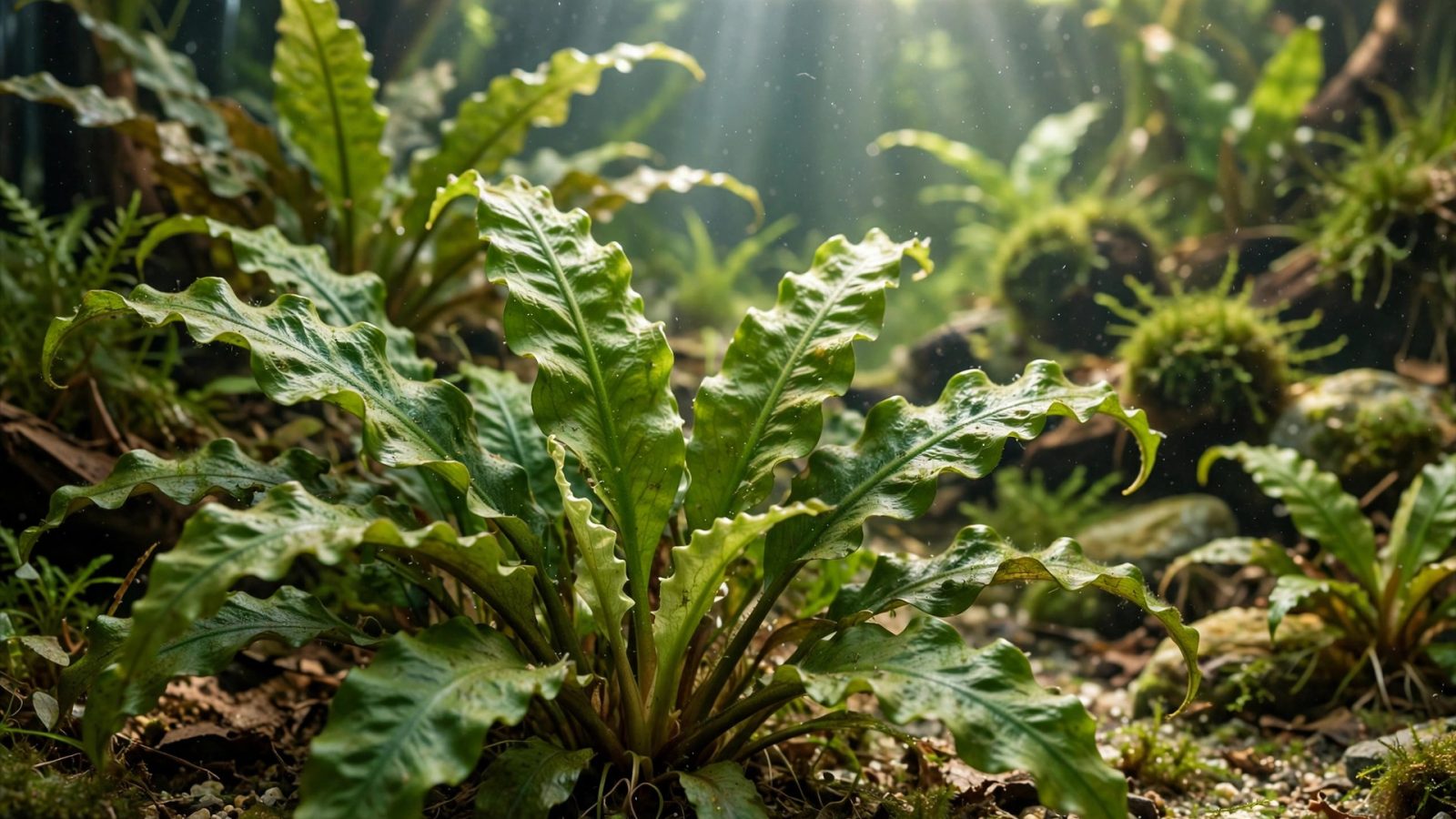
Cryptocoryne care has a reputation problem — and it is almost entirely undeserved. Crypts are called difficult because of one dramatic habit: “crypt melt,” where a healthy-looking plant dissolves into mush days after planting. Nearly every crypt keeper experiences it exactly once, panics, and then learns the truth: the plant is not dying, it is rebooting. The roots survive, and new growth follows.
Once you understand melt, crypts are genuinely easy plants: adaptable to low light, undemanding about CO2, and available in a remarkable range of leaf shapes, colors, and sizes. This guide explains what crypt melt really is, how to prevent it, the recovery protocol when it happens, and how to grow the most popular species well.
Cryptocoryne Care at a Glance
| Parameter | Recommendation |
|---|---|
| Scientific name | Cryptocoryne spp. |
| Light | Low to medium (15–40 PAR); many prefer shade |
| Temperature | 72–82°F (22–28°C); avoid sudden swings |
| pH | 6.0–7.5 |
| Water hardness | Soft to moderately hard |
| CO2 | Not required |
| Fertilizer | Root tabs in inert substrate; light liquid dosing |
| Growth rate | Slow to moderate |
| Placement | Foreground to midground (most species) |
| Difficulty | Easy — once you understand melt |
What Is Crypt Melt?
Crypt melt is the plant’s stress response to sudden environmental change. When water parameters, lighting, or temperature shift abruptly — as they do when a plant moves from nursery to store to your tank — the crypt sacrifices its leaves, dissolving them to conserve energy in the root system. Within weeks, it grows new leaves adapted to your water.
Key facts that calm every panicking beginner:
- Melt affects the leaves, not necessarily the plant. Firm, white roots and a solid crown mean the crypt is alive.
- It is triggered by change, not by anything you did wrong. Even expert keepers get melt on new crypts.
- Recovery is the norm, not the exception. Most melted crypts regrow within 3–6 weeks.
- Established crypts rarely melt unless something major changes — a rescape, a CO2 failure, or a big temperature swing.
The golden rule of cryptocoryne care: plant it and leave it alone. Every time you uproot a crypt, you risk triggering another melt cycle. Choose the spot carefully, plant once, and resist the urge to “check the roots.”
Preventing Melt on New Crypts
You cannot always prevent melt, but you can tilt the odds:
- Buy submersed-grown plants when possible. Tissue-culture cups and submersed nursery stock skip the emersed-to-submersed transition entirely.
- Match parameters roughly to the store’s water, then acclimate slowly. A drip acclimation over an hour beats a sudden plunge.
- Plant into a stable tank. Newly set-up tanks with fluctuating parameters melt crypts more often than mature, stable ones.
- Keep the crown at substrate level. Like swords, a buried crown rots; an exposed crown dries the root zone.
The Crypt Recovery Protocol
If your new crypt melts despite your best efforts, follow this protocol:
- Do nothing for two weeks. Seriously. Do not uproot, move, or fertilize aggressively. Stability is the treatment.
- Remove fully dissolved leaves gently with tweezers to prevent ammonia spikes, but leave anything still firm.
- Maintain normal care — regular water changes, normal light, existing fertilizer routine. Do not “rescue” the plant with extra ferts or light; that adds stress.
- Watch the crown. Tiny new leaves emerging from the center, usually within 2–4 weeks, signal recovery. These submersed-grown leaves are tougher and better adapted than the ones that melted.
- Resume feeding once new growth is established — a root tab near (not under) the plant supports the regrowth.
Only declare a crypt dead if the crown turns to mush and the roots dissolve — which is rare. For the broader science of transition melt, see why aquarium plants melt.
Light, CO2, and Fertilizer
Crypts are low-light specialists — 15–40 PAR covers nearly every species, and many (like C. parva and C. wendtii) actually prefer the shade under taller plants. Too much light invites algae onto their slow-growing leaves without speeding growth meaningfully. They are naturals for low-light aquascapes and shaded areas other plants will not tolerate.
CO2 is not required. It accelerates growth modestly, but crypts are patient plants — they will fill in on their own schedule. One caution: CO2 fluctuations (a tank running out, inconsistent DIY CO2) can trigger melt in established crypts. Stable low-tech beats unstable high-tech for this genus.
Feeding: crypts are root feeders. In inert substrate, place a root tab near each plant every 2–3 months. In aquasoil, they feed happily for the soil’s lifespan. Supplement with a light liquid fertilizer for the water-column feeders among them. Hungry crypts show small new leaves and faded color — the fix is food at the roots, per our fertilizer guide.
Popular Cryptocoryne Species
- Cryptocoryne wendtii — the beginner standard. Variable leaf color (green, bronze, red-brown), 4–8 inches, nearly indestructible once settled. Start here.
- Cryptocoryne parva — the smallest crypt, 2–3 inches. A true foreground crypt, but extremely slow-growing. Buy in quantity.
- Cryptocoryne undulata — ruffled green leaves, 6–10 inches. Elegant midground texture.
- Cryptocoryne beckettii — bronze-green, 4–8 inches. Color without high light.
- Cryptocoryne crispatula var. balansae — long, crinkled leaves to 20+ inches. A background crypt for big tanks.
- Cryptocoryne spiralis — tall, narrow leaves for background use, similar role to vallisneria but slower.
- Cryptocoryne ‘Flamingo’ — pink variegated leaves. Stunning, expensive, and genuinely finicky — not a beginner plant.
Planting Crypts Correctly
Most crypts arrive as potted plants. Remove the pot, rinse off the rockwool gently (crypt roots are fine and numerous — be careful), and separate the plant into smaller portions if it is a dense clump. Plant each portion with roots spread and the crown exactly at the substrate surface. In a new tank, expect some melt; in an established tank with matched parameters, you may get none at all.
Spacing: crypts spread by runners into colonies. Space small species 2 inches apart, larger ones 4–6 inches. The colony fills in over months — crypts reward patience, not crowding.
Propagation
Established crypts send out underground runners that surface as daughter plants. When a daughter has 4–5 leaves, sever the runner with scissors and replant. That is the entire technique. A happy C. wendtii colony can double its footprint yearly with zero intervention — free plants for the price of patience.
Common Cryptocoryne Problems
Total melt after planting
Normal transition melt. Follow the recovery protocol above. The plant is almost certainly alive underground.
Melt in an established plant
Something changed: temperature swing, CO2 interruption, major rescape, or a big water-parameter shift. Identify and stabilize the change; the crypt will regrow. This is why stability matters more than perfection in crypt tanks.
Holes in leaves
Potassium deficiency, the same as in most plants. Root tabs plus a potassium-containing liquid fertilizer resolve it. Compare with our holes in leaves diagnosis.
Stunted, tiny new leaves
Usually exhausted substrate or too little light. Refresh root tabs and check that the crypt is not buried in deep shade.
Algae on slow-growing leaves
Reduce light or increase shading; add Amano shrimp or nerite snails. Old algae-coated leaves can be removed at the base.
Crypts in Aquascaping
Crypts excel as midground groups in nature-style layouts, where their varied leaf textures contrast with hardscape. A drift of C. wendtii ‘Bronze’ against dark stone is a classic aquascaping combination. Their shade tolerance makes them the answer to the eternal question of what to plant under overhangs and behind tall hardscape where light barely reaches.
Cryptocoryne in Aquascaping Styles
Crypts adapt to nearly every layout philosophy:
- Nature style: drifts of C. wendtii around driftwood bases create the soft, aged transitions this style demands. The bronze variety against dark stone is iconic.
- Dutch style: the “streets” of precisely grouped plants suit C. undulata and C. beckettii — their defined leaf shapes read clearly in formal arrangements.
- Jungle style: let crypts do what they want. C. crispatula var. balansae in the background with wendtii colonies in the midground creates effortless density.
- Iwagumi: generally too minimalist for crypts, but a single C. parva cluster softening a stone base can work beautifully.
Rare and Collectible Crypts
Beyond the beginner species lies a collector’s world:
- Cryptocoryne ‘Flamingo’: pink variegated leaves. Genuinely difficult — needs stable CO2, soft water, and patience. Not for beginners, despite its beauty.
- Cryptocoryne nurii: dark, hammered-texture leaves. Slow but rewarding for experienced keepers.
- Cryptocoryne cordata: large, heart-shaped leaves. A specimen plant for big tanks.
- Cryptocoryne aponogetifolia: giant background crypt to 24+ inches. For 75+ gallon tanks only.
The pattern: price and difficulty scale together. Master wendtii and parva before spending collector money — the care principles are identical, but the expensive varieties punish mistakes harder.
Long-Term Colony Management
A crypt colony is a multi-year investment. Mature colonies (2+ years old) develop behaviors worth knowing:
- Self-regulation: established colonies reach an equilibrium density and slow their spread. The frantic runner phase of year one settles into stately stability.
- Generational turnover: individual rosettes age and decline while daughters take over. A colony that looks “tired” may just need its oldest rosettes removed to let daughters shine.
- Substrate exhaustion: after 2–3 years, even aquasoil depletes. Long-term colonies need root-tab supplementation regardless of original substrate.
- The never-move rule compounds: a five-year-old colony has root systems you cannot comprehend. Moving it is effectively starting over. Plan permanent positions.
Water Parameters: The Stability Manifesto
If cryptocoryne care had a single commandment, it would be: thou shalt keep parameters stable. More crypts are killed by well-meaning “improvements” than by neglect. The specifics:
- Temperature: 72–82°F is the comfort zone, but consistency matters more than the number. A tank that swings 4°F daily stresses crypts more than a stable tank at either end of the range. Heater reliability beats heater precision.
- pH and hardness: crypts adapt to pH 6.0–7.5 and soft-to-moderately-hard water. Pick your water and stick with it — chasing “ideal” parameters with chemicals causes the swings that trigger melt.
- Water changes: regular, moderate changes (25–30% weekly) beat infrequent massive ones. A 50%+ change with differently-parametered water is a classic melt trigger. Match temperature and dechlorinate; consistency in, stability out.
- TDS creep: in low-water-change tanks, total dissolved solids climb over months. Crypts tolerate this better than most plants, but sudden correction (a huge water change to “fix” high TDS) shocks them. Correct gradually.
The experienced crypt keeper’s secret: set up the tank, get parameters reasonable, then stop fiddling. The plants will tell you if something is genuinely wrong — and “wrong” means a trend over weeks, not a single test reading.
Crypts and Algae: The Slow-Grower’s Defense
Like all slow-growing plants, crypts are vulnerable to algae colonizing their long-lived leaves. The defense strategy:
- Shade is your friend. Crypts evolved as understory plants; placing them under taller vegetation or hardscape overhangs matches their nature and starves algae of light.
- Biological controls first: Amano shrimp, nerite snails, and otocinclus graze crypt leaves harmlessly. A cleanup crew is not optional for slow-grower tanks — it is infrastructure.
- Remove, don’t scrub: algae-coated crypt leaves rarely recover their appearance. Remove the worst leaves at the base; the plant replaces them with clean growth. Scrubbing damages the leaf surface and invites worse colonization.
- Balance, not warfare: persistent algae on crypts signals a systemic imbalance (too much light, excess nutrients, insufficient plant mass). Fix the system; the crypts are just the messenger.
The Bottom Line
Cryptocoryne care is a mindset more than a technique: plant once, keep conditions stable, and trust the roots when the leaves fail. Survive the first melt — which may never even happen if you buy submersed stock — and you own one of the most adaptable, shade-tolerant, low-maintenance plant groups in the hobby. Every experienced keeper has a crypt story that starts with panic and ends with a thriving colony. Yours will too.