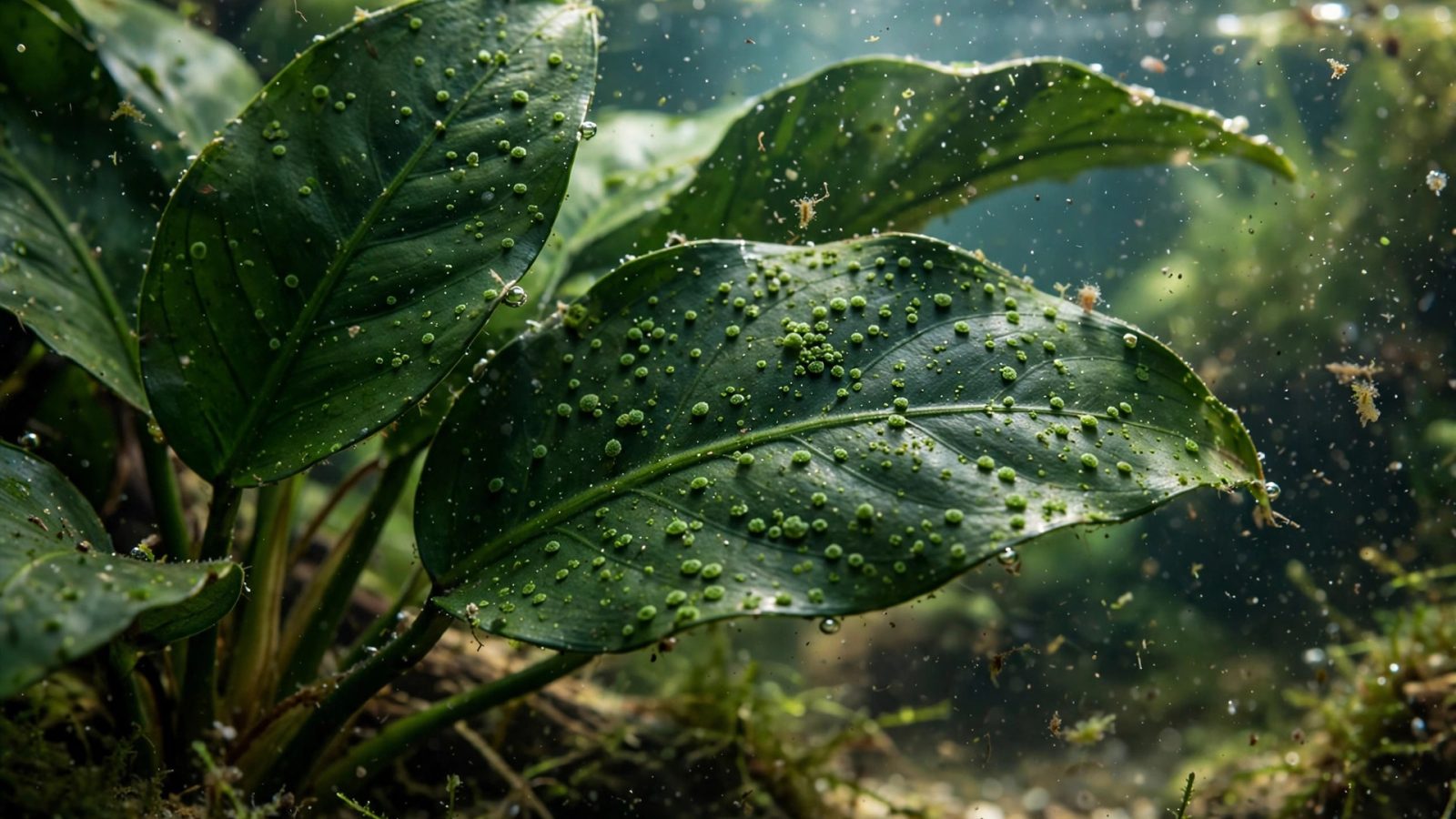
Green spot algae on anubias is almost a rite of passage — those hard, round green dots cemented to the broad leaves, impossible to wipe off, slowly spreading until the leaf looks diseased. It is not a disease, and your anubias is not dying. GSA is a specific algae with a specific cause (too much light hitting slow-growing leaves, usually with lean phosphate), and it responds to a specific set of fixes. This guide covers identification, removal without wrecking the leaves, and the balance changes that keep it away.
Why Anubias Gets It Worst
Green spot algae (a Coleochaete-type encrusting algae) grows slowly and grips hard — which makes slow-growing plants its ideal host. Anubias leaves persist for months or even years, giving GSA all the time it needs to colonize. Fast-growing stem plants shed and replace leaves too quickly for GSA to get a foothold, which is why you see it on anubias, Java fern, and old sword leaves but rarely on rotala tips.
The mechanism is straightforward: a leaf sitting under strong light, photosynthesizing slowly (anubias is a slow grower), with limited phosphate available, becomes prime real estate. The algae is not attacking a weak plant — it is exploiting a leaf that will sit still long enough to be colonized. Note this is a completely different problem from anubias leaves turning yellow, which is about nutrients inside the plant rather than algae on top of it.
Identification: Is It Really GSA?
- Hard, flat, circular green spots 1–3mm across, firmly attached — you cannot rub them off with a finger.
- On the upper leaf surface facing the light; rarely underneath.
- Slow spread over weeks, not days. Rapid green dust that wipes off easily is a different algae.
- Also on glass and hardscape near the light — GSA on the glass alongside the anubias confirms the diagnosis.
Removal: What Works on the Leaves
GSA’s grip is its defense. Be realistic: heavily encrusted leaves will never look pristine again.
The triage rule
If a leaf is more than about a third covered, trim it. Anubias grows new leaves slowly, but a badly encrusted leaf is a permanent algae reservoir that seeds its neighbors. Removing the worst leaves is the fastest way to reduce the colony. Keep leaves with only a few spots for treatment.
Gentle mechanical removal
For light spotting: a soft toothbrush or algae pad, gently, under water during a water change. You will not remove it all — the goal is thinning the colony, not perfection. Never use anything abrasive; scratched anubias leaves invite worse problems.
Spot treatment
Liquid carbon or hydrogen peroxide applied directly to the spots (filter off, syringe application, conservative dose) kills GSA over several days — spots turn pale and eventually slough off. The same safety rules apply as with any chemical treatment: labeled doses only, watch sensitive livestock, one intervention at a time. See our black beard algae guide for the full spot-dosing protocol, which works identically for GSA.
What does not work
- Wiping with your fingers — GSA laughs at this.
- Algae-eating fish — nerite snails rasp some GSA off glass, but little touches it on leaves.
- Starving phosphates to zero — this weakens your plants without eliminating the algae, and the evidence for phosphate-limitation controlling GSA is weak. Keep phosphate at normal levels.
The Real Fix: Light Management
GSA is fundamentally a light-balance problem. The fixes, in order of impact:
- Shade the anubias. This is the single most effective step. Anubias is a low-light plant — tuck it under hardscape overhangs, beneath taller plants, or in the dimmer zones of the tank. Leaves that are not blasted with light do not grow GSA. This matches the plant’s natural preference anyway.
- Reduce overall intensity or duration. If GSA is also on the glass, the whole tank is getting more light than its CO2 and nutrient levels support. Dim the light or cut the photoperiod to 6–7 hours.
- Keep phosphate adequate. Maintain normal phosphate levels through regular fertilization — the old “zero phosphate” advice is counterproductive. A consistent fertilizer schedule keeps plants competitive.
- Maintain the glass. Scrape GSA off the glass weekly. Glass colonies seed leaf colonies; breaking the cycle on the easy surface helps the hard one.
Anubias Placement That Prevents GSA
Think like the plant’s native habitat: anubias grows emersed on shaded riverbanks and submerged on rocks in dappled light — never in full tropical sun. In your tank:
- Attach to driftwood or rock in the lower third of the tank, or under overhangs.
- Use taller background plants as a living shade canopy.
- In high-light tanks, anubias belongs in the shadows by design — it will grow slower but stay cleaner.
- When aquascaping, plan the shade before placing the anubias, not after the GSA appears.
Timeline and Expectations
Existing spots will not vanish when you fix the light — they fade slowly over weeks as the algae dies and the leaf gradually sheds it. New leaves emerging in proper shade come in clean. Full cosmetic recovery of an affected plant takes one to two new-leaf cycles (anubias is slow — think months, not weeks). Judge progress by the new leaves, not the old ones.
GSA in High-Tech vs Low-Tech Tanks
Green spot algae behaves differently depending on the setup, and the fix emphasis shifts accordingly:
- High-tech tanks (CO2 injected, strong light): GSA here almost always means the anubias is sitting in light meant for demanding stems. The tank-wide balance may be fine — the plant is simply misplaced. Move the anubias into the shade of hardscape or tall stems rather than dimming a light your carpet needs.
- Low-tech tanks (no CO2, moderate light): GSA suggests the photoperiod is too long for the available carbon, or the light is stronger than the slow plant mass can use. Shortening the day to 6–7 hours and shading the anubias usually resolves it without touching intensity.
- New tanks: GSA appearing in the first two months often fades on its own as the tank matures and plant mass increases. Hold the shade-and-scrape routine steady rather than chasing it with product after product.
Frequently Asked Questions
Is green spot algae harmful to the plant?
Light spotting is cosmetic. Heavy encrustation blocks light and slowly weakens the leaf — which is why trimming badly affected leaves helps the plant more than leaving them.
Will reducing light hurt my other plants?
Only if you overcorrect. Shading the anubias specifically (placement, plant canopy) solves the problem without dimming the whole tank. If you reduce tank-wide light, do it gradually and watch fast growers for signs they want more.
My phosphate reads zero — should I dose phosphate?
If you are not fertilizing at all, yes — start a complete fertilizer rather than phosphate alone. But do not expect phosphate dosing alone to erase existing GSA; light management does the heavy lifting.
Can I bleach-dip anubias to kill GSA?
A brief dilute bleach dip (1:19 bleach to water, 60–90 seconds, followed by thorough rinsing and a dechlorinator soak) kills GSA on hardy anubias leaves, but it is harsh: it can damage leaf tissue and melt sensitive varieties. Try shading and spot treatment first; reserve bleach dips for badly encrusted plants you would otherwise throw away, and never dip the rhizome longer than necessary.
How do I keep new anubias GSA-free from the start?
Quarantine and place deliberately: inspect new plants for spots before they enter the display, and put them straight into a shaded position rather than a bright holding spot “temporarily.” The first month in proper shade sets the pattern — leaves that start clean in correct light rarely develop GSA later.
GSA Beyond Anubias: Other Victims
- Java fern: the second-most common host — same slow-leaf mechanism. Treat identically: shade, trim worst leaves, spot-treat the rest.
- Old sword leaves: outer leaves that have persisted for many months accumulate GSA. Often the right move is simply trimming the oldest leaves on schedule rather than fighting the algae.
- Bucephalandra: prized slow growers are GSA magnets in high light. Buce belongs in shade by design — if yours is in bright light for color, accept GSA management as the price or move it.
- Glass and equipment: GSA on glass is the same organism and the same cause. A razor scraper (glass tanks) or plastic blade (acrylic) weekly keeps it controlled. Glass GSA is also your early warning — spots on the glass appear before spots on leaves.
The Phosphate Question, Answered Honestly
Decades of forum advice says “low phosphate causes GSA; dose phosphate to fix it.” The reality is more nuanced: GSA appears across a wide range of phosphate levels, and while severe phosphate starvation (near zero, unfertilized tanks) does correlate with heavier GSA, dosing phosphate alone rarely clears an existing outbreak. The controlled experiments hobbyists have run point to light intensity relative to plant growth rate as the dominant variable, with phosphate as a secondary factor.
Practical takeaway: maintain normal phosphate via complete fertilization (do not starve it), but put your effort into light management — shading, photoperiod, intensity. If someone tells you phosphate dosing alone cured their GSA, they probably also changed something about their light or maintenance at the same time.
Long-Term Anubias Care for GSA-Free Leaves
- Annual leaf audit: once a year, remove the oldest, most spotted leaves. Anubias can carry the same leaves for years — scheduled renewal keeps the plant looking fresh.
- Rhizome division: every 1–2 years, divide overgrown rhizomes. Fresh divisions push clean new leaves and the old sections can be retired.
- Stable placement: once you find a shaded spot where leaves stay clean, stop moving the plant. Every relocation resets its adjustment and invites a GSA window.
- Gentle leaf cleaning during water changes — a soft brush over the leaves monthly prevents colonies from establishing unnoticed.