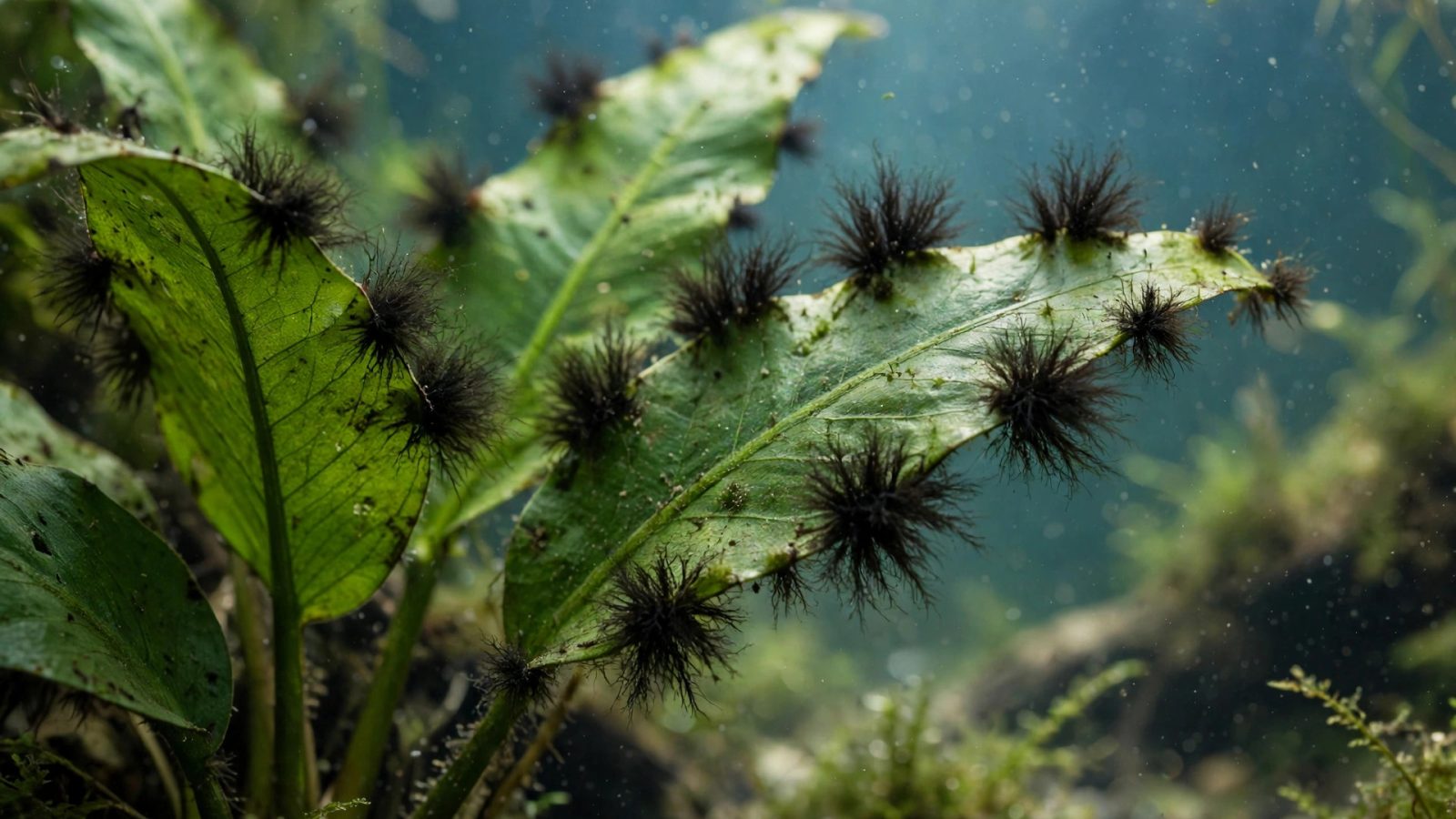
Black beard algae on aquarium plants is the problem hobbyists fear most — dark, fuzzy tufts that grip leaves like Velcro, spread relentlessly, and shrug off the treatments that work on other algae. BBA (Audouinella) is genuinely the toughest common algae in the hobby, but it is beatable. This guide covers what causes it, how to remove it from plants without destroying them, and — most importantly — how to change the conditions that invited it so it does not come back.
Identifying Black Beard Algae
BBA forms short, dense, dark tufts — black, dark gray, or deep reddish — growing on leaf edges, hardscape, and equipment. Early colonies look like dark stubble on leaf margins; mature tufts grow 5–10mm long and feel coarse. It anchors firmly: unlike diatoms or soft green algae, you cannot wipe BBA off with a finger.
Do not confuse it with: staghorn algae (grayish, branching like antlers, grows in distinct strands — see our staghorn guide), black brush on driftwood that is actually just dark biofilm in a new tank, or dark spots that are phosphorus-deficiency necrosis on the leaf itself rather than something growing on it.
What Causes BBA
BBA is an instability algae. It thrives where conditions fluctuate — and the research and collective hobby experience point to a consistent set of triggers:
- Unstable or inadequate CO2. The number-one trigger in injected tanks. BBA blooms when CO2 is inconsistent — fluctuating bubble rates, poor diffusion, or levels too low for the light intensity. In low-tech tanks without CO2, excessive light relative to available carbon plays the same role.
- Too much light for the system’s balance. High light with limited CO2 and lean nutrients is the classic BBA recipe. The algae tolerates the stressful conditions better than higher plants do.
- Organic waste buildup. Dirty filters, mulm-choked substrate, overfeeding, and decaying plant matter all correlate with BBA outbreaks. It loves a neglected tank.
- Flow dead spots. Areas with stagnant water accumulate organics and deliver CO2 and nutrients poorly — BBA colonizes them first. Leaf edges in dead spots are its favorite real estate.
- Recent instability. New tanks, rescapes, filter changes, and CO2 adjustments all precede outbreaks. BBA exploits transition.
Notice what is not on the list: phosphates and nitrates at normal levels. The old advice to starve phosphates to beat BBA is outdated — BBA grows fine in low-phosphate water, and starving your plants only weakens the competition.
The Triage Decision: Save the Leaf or Sacrifice It
Before treating, decide leaf by leaf. BBA-damaged leaves rarely recover their appearance even after the algae dies — dead BBA turns reddish/white and remains visible until the leaf is replaced.
- Lightly affected, valuable plant: treat in place (spot-dosing below).
- Heavily coated leaf: trim it. The plant cannot photosynthesize through the tufts, and the leaf is an algae farm. Fast growers replace trimmed leaves in weeks.
- Whole slow-growing plant coated (anubias, Java fern): treat rather than trim — these plants replace leaves too slowly to sacrifice. This is where spot treatment earns its keep.
- BBA on hardscape/equipment: remove and scrub, or treat outside the tank — no plant to protect.
Removal Method 1: Spot-Dosing Liquid Carbon
The most reliable in-tank treatment is direct spot application of a glutaraldehyde-based liquid carbon product (sold as “liquid CO2” or algae treatments). Applied directly to the tufts, it kills BBA within days — the tufts turn pinkish-red, then white/gray as they die.
How to spot-dose safely
- Turn off filtration and flow so the product sits on the algae instead of dispersing.
- Apply with a syringe or pipette directly onto the tufts. Use the product’s recommended dose for your tank volume — do not exceed it.
- Wait 10–15 minutes with flow off, then restart filtration.
- Repeat every 2–3 days on remaining tufts until they all change color and die.
Safety rules (non-negotiable)
- Never exceed the labeled dose. Glutaraldehyde is toxic to fish, shrimp, and plants at high concentrations. More is not better — it is dangerous.
- Know your sensitive species. Vallisneria, some mosses, and certain crypts react badly even at normal doses. Treat a small area first and wait 48 hours.
- Shrimp and snail caution. Invertebrates are more sensitive than fish. Dose conservatively in shrimp tanks, and never spot-dose directly onto livestock.
- Do not combine with other chemical treatments. One intervention at a time.
Removal Method 2: Hydrogen Peroxide Spot Treatment
3% hydrogen peroxide from the pharmacy, applied directly to BBA with flow off, oxidizes the tufts on contact — they fizz and die within a day or two. Use roughly 1–2ml per 10 liters of tank water as a conservative ceiling per treatment, applied precisely to the algae.
Peroxide breaks down into water and oxygen quickly, which makes it appealing, but it is still an oxidizer: it damages delicate plants (mosses, fine-leafed stems) and stresses livestock at high doses. Same rules as above — flow off, targeted application, conservative dosing, observe before repeating. Many hobbyists alternate peroxide and liquid-carbon spot treatments on stubborn colonies.
Removal Method 3: The Dip (For Removable Plants and Hardscape)
If the affected plant or decoration can come out of the tank, a brief dip is more effective and safer for livestock than in-tank treatment:
- Bleach dip: 1 part household bleach to 20 parts water, 60–90 seconds, then rinse thoroughly and soak in dechlorinated water with extra conditioner. Effective but harsh — avoid on delicate plants.
- Peroxide dip: 3% hydrogen peroxide undiluted, 3–5 minutes, then rinse. Gentler than bleach.
- Liquid carbon dip: strong solution for 5 minutes. Gentlest option.
Always rinse exhaustively and soak in conditioned water before returning anything to the tank. When in doubt, test the dip on one leaf first.
Removal Method 4: Biological Help (Limited)
Be honest about livestock: very few creatures eat established BBA. Siamese algae eaters (true Crossocheilus oblongus, not Chinese algae eaters) graze young, soft BBA tufts and help prevent spread, but they will not clear an established outbreak. Amano shrimp pick at it lightly. Nothing eats mature tufts reliably. Livestock is prevention support, not a cure — and never buy fish to fix an algae problem unless the fish suits your tank anyway.
The Real Cure: Fixing the Conditions
Killing visible BBA without changing conditions is mowing weeds. Long-term success comes from stability:
- Stabilize CO2. In injected tanks: consistent bubble rate, clean diffuser, good circulation to all areas, drop checker reading stable through the photoperiod. In low-tech tanks: reduce light to match available carbon rather than chasing CO2 you do not have.
- Reduce light intensity or duration. Drop to 6 hours temporarily during treatment; long-term, match light to your CO2 and nutrient levels. A dimmer on the LED is one of the best algae investments.
- Clean the system. Rinse filter media in tank water, vacuum mulm, remove decaying leaves, cut back overfeeding. Reduce the organic load BBA feeds on.
- Fix flow. Reposition the filter outflow or add a small circulation pump so no area sits stagnant. Every leaf should gently sway.
- Feed the plants, not the fear. Maintain consistent fertilization — starving plants cannot outcompete algae. Follow a regular dosing schedule through the whole battle.
Timeline: What to Expect
- Days 1–3: treated tufts turn pink/red — the algae is dying.
- Week 1–2: dead tufts turn white/gray; some detach. Trim the worst leaves now.
- Weeks 2–4: no new tufts appearing means conditions are fixed. New plant growth comes in clean.
- Month 2+: old damage fully grown out or trimmed away. If new tufts appear, one of the five conditions above is still off — revisit the list rather than just re-treating.
Frequently Asked Questions
Will BBA kill my plants?
Indirectly, yes — heavy coatings block light and the leaf slowly starves. But BBA does not parasitize plants; a plant with treated, cleaned leaves recovers fully. The danger is leaving it smothering foliage for months.
Can I just black out the tank?
A 3–5 day blackout weakens BBA but rarely eradicates established tufts, and it stresses your plants too. Blackout works better as a supplement to spot treatment and condition fixes, not a standalone cure.
Why did BBA appear when my parameters “look fine”?
Because the triggers are about stability and balance, not individual parameter values. Fine-looking nitrates with fluctuating CO2 and a dirty filter is prime BBA territory. Judge the system, not the test kit.
Is BBA harmful to fish?
No — it is unsightly and hard on plants, but not toxic to fish. The chemical treatments used against it are far more dangerous to livestock than the algae itself, which is why dosing discipline matters.
Equipment Deep-Clean: Removing BBA Reservoirs
BBA colonizes equipment as readily as plants, and dirty equipment re-seeds the tank after you treat the leaves. During a BBA battle, deep-clean:
- Filter intake and outflow: BBA loves the high-flow surfaces. Scrub intake strainers and spray bars — reduced flow from clogged intakes also worsens the dead spots BBA favors.
- Heater and thermometer: wipe down; tufts here are easy to miss and constantly release spores.
- Diffuser and CO2 equipment: a clogged diffuser produces the large bubbles and poor dissolution that cause the very CO2 instability behind the outbreak. Soak ceramic diffusers in bleach solution, rinse exhaustively.
- Hardscape: remove rocks and wood for scrubbing or dipping — boiling water poured over rocks kills BBA (let cool before returning).
BBA in Low-Tech Tanks: A Different Playbook
Without injected CO2, you cannot fix BBA by “stabilizing CO2” — so the levers change:
- Light is your main dial. Low-tech BBA is almost always too-much-light-for-available-carbon. Reduce intensity or photoperiod until new growth is clean — often 6 hours at moderate intensity.
- Floating plants are allies. A partial cover of frogbit or salvinia both shades the tank and consumes excess nutrients — two BBA suppressants in one.
- Go slower on changes. Low-tech tanks stabilize slowly; give each adjustment a full month before judging.
- Accept some BBA history. Old hardscape in low-tech tanks may carry faint BBA staining indefinitely. If it is not spreading, it is controlled — perfection is not required.
The Maintenance Routine That Keeps BBA Away
Post-victory, this routine prevents recurrence:
- Weekly: 30–50% water change, glass cleaning, dead-leaf removal, quick equipment wipe.
- Monthly: filter media rinse (tank water), diffuser check/clean, mulm vacuum of visible areas.
- Quarterly: light intensity review (are plants still balanced?), CO2 system full check, substrate deep-section rotation.
- Continuously: feed lightly, do not skip fertilizer, keep a maintenance log. BBA exploits neglect — a boring, consistent routine is the best algaecide ever invented.
BBA Myths Worth Retiring
- “Phosphates cause BBA.” No. BBA grows in near-zero phosphate. Starving phosphates weakens plants without stopping the algae.
- “A blackout cures BBA.” It weakens it temporarily; established tufts survive and return. Useful as a supplement, not a cure.
- “Siamese algae eaters will clear it.” They graze young tufts and help prevent — they do not eradicate established colonies. Buy them because you want the fish, not as medicine.
- “More fertilizer feeds BBA.” Consistent complete fertilization grows stronger plants that outcompete algae. The tanks with the worst BBA are usually the most neglected, not the most fertilized.
When to Call It: Realistic BBA Expectations
Honesty about timelines prevents the discouragement that makes people quit or nuke their tanks:
- Light outbreaks (a few tufts on leaf edges): 2–4 weeks to clear with spot treatment plus one condition fix.
- Moderate outbreaks (multiple plants, hardscape spots): 6–10 weeks of treatment plus systematic condition fixes. Expect to trim and regrow some plants entirely.
- Severe outbreaks (tank-wide, months established): 3–4 months, and sometimes the pragmatic answer is a full teardown — save the livestock and filter media, discard badly affected plants, sterilize hardscape, and restart with the lessons learned. There is no shame in this; some battles cost more than the tank is worth.
The variable that matters most is not which treatment you use — it is whether the underlying instability gets fixed. Spot-dosing without fixing CO2 is mowing a lawn while the sprinkler floods it. Fix the water, then kill the algae, in that order of priority.
BBA and Rescapes: Starting Clean
If BBA drove you to a rescape, do it right:
- Keep the filter media wet and alive — it is the biological foundation. Everything else can be replaced; the bacteria colony cannot be bought.
- Sterilize hardscape with a bleach soak (1:20, 24 hours for rocks/wood), then dechlorinate thoroughly and sun-dry.
- Start with clean plants — new tissue-culture plants are BBA-free by design. Do not transfer visibly affected plants to the new scape “to save money.”
- Run the new scape lean on light for the first month (6 hours, moderate intensity) while plants establish. The highest-risk BBA window is a bright new tank with unestablished plants.