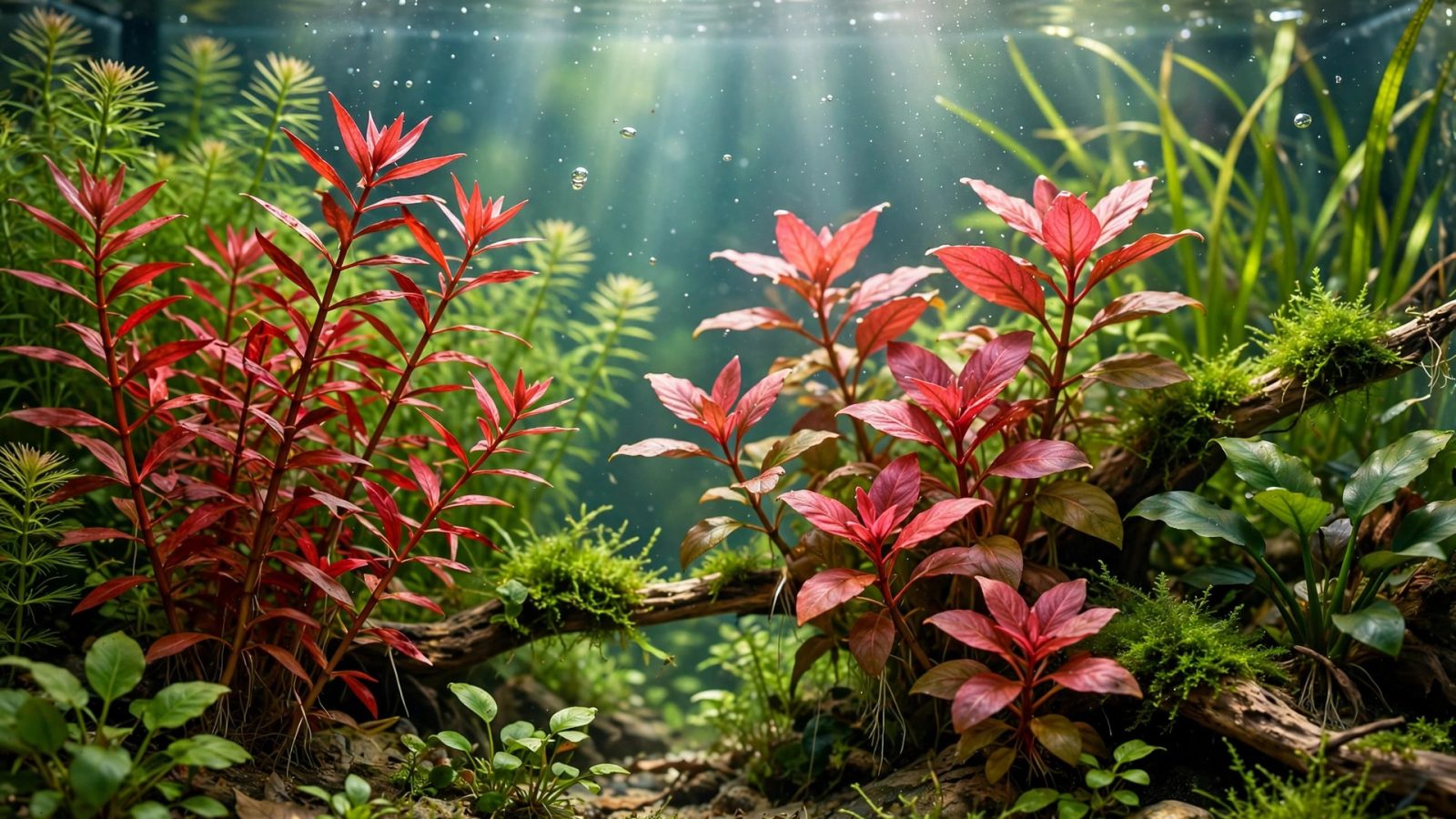
Red plants are the holy grail of aquascaping — and the most mythologized. “Red plants need CO2” gets repeated as gospel, discouraging beginners from ever trying. Here’s the truth: while the most demanding red species do want injected carbon, several genuinely red aquarium plants color up beautifully in low-tech tanks. The best red aquarium plants for beginners below are proven without CO2 — they get their color from strong light and good nutrition, not from a pressurized cylinder.
Understanding why plants turn red kills the myth. Red coloration comes from anthocyanin pigments, which plants produce as sunscreen — a response to strong light. CO2 helps only indirectly, by letting plants grow fast enough to use intense light productively. Give a red-capable plant strong light, adequate iron, and slightly limited nitrate, and it reddens with or without CO2. The seven below are the species where this works reliably.
How to Get Red Color Without CO2
- Strong light matters most. Red needs photons — aim for the higher end of moderate lighting, 8 hours daily. A dim tank grows these plants green; that’s the #1 reason “beginner reds” disappoint.
- Iron helps, but isn’t magic. Dose a comprehensive fertilizer with iron; iron deficiency shows as pale new growth. But dumping extra iron without enough light just feeds algae.
- Keep nitrates moderate, not zero. Slightly lean nitrate (5–10ppm) intensifies reds; zero nitrate starves the plant. Don’t chase extreme limitation — healthy red beats stressed red.
- Trim for color: the reddest growth is always the newest, nearest the light. Regular trimming keeps the plant producing fresh red tips instead of aging to green.
The 7 Best Red Aquarium Plants for Beginners
1. Ludwigia repens
The beginner red. Ludwigia repens grows fast, tolerates a wide range of conditions, and develops bronze-red to deep red leaves under good light — no CO2 required. It’s a proper stem plant: trim tops, replant, watch the stand thicken. In moderate light you get attractive bronze-green; under strong light, genuine red. It’s nearly indestructible, propagates endlessly, and teaches every skill (trimming, replanting, nutrient balance) you’ll need for fussier reds later. If you try one red plant, make it this one.
2. Alternanthera reineckii ‘Mini’
AR ‘Mini’ is the dwarf cultivar that brings intense pink-red to the midground — the most color-dense plant on this list. It stays 4–8 inches, making it a midground focal point rather than a background stem. It’s honest about needing strong light and iron; in dim tanks it goes leggy and green. But it doesn’t demand CO2 — many aquarists grow it vividly red in low-tech setups with good lighting. Trim and replant tops to maintain the bush; each cutting roots quickly. Featured in our midground plant guide for exactly this role.
3. Red Tiger Lotus (Nymphaea zenkeri)
The tiger lotus doesn’t do subtle: spotted red-bronze leaves, some reaching the surface as lily pads, on a plant that feeds from a bulb and asks almost nothing. It’s the easiest dramatic red in the hobby — plant the bulb, add root tabs, and watch. Trim surface pads to keep it producing submerged leaves (or let a few float for the full lily effect). It colors up under moderate light where stem plants would stay green, making it the most light-forgiving red here. Also goldfish-resistant — see our goldfish-proof list.
4. Rotala rotundifolia
Rotala is the gradient red — green at the base transitioning to pink-red at the tips near the light. Under strong lighting the top third of a healthy stand glows warm pink, creating a color gradient no other beginner plant replicates. It’s a fast, easy stem plant: trim, replant, repeat. The red intensifies with leaner nitrates and good iron, but even in average conditions you get attractive pinkish tips. It bridges fast-growing utility and red-plant beauty in one species.
5. Cryptocoryne wendtii ‘Red’ / ‘Mi Oya’
The red crypts bring burgundy-bronze color to the midground with zero stem-plant fuss. ‘Red’ and ‘Mi Oya’ varieties develop deep reddish-brown ruffled leaves under moderate light — no CO2, no intense lighting heroics. They’re crypts, so the rules are: root tabs, stable conditions, don’t move them, wait out the melt. Once established they’re permanent, slow-growing color anchors. The red deepens with maturity; a year-old red crypt is a genuinely stunning plant.
6. Red Root Floaters (Phyllanthus fluitans)
The cheat code: red color with almost no effort. Red root floaters are floating plants with round green leaves that blush red on top and — as the name promises — vivid red roots dangling below. They get unlimited atmospheric CO2 and sit closest to the light, so they color up where submerged plants struggle. Corral them to keep surface coverage at 30–50%, and watch the roots: long, deep-red roots signal a happy plant and provide grazing cover for shrimplets. They’re covered further in our floating plant guide.
7. Ludwigia palustris ‘Super Red’
‘Super Red’ is the most intensely red stem plant a beginner can grow — under strong light, the entire stem glows deep crimson, not just the tips. It’s slightly more demanding than L. repens (wants better light and consistent fertilizing) but still firmly low-tech — no CO2 needed. Growth is fast and the color payoff is the highest on this list. Plant it where it gets unobstructed light; shaded stems revert to green. Trim aggressively — it responds by branching into a dense red thicket.
Red Plants That Aren’t Beginner-Friendly (Honest Warning)
For transparency, the reds to avoid until you’re experienced: Ammannia gracilis/pediculata (stunning, but melts without CO2 and soft water), Rotala macrandra (the reddest rotala, and the fussiest — demands CO2, soft water, intense light), Ludwigia ‘Pantanal’ (gorgeous meta-red, genuinely difficult), and Persicaria ‘Kawagoeanum’ (beautiful, CO2-hungry). These aren’t “try harder” plants — they have physiological needs low-tech tanks can’t meet. Master the seven above first; they’ll teach you whether you’re ready.
Designing With Red: Less Is More
Red is a visual exclamation point — use it like one. The classic aquascaping rule is one red group per tank (two at most in large aquariums), placed at the focal point or golden-ratio intersection. A single dense stand of Ludwigia ‘Super Red’ against a green background has ten times the impact of red plants scattered everywhere. Surround reds with contrasting green — the red appears more intense against complementary green than against other reds.
Layer reds by height: red root floaters on the surface, AR ‘Mini’ in the midground, ludwigia stems in the background. Three red touches at three depths create a color echo that pulls the eye through the whole scape — sophisticated without being gaudy. And remember: red plants are hungriest for light, so give them the brightest positions, unshaded by hardscape or taller neighbors.
Companion Planting: Greens That Make Reds Pop
Red looks redder against the right green. The strongest contrast comes from blue-green and bright lime foliage placed adjacent to your red group: a stand of Ludwigia ‘Super Red’ backed by the cool green of Java fern or the vivid lime of pearl weed reads dramatically more intense than the same reds surrounded by dark bronze crypts. Color theory is doing real work here — complementary contrast makes both colors appear more saturated than either looks alone.
Texture contrast matters as much as color. Pair fine-leaved reds (rotala) with bold, broad greens (anubias, Amazon sword) and vice versa — a lacy red stem stand next to big green leaves gives the eye two kinds of information at once, which reads as intentional design rather than a random collection. Avoid placing reds directly against other warm tones: red tiger lotus next to bronze cryptocoryne wendtii muddies both, while the same lotus against green vallisneria sings.
One practical pairing that never fails: AR ‘Mini’ in front of a Java fern wall. The dark, matte green backdrop makes the pink-red pop even under moderate light, and both plants want the same easy conditions. It’s the highest color payoff per unit of effort in low-tech aquascaping.
Frequently Asked Questions
Why are my “red” plants growing green?
Insufficient light — 90% of the time. The plant is healthy but not producing anthocyanin sunscreen because the light doesn’t warrant it. Increase intensity (not duration), ensure iron is adequate, and give it 2–3 weeks. If new growth emerges reddish, you’ve solved it.
Do red plants really not need CO2?
The seven on this list, correct. CO2 accelerates their growth and can intensify color, but it’s not required for red coloration — strong light is the actual driver. The no-CO2 method grows all seven well.
Will red plants survive in low light?
They’ll survive but stay green — a healthy green ludwigia is still a fine plant, just not the red one you wanted. If your setup is low-light, choose from our low-light plant list instead and add red later with a lighting upgrade.
How do I make reds redder?
The trifecta: strong light, adequate iron, and slightly lean nitrate (5–10ppm). Trim regularly so the plant keeps producing new growth near the light. Avoid the temptation to overdose iron — excess iron without matching light just grows algae.
Feeding Red Plants: The Iron Question
Iron’s role in red coloration is real but misunderstood. Iron is essential for chlorophyll production and enzyme function — a deficiency shows as pale, yellowish new growth (interveinal chlorosis), which obviously can’t be red. So adequate iron is necessary for red color, but extra iron beyond sufficiency doesn’t make plants redder. The hobby myth of “dose iron for reds” comes from conflating deficiency correction with color enhancement.
Practical approach: use a comprehensive all-in-one fertilizer that includes chelated iron (DTPA or EDDHA chelates stay available longest), dosed per the bottle for your tank size. That’s sufficient for all seven plants here. If new growth emerges pale despite complete fertilizing, then consider a dedicated iron supplement — but check lighting first, because light deficiency mimics iron deficiency visually. Never dose iron to “fix” a dim tank; you’ll grow spectacular algae instead.
The other nutrients matter too. Potassium deficiency shows as pinholes in older leaves (common in ludwigia and rotala); magnesium deficiency as marbled yellowing. Red plants under strong light grow fast and eat heavily — they’re the first to show deficiencies in a lean tank. A consistent weekly all-in-one dose prevents the cascade where you chase individual deficiencies one by one.
Light Upgrades: Getting Reds Without Breaking the Bank
If your current light grows green plants well but won’t redden ludwigia, you need more intensity — not necessarily an expensive fixture. Options in ascending cost: raise the photoperiod to 8–9 hours (free, but watch for algae); add a second inexpensive LED bar alongside your current light (doubles intensity for modest cost); replace with a purpose-built planted-tank light (best long-term solution, with adjustable intensity and spectrum).
When shopping, ignore wattage marketing and look for PAR values at your tank’s depth — you want 50–80 PAR at the substrate for reliable reds. Full-spectrum lights with strong red and blue channels render red plants most vividly; a light that’s all cool white grows plants fine but makes reds look flat. And add a timer — consistent photoperiods grow better plants than manual on/off, because plants (like all photosynthesizers) run on circadian rhythm.
Troubleshooting Red Plants
Leggy stems with small leaves: not enough light, full stop. The plant is stretching toward the surface. Increase intensity and trim the leggy portions — new growth under better light will be compact and colorful.
Red fading to green over time: usually declining light (old LEDs dim over 2–3 years) or increasing shade as neighboring plants grow. Trim back the shade-castors, clean the light’s lens cover, and consider whether the fixture needs replacement.
Algae on red plants specifically: red plants under strong light are algae magnets — the same intense light that reddens them grows algae on their slow-growing leaves. Keep a cleanup crew (Amano shrimp, nerites), maintain the 8-hour photoperiod ceiling, and remove affected leaves promptly. Healthy, fast-growing red stems outrun algae; struggling ones get smothered.
Melting after planting: tissue-culture and emersed-grown reds often melt their old leaves when transitioning underwater. This is normal — remove the mush, keep conditions stable, and wait for submerged growth. AR ‘Mini’ and rotala are particularly dramatic melters that recover fully within 3–4 weeks.