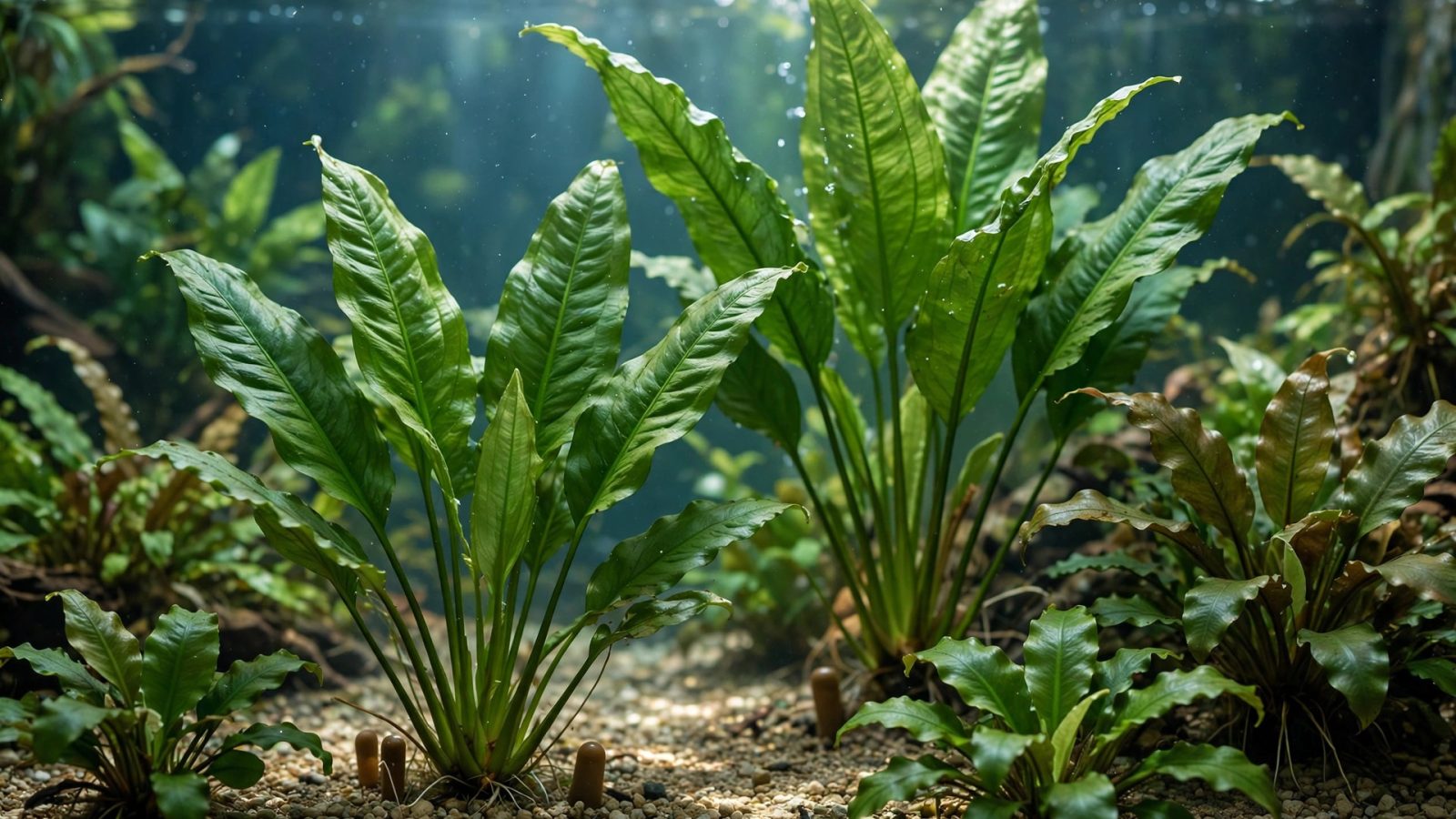
Aquasoil is wonderful stuff — and completely unnecessary for a thriving planted tank. Millions of beautiful aquariums run on the cheapest substrate in the hobby: plain inert gravel. The best aquarium plants that grow in plain gravel don’t care that your substrate has no nutrients, because they either feed through the water column, anchor as epiphytes, or accept targeted feeding through root tabs. These ten species prove that the substrate debate is overblown — technique beats materials.
The key concept is supplementation, not substrate. Inert gravel provides anchoring and a home for beneficial bacteria — both valuable — but zero nutrition. You replace aquasoil’s built-in fertility with two tools: root tabs (slow-release fertilizer capsules pushed into the gravel near heavy root feeders) and liquid fertilizer (dosed into the water for column feeders). Together, they replicate everything aquasoil does, at a fraction of the cost, without the ammonia leach or the 1–2 year exhaustion lifespan.
The Root Tab Method
Root tabs are compressed fertilizer pellets — typically clay-based, loaded with macros and micros — that you push deep into the substrate near plant roots. They dissolve over 2–3 months, feeding the root zone directly. Placement: one tab every 4–6 inches in planted areas, pushed to the bottom of the gravel bed with tweezers or fingers, positioned 2–3 inches from plant crowns (not directly under, which can burn roots).
Refresh on a schedule — set a phone reminder for every 10–12 weeks. The #1 gravel-tank failure is tabs that ran out six months ago while the aquarist wonders why growth stalled. When you refresh, don’t remove old tab remnants; just push new ones into new spots nearby. Combine with weekly liquid fertilizer for column feeders, and your gravel bed is nutritionally complete.
The 10 Best Plants for Plain Gravel
1. Vallisneria (all varieties)
Vallisneria is the gravel-tank champion. Its runner-spreading habit colonizes gravel effortlessly, its ribbon leaves tolerate any water, and with root tabs it grows as vigorously as in aquasoil. Jungle val for tall tanks, Italian val for standard — both form the background curtain that makes a gravel tank look intentional. It’s also a tall-tank essential and survives goldfish. If your gravel tank has one background plant, this is it.
2. Amazon Sword (Echinodorus amazonicus)
The classic gravel success story. Amazon swords are heavy root feeders that thrive in gravel with root tabs — without tabs they slowly starve, which is where the “swords need aquasoil” myth comes from. Give a sword 3–4 tabs in a ring around its base, refreshed quarterly, and it grows as massively as in any aquasoil tank. The broad leaves and dramatic size make it the centerpiece gravel tanks need. Match it with the epiphytes from our substrate-free guide for a complete low-cost scape.
3. Cryptocoryne wendtii
Crypts are root feeders that adapt to gravel readily — wendtii’s ruffled rosettes establish in plain gravel with root-tab support and then persist for years. The standard crypt rules apply: plant, don’t move, wait out the melt. In gravel, give new crypts an extra tab at planting time; the initial nutrient boost overcomes transplant shock faster. The bronze and red varieties bring color to the gravel midground without any substrate upgrade.
4. Dwarf Sagittaria (Sagittaria subulata)
Dwarf sag spreads through gravel via runners with cheerful indifference to substrate fertility — though it spreads faster with root tabs scattered through the planting zone. It’s the easiest gravel carpet: plant plugs in a grid, add tabs every few inches, and watch it fill in. In gravel it tends toward the taller end of its range (4–6 inches), which actually suits the slightly coarser aesthetic of gravel tanks. Fine gravel (2–3mm) works best; coarse gravel slows runner spread.
5. Anubias (all varieties)
Epiphytes don’t care about substrate at all — anubias feeds from the water column, making gravel vs. aquasoil a non-question. Tie it to the driftwood and rocks in your gravel tank and dose liquid fertilizer. It’s the structural plant that makes gravel tanks look deliberate rather than budget-constrained. Same for Java fern and buce — the whole epiphyte category is substrate-agnostic by biology.
6. Water Wisteria (Hygrophila difformis)
Water wisteria is primarily a water-column feeder — its roots anchor it, but the leaves do the eating. In gravel with liquid fertilizing, it grows as fast as anywhere, making it the ideal background stem for gravel tanks. It doesn’t need root tabs (though it won’t refuse them), just consistent liquid ferts and moderate light. The lacy leaves provide the fine texture that gravel tanks need to avoid looking coarse.
7. Tiger Lotus (Nymphaea zenkeri)
The bulb is a nutrient battery — tiger lotus carries its own reserves and supplements from root tabs placed nearby. In gravel it performs identically to aquasoil plantings: red-bronze leaves, surface pads, dramatic presence. Push 2–3 tabs in a ring around the bulb at planting and refresh quarterly. It’s the highest-impact single plant for a gravel tank — one bulb transforms the aquascape. Also featured in our beginner red plant list.
8. Rotala rotundifolia
Rotala is the stem-plant proof that gravel works: it feeds almost entirely through the water column, rooting in gravel purely for anchorage. With liquid fertilizer and moderate light, it grows upright, colors up pink-red at the tips, and propagates from trimmings — everything it does in aquasoil. It’s the best argument against substrate snobbery: a thriving, colorful rotala stand in 50-cent gravel. Trim and replant tops every few weeks to maintain the dense stand.
9. Hornwort (Ceratophyllum demersum)
Hornwort doesn’t root, so substrate is literally irrelevant — float it or weight it down in gravel. It’s the nutrient sponge that keeps gravel tanks (which lack aquasoil’s ammonia-buffering) stable during the early months. Every gravel setup should include hornwort or water sprite for the first 2–3 months as biological insurance, then reduce or remove it as the permanent planting establishes. See its role in new-tank setups.
10. Cryptocoryne beckettii
A second crypt because gravel tanks need midground variety: beckettii’s upright, spear-like bronze-green leaves contrast with wendtii’s ruffled form, and it establishes in gravel with the same root-tab support. Plant groups of 5–7 for proper stands. Between wendtii, beckettii, and the epiphytes, a gravel tank’s midground is fully covered — no aquasoil required at any layer.
Gravel Selection: Not All Gravel Is Equal
Grain size matters most: 2–4mm “pea gravel” is the sweet spot — small enough for runners to cross and roots to penetrate, large enough not to compact. Fine gravel also traps less debris than coarse, keeping the bed cleaner. Color is aesthetic — natural browns and grays show off green plants best; black gravel makes colors pop but shows every speck of debris. Avoid painted/coated gravels of dubious origin; stick to aquarium-branded or known-safe landscaping gravel.
Depth: 1.5–2 inches in front, sloping to 3 inches at the back. Deeper isn’t better — beyond 3 inches, the lower layers go anaerobic (oxygen-free), producing hydrogen sulfide pockets that smell like rotten eggs when disturbed. If you inherit a deep gravel bed, don’t panic — just don’t stir it deeply; siphon the surface during water changes and let the depths be.
Gravel Tank Maintenance Rhythm
Vacuum differently: hover the siphon just above the gravel surface to lift detritus without disturbing root-tab zones or plant roots. Deep-vacuuming planted areas uproots runners and releases tab nutrients in a spike — surface-skim only where plants grow, deeper vacuum in open areas. Water changes: 30% weekly, standard. Tabs: refresh every 10–12 weeks on schedule. Liquid ferts: weekly all-in-one, since gravel provides nothing to the water column.
The gravel tank’s maintenance is honestly less than aquasoil’s: no ammonia leach to manage at startup, no substrate exhaustion to plan for, no buffering capacity to monitor. Tabs and liquid ferts are predictable, replaceable inputs. Many experienced aquarists switch to gravel after years of aquasoil, not from it — the control and cost savings win them over.
Frequently Asked Questions
Can I grow a carpet in gravel?
Yes — dwarf sag, Monte Carlo, and pearl weed all carpet in fine gravel with root tabs. See our carpeting guide for the technique. Coarse gravel is the main obstacle; 2–3mm grain is the fix.
Do I need soil under the gravel?
No — that’s the whole point of this list. A dirted-gravel (Walstad-style) setup is a different, valid method, but it’s not required. Tabs + liquid ferts achieve the same nutrition with less mess and more control.
How long do root tabs last?
Typically 2–3 months per tab, depending on brand and plant uptake. Heavy root feeders (swords, vals) exhaust them faster. The quarterly refresh schedule covers all cases — when in doubt, refresh.
Is gravel safe for bottom-dwellers?
Smooth, small-grain gravel is safe for corydoras and loaches; sharp or coarse gravel can damage barbels. If you keep bottom-dwellers, choose rounded 2–3mm gravel or a sand section. The plants don’t care — the fish do.
Cost Comparison: Gravel vs. Aquasoil (Honest Numbers)
For a standard 20-gallon long (30×12 inch footprint), substrate costs break down roughly: aquasoil — 2 bags (18L total) at $30–40 each = $60–80, replaced every 1–2 years as nutrients exhaust = $30–80/year ongoing. Plain gravel — 20 lbs at $1–2/lb = $20–40 once (gravel doesn’t exhaust), plus root tabs ($15 for a year’s supply) and liquid fertilizer ($20/year) = ~$35/year ongoing. The gravel route costs roughly half over three years — and the gap widens in larger tanks.
But cost isn’t the only factor. Aquasoil’s advantages are real: it buffers pH for soft-water species, its soft granules are ideal for delicate runners, and new tanks establish faster with built-in nutrition. Gravel’s advantages: no ammonia leach (safer for immediate stocking), no replacement cycle, complete control over nutrition, and compatibility with digging fish that destroy aquasoil. Neither is universally better — but gravel’s reputation as “inferior” is undeserved. It’s different, not worse, and for the ten plants on this list the results are indistinguishable.
Transitioning an Existing Tank to Gravel (or Vice Versa)
Already running aquasoil and considering gravel? Or setting up a second tank and wondering? A few notes: don’t mix them — aquasoil granules migrate up through gravel over months, creating a messy layered look. Choose one. Transitioning established plants to gravel is straightforward: move the plants, add root tabs at planting, and expect 2–3 weeks of adjustment. Epiphytes and column feeders won’t notice; heavy root feeders (swords, crypts) may pause briefly, then resume with tab support.
Going the other direction (gravel to aquasoil) is more disruptive — aquasoil leaches ammonia for 2–4 weeks, so it’s essentially a new-tank cycle. If you’re happy with your gravel results, there’s rarely a reason to switch. The plants on this list grow identically in both; the upgrade only matters for demanding species (carpeting HC Cuba, exotic stems) that genuinely need aquasoil’s properties. Master gravel first — it’s the harder skill, and it transfers everywhere.