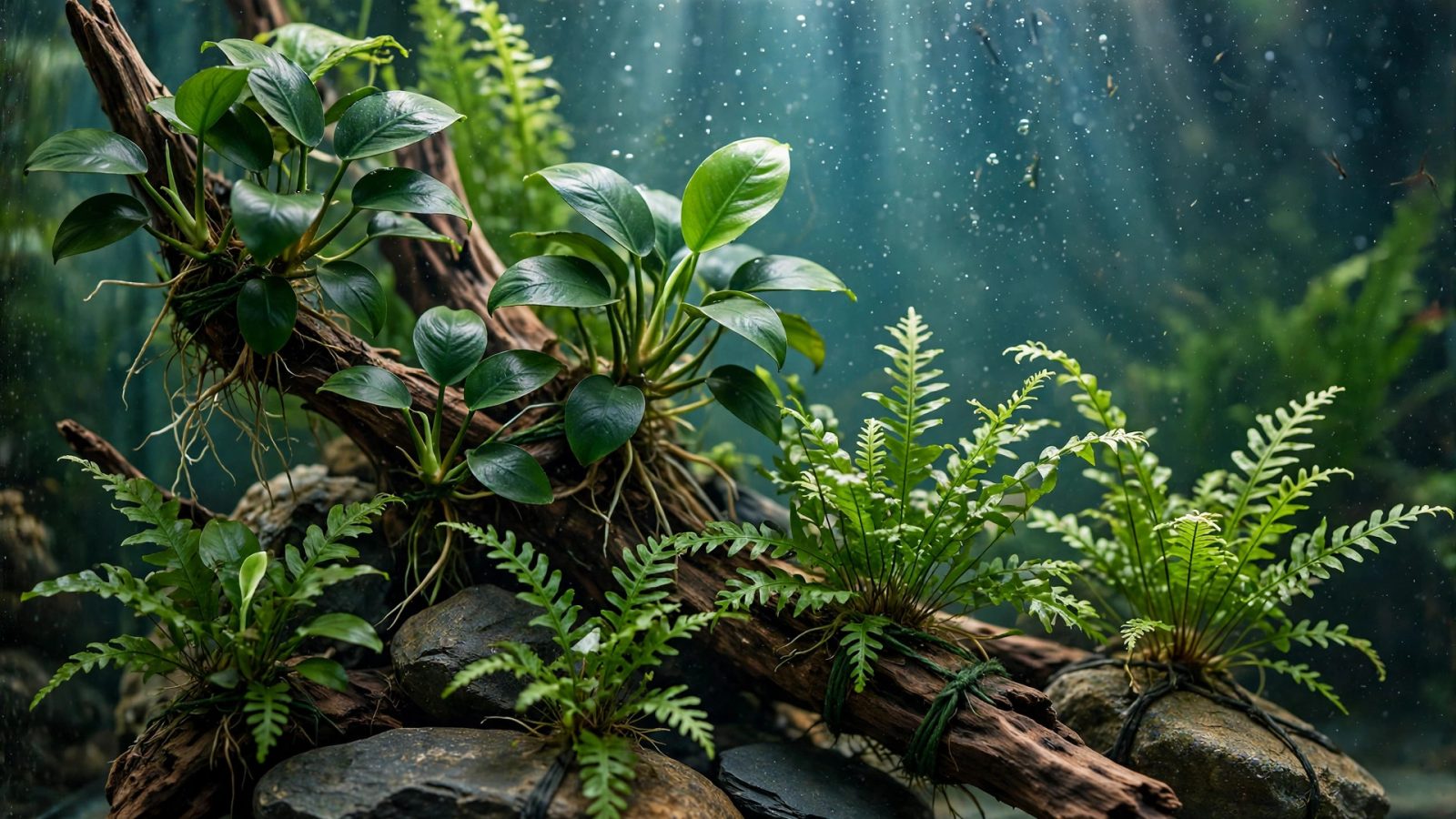
Not every aquarium needs a bed of aquasoil or gravel. Aquarium plants that grow without substrate — epiphytes, mosses, and floaters that pull nutrients straight from the water — let you build a lush planted tank on bare glass, smooth river rock, or a pure hardscape of driftwood and stone. If you’re running a bare-bottom tank for easy cleaning, a quarantine setup, or a minimalist iwagumi-style scape, these are the species that make it work.
The trick is understanding why most plants need substrate and why these don’t. Rooted plants like sword plants and cryptocorynes feed heavily through their roots, so they demand a nutrient-rich bed. Epiphytes evolved differently: in the wild they anchor to rocks, fallen branches, and riverbanks, absorbing everything they need through their leaves and rhizomes. Give them something to hold onto, dose a liquid fertilizer, and they’ll thrive with nothing under them at all.
How to Grow Plants With No Substrate
Before the plant list, three rules that decide success or failure:
- Never bury the rhizome. Epiphytes like anubias and Java fern grow from a thick horizontal stem called a rhizome. Bury it in anything — even sand — and it rots. Keep it fully exposed to the water.
- Attach, don’t plant. Tie plants to driftwood or rock with cotton thread or fishing line, or glue them with cyanoacrylate-based super glue gel (the gel type is aquarium-safe once cured). The thread dissolves or the roots grip within a few weeks.
- Feed the water column. With no substrate, there’s no nutrient reserve. A comprehensive liquid fertilizer dosed weekly replaces what root tabs would do in a planted bed. If you’re already growing aquarium plants without CO2, the same low-tech fertilizing routine applies here.
The 9 Best Aquarium Plants That Grow Without Substrate
1. Anubias barteri var. nana
The undisputed king of substrate-free tanks. Anubias nana’s thick, dark-green leaves are tough enough to shrug off algae and curious fish, and its slow growth means it asks almost nothing of you. Tie a portion to driftwood with the rhizome fully exposed and it will gradually anchor itself with fine roots. It tolerates the dimmest corners of the tank, which is why it tops our list of low-light aquarium plants for beginners too. Watch for yellowing leaves — our guide to anubias leaves turning yellow covers the nine most common causes.
2. Java Fern (Microsorum pterotoides)
Java fern is the classic companion to anubias in hardscape tanks: same epiphyte lifestyle, same tolerance for neglect, but with long, flowing strap-like leaves that add movement and height. It comes in several varieties — standard, ‘Windelov’ with its lacy forked tips, and needle-leaf — all of which attach to wood and rock the same way. Our full Java fern care guide covers lighting, fertilizer, and the plantlets it sprouts on mature leaves (free plants, essentially). Keep it out of intense light or the leaves develop dark spots.
3. Bucephalandra
Bucephalandra — “buce” to hobbyists — is the premium epiphyte. Native to Borneo’s fast-flowing streams where it clings to rocks, it brings small, often iridescent or ruffled leaves in greens, blues, and purples you won’t find in any other easy plant. It grows even slower than anubias, which makes it nearly algae-proof once established but also means a tissue-culture cup looks sparse for months. Attach it to rockwork in the midground; under stable conditions it rewards patience with dense, jewel-like clusters.
4. Bolbitis heudelotii (African Water Fern)
If Java fern is too common for your taste, Bolbitis is its wilder cousin. The African water fern produces translucent, deeply textured dark-green fronds that look spectacular attached to a vertical piece of driftwood. It prefers softer, slightly acidic water and steady conditions — it sulks after big parameter swings — but in a stable tank it’s a trouble-free, substrate-free centerpiece. Give it moderate flow; in nature it grows in currents, and gentle circulation keeps its fronds clean.
5. Java Moss (Taxiphyllum barbieri)
Java moss will grow on practically anything: wood, rock, filter intakes, even the silicone seams of the tank. Press a clump onto hardscape, hold it with thread or a dab of glue, and within weeks it forms a soft green carpet over the surface. It’s the easiest way to age a new hardscape and make it look established. Trim it periodically — the underside dies off if the mat gets too thick — and rinse trimmings out before they clog your filter. Shrimp keepers love it, and it pairs naturally with the species in our shrimp tank plant list.
6. Christmas Moss (Vesicularia montagnei)
Christmas moss earns its name from the tiny triangular fronds that branch like miniature fir trees. It’s neater and more structured than Java moss, making it the better choice for deliberate aquascaping — moss walls, tree canopies on branching driftwood, defined patches on stone. It grows a touch slower and appreciates slightly cooler water, but the sculpted look is worth it. Attach it in thin layers; thick clumps take far longer to anchor.
7. Anubias coffeefolia
A second anubias deserves a spot because coffeefolia looks nothing like nana: its puckered, ribbed leaves catch light beautifully and bring texture contrast to a hardscape. It grows larger — leaves can reach several inches — so it works as a midground anchor where nana would disappear. Same rules apply: rhizome exposed, tied or glued to wood or rock, low to moderate light. It’s slightly less common in shops, so grab it when you see a healthy pot.
8. Subwassertang (Lomariopsis lineata)
Subwassertang is technically a liverwort, not a moss, and it behaves like no other plant on this list. It forms tangled, ribbon-like green masses that can be wedged into rock crevices, draped over wood, or simply left to tumble — it has no roots at all. Shrimp and fry adore hiding in it. It grows slowly and dislikes being smothered by algae, so give it a spot with gentle flow and modest light. A genuinely unusual texture for a substrate-free scape.
9. Marimo Moss Balls (Aegagropila linnaei)
Marimo balls aren’t moss and don’t attach to anything — they’re colonies of algae rolled into spheres by gentle water movement. But they belong on this list because they need zero substrate, zero planting, and almost zero care: drop them on bare glass, roll them occasionally so all sides get light, and rinse them in old tank water during water changes. They’re nearly indestructible, safe with every fish and invertebrate, and oddly charming rolling slowly across a bare-bottom tank.
Fertilizing a Substrate-Free Tank
Without substrate, 100% of nutrition comes from the water column, so a liquid fertilizer isn’t optional — it’s the entire feeding program. Choose a comprehensive all-in-one liquid fertilizer that includes both macros (nitrogen, phosphorus, potassium) and micros (iron, manganese, trace elements). Dose weekly after your water change, following the bottle’s directions for your tank size.
Two mistakes to avoid: first, assuming fish waste is enough. In a heavily stocked tank it contributes, but lightly stocked or shrimp-only tanks run lean, and epiphytes show deficiencies as pale new growth and pinholes. Second, overdosing in a low-plant-mass tank — with slow growers like anubias and buce, excess nutrients mostly feed algae. Start at half dose, watch new growth for two to three weeks, and adjust.
Lighting and Placement Tips
Nearly every plant on this list prefers low to moderate light — another reason they suit bare-bottom and hardscape tanks, which often run simple stock lighting. Keep the photoperiod to 6–8 hours daily on a timer. Because there’s no substrate to hide equipment in, route your heater and filter intake behind hardscape; a bare glass bottom shows everything.
Placement follows one principle: put epiphytes where their rhizomes stay visible and water flows around them. Midground wood and rock are ideal. Mosses go wherever you want softness — foreground rocks, branch tips, filter covers. Floaters like frogbit can join the party too; see our floating aquarium plants guide for species that need no planting at all.
Can You Run a Tank With Zero Substrate Long-Term?
Yes — bare-bottom planted tanks are a proven approach, popular with breeders, shrimp keepers, and aquascapers who want maximum cleanliness. Waste sits visibly on the glass instead of vanishing into gravel, so a quick siphon during water changes keeps the tank spotless. The tradeoff is biological: substrate hosts beneficial bacteria, so a bare-bottom tank leans harder on filter media. Keep your filter well-maintained and don’t overstock, and a substrate-free planted tank runs beautifully for years.
Best Hardscape Pairings for Epiphytes
The hardscape you choose shapes how these plants look. Driftwood — spider wood, manzanita, mopani — is the classic partner: its branches give epiphytes vertical real estate, and Java fern and Bolbitis look most natural flowing from wood. Soak new wood until it sinks and stops leaching heavy tannins (a week or two, with water changes), since floating wood uproots your carefully tied plants.
Seiryu and dragon stone suit bucephalandra and anubias nana ‘petite’ beautifully — wedge rhizomes into crevices where they’ll grip within a month. Smooth river rock works too but gives roots less purchase, so use thread or glue rather than wedging. Lava rock is the unsung hero: cheap, porous, pH-neutral, and its rough surface lets moss and epiphyte roots anchor faster than any other stone.
One caution with stone: test it before committing. Pour white vinegar on the rock — vigorous fizzing means it contains carbonates that will raise your pH and hardness over time. Inert stones (lava rock, dragon stone, slate) are the safe choices for a planted tank where you want parameters stable.
The Weekly Routine: Maintaining a Substrate-Free Tank
Substrate-free tanks are easier to clean than planted-substrate tanks, but they have their own rhythm. Weekly: siphon debris straight off the bare glass — waste can’t hide in gravel, so a quick pass with the siphon during your water change keeps the bottom spotless. Dose liquid fertilizer after the water change, when nutrient levels are lowest. Biweekly: inspect rhizomes and attachment points; epiphyte roots grow over thread and glue, but a plant that’s worked loose should be re-tied before it drifts into the filter intake.
Monthly: trim mosses before the mat gets thick enough to die underneath — thin, frequent trims beat rare buzz-cuts. Roll marimo balls so all sides get light, and rinse them in old tank water. Check hardscape stability: wood shifts as it waterlogs fully over the first months, and a shifting branch can tear a well-anchored anubias loose. A substrate-free tank rewards this light, regular attention with years of trouble-free growth — there’s simply less to go wrong when there’s no substrate chemistry to manage.
Frequently Asked Questions
Do epiphytes need CO2?
Not required. Anubias, Java fern, mosses, and buce all grow well in low-tech tanks without injected CO2 — they’re among the slowest growers in the hobby, so their carbon demand is modest. CO2 speeds them up, but it’s a luxury, not a need.
How long until a tied plant attaches itself?
Typically 3–6 weeks for anubias and Java fern to grip wood or rock with new roots; mosses anchor in 2–4 weeks. Leave the thread in place until you’re sure — cotton thread dissolves on its own, so there’s no harm in waiting.
Can I use super glue on aquarium plants?
Yes. Cyanoacrylate gel (the thick “gel” type, not runny liquid) is aquarium-safe once cured, which takes about a minute. Apply a small dab to dry hardscape, press the rhizome or moss onto it for 30 seconds, and place it back in the tank. Avoid getting glue on leaves.
Will these plants survive in a goldfish tank?
The tough-leaved epiphytes — anubias, Java fern, Bolbitis — are among the few plants goldfish reliably leave alone, which is why they headline our goldfish-proof plant list. Mosses are less safe; goldfish will pick at them.
What if my tap water is very hard?
Most epiphytes adapt to moderately hard water. Anubias, Java fern, and mosses are flexible; bucephalandra and Bolbitis prefer softer water and may grow slowly in liquid rock. If your water is extremely hard, lean on the adaptable species.