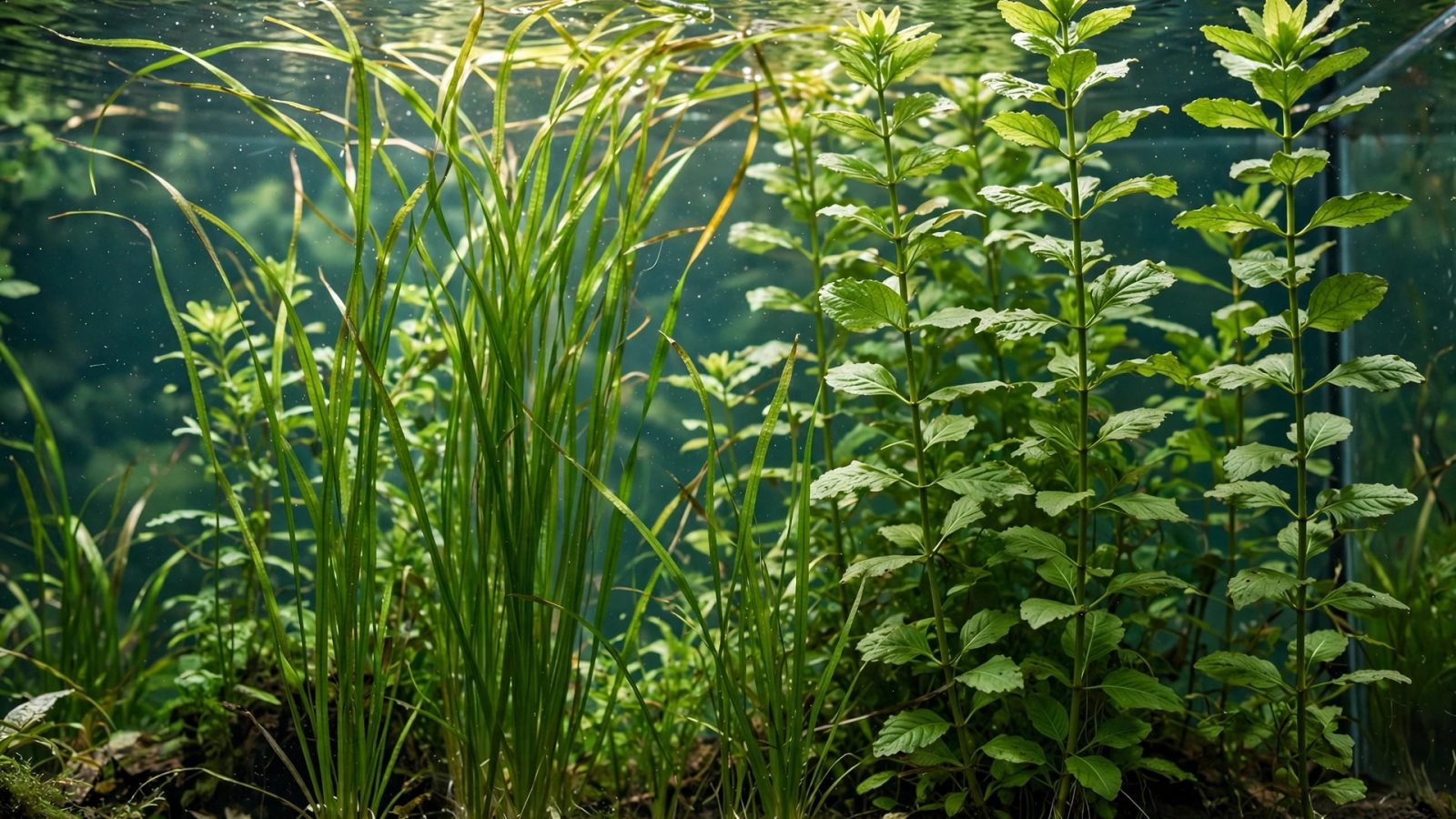
Tall aquariums — 18 inches of height and up — are beautiful and frustrating in equal measure. Standard plant lists assume a long, shallow tank where everything sits within easy reach of the light. In a tall tank, the best background aquarium plants for tall tanks need to do something harder: climb 20-plus inches of water column, stay full from bottom to top, and still look good when the light at the substrate is a fraction of what’s at the surface. The ten plants below are proven height-climbers, chosen because they actually fill vertical space instead of stalling halfway up.
The core challenge of a tall tank is light falloff. Light intensity drops fast with depth — a fixture that delivers strong light at the surface may deliver only moderate light at the substrate of a 24-inch-tall tank. That rules out carpeting species and many stem plants that demand high light throughout. The winners are plants that either tolerate moderate light at their base while their tops reach the brightness above (vallisneria, swords) or grow so fast they outrun the problem (hornwort, water wisteria).
What Makes a Good Tall-Tank Background Plant
- Vertical reach: must comfortably exceed 18 inches; 24+ is better for truly tall tanks.
- Fullness along the stem: plants that drop their lower leaves in shade (many rotalas) leave an ugly bare stalk — exactly what you don’t want as a backdrop.
- Moderate light tolerance at the base: the bottom of the plant lives in the dimmest zone of the tank.
- Manageable spread: aggressive runners can take over; pick spreaders you can thin, not ones that wage war.
The 10 Best Background Plants for Tall Aquariums
1. Vallisneria americana (Jungle Val)
The quintessential tall-tank plant. Jungle val sends up broad, ribbon-like leaves that easily reach 3 feet, arching gracefully at the surface. It spreads by runners, forming a dense green curtain along the back glass — the single fastest way to make a tall tank look finished. It tolerates a wide range of water conditions and moderate light, feeding happily through root tabs in the substrate. Thin the runners every few months or they’ll colonize the entire back half of the tank. For narrower tanks, Vallisneria spiralis offers the same look in a slimmer leaf.
2. Amazon Sword (Echinodorus amazonicus)
When you want one bold specimen instead of a curtain, the Amazon sword delivers. Its broad, arching leaves can span 20 inches tall and a foot wide, creating a dramatic focal anchor in the back corner of a tall tank. It’s a heavy root feeder — give it rich substrate or several root tabs and it rewards you with explosive growth. Older leaves eventually yellow; trim them at the base to keep the rosette tight. Swords pair beautifully with the hardscape-anchored epiphytes in our substrate-free plant guide for a layered look.
3. Giant Hygrophila (Hygrophila corymbosa)
Don’t let the name intimidate you — “giant” here means gloriously tall, not tank-busting. Hygrophila corymbosa grows sturdy upright stems past 24 inches with broad, bright-green leaves that stay attached all the way down, unlike fussier stem plants. It’s forgiving of moderate light and inconsistent fertilizing, making it one of the most reliable tall background plants for beginners. Trim the tops and replant them to thicken the stand; the cut stems branch into bushier growth.
4. Water Wisteria (Hygrophila difformis)
Water wisteria is the fast-growing problem-solver of the tall tank. Its lacy, deeply divided leaves grow inches per week under decent light, quickly filling the upper water column where other plants stall. That speed makes it excellent for new setups — it outcompetes algae while the tank matures, the same role fast-growing plants play in new tanks. The catch: it needs regular trimming or it shades everything below. Treat it as a living, adjustable backdrop.
5. Hornwort (Ceratophyllum demersum)
Hornwort doesn’t root at all — it can be floated or weighted down — yet it’s one of the best tall-tank background plants because it simply grows until it runs out of water column. Bunches anchored at the back reach the surface in weeks, forming a feathery green wall. It’s a nutrient sponge that starves algae, tolerates cold water (see our cold-water plant picks), and costs almost nothing. The tradeoff is messiness: it sheds needles when conditions change, so give it stable parameters and gentle handling.
6. Aponogeton crispus
Aponogetons are the tall tank’s secret weapon. A. crispus grows from a bulb-like rhizome, sending up ruffled, translucent leaves that can exceed 2 feet — and it does it fast, often outpacing everything else in the tank. It goes through a natural rest period where growth pauses for a few weeks; don’t panic and don’t throw it away. Give it root tabs, moderate light, and room — a single specimen can dominate a back corner beautifully.
7. Tiger Lotus (Nymphaea zenkeri)
For color at height, nothing beats the red tiger lotus. Its spotted red-bronze leaves start low but send lily pads shooting to the surface on long stems — in a tall tank, those ascending stems become a striking vertical feature. Let a few pads reach the surface for the full effect, but trim most of them to keep the plant producing submerged leaves instead of going full lily. It feeds heavily through its bulb, so place root tabs nearby. One of the few genuinely red plants that doesn’t demand CO2 — more options in our red aquarium plants for beginners guide.
8. Cabomba (Cabomba caroliniana)
Cabomba’s fine, fan-like foliage creates the softest, most delicate backdrop of any plant on this list — a feathery green haze that contrasts beautifully with broad-leafed neighbors. It grows fast and tall, but it’s honest about its needs: cabomba wants decent light and dislikes being shaded, so plant it where it won’t be crowded. In softer, slightly acidic water it thrives; in very hard water it can struggle. Handle gently — the delicate stems bruise easily during planting.
9. Rotala rotundifolia
The one true stem plant on this list earns its place by being the toughest of its kind. Rotala rotundifolia grows upright to 20+ inches, and unlike many stem plants it keeps respectable lower foliage in moderate light. Under stronger light the tops blush pink-red, giving you a gradient backdrop — green at the base, warm color at the surface. Trim and replant the tops regularly; each cutting roots easily and the mother stem branches, so one bunch becomes a dense stand within a couple of months.
10. Crinum calamistratum
The conversation piece. Crinum calamistratum grows from a bulb, producing extraordinarily long, dark-green, crinkled leaves that can reach 3–4 feet — they snake up through the water column and trail across the surface like sea serpents. It’s slow to establish (bulbs sulk for weeks after planting) but nearly indestructible once settled, tolerating the moderate light at the bottom of tall tanks. Plant the bulb with its neck exposed, give it root tabs, and then leave it alone — it hates being moved.
Arranging the Background in a Tall Tank
Plant background species in a gentle arc or staggered clusters rather than a flat wall — depth comes from variation. Put the tallest growers (vals, crinum) at the very back corners, medium-height plants (swords, hygro) slightly forward, and leave the center back a touch lower so the eye travels. Because tall tanks are often viewed from the front only, you can plant densely without worrying about the rear view.
Don’t neglect the midground: a tall tank with a towering background and bare middle looks empty. Transition with medium-height plants from our midground plant guide — anubias on wood, compact swords, or bucephalandra on rock — to bridge the gap between substrate and canopy.
Lighting a Tall Tank for Plants
Depth is the enemy of light. For tanks 24 inches or taller, choose a fixture rated for the depth, not just the tank length — look for lights with good PAR at 24 inches, or run two moderate fixtures instead of one strong one. Raise the photoperiod gradually: start at 6 hours daily and add 30 minutes per week until you reach 8, watching for algae. Floating plants can help by diffusing intense surface light; our floating plants guide covers species that won’t completely block the light below.
Frequently Asked Questions
How many background plants do I need for a tall tank?
For a 55-gallon tall (48×13×21 inches), plan on 6–10 bunches or pots along the back. Tall tanks need more plant mass than you’d expect because vertical space eats volume — buy generously and thin later.
Why are my tall plants losing their lower leaves?
Usually insufficient light reaching the bottom, or a stem-plant species that naturally sheds shaded leaves. Switch to the shade-tolerant species on this list (vals, swords, hygro) and consider a stronger light or longer photoperiod.
Can I use these plants in a regular (non-tall) tank?
Absolutely — they’ll just need more frequent trimming. Jungle val and water wisteria in a standard 20-gallon will reach the surface fast; treat them as fast background fillers and trim weekly.
Do tall background plants need CO2?
None of the ten require it. They’ll grow faster with CO2, but every species here is proven in low-tech setups. If you’re running low-tech, see how to grow aquarium plants without CO2 for the full method.
Feeding Tall Background Plants: Roots Matter More Here
Most of the heavyweight background plants — swords, vals, aponogetons, crinum, tiger lotus — are root feeders first and water-column feeders second. In a tall tank this matters doubly, because you’re asking for maximum vertical growth and that takes serious nutrition. A nutrient-rich substrate like aquasoil gives you a head start, but plain gravel or sand works fine if you commit to root tabs.
Place root tabs in a grid pattern along the back of the tank, roughly one tab every 4–6 inches, pushed deep near (not under) the plant crowns. Replace them every 2–3 months — set a phone reminder, because exhausted tabs are the #1 reason established background plants mysteriously stall. Supplement with a liquid all-in-one fertilizer for the stem plants and water-column feeders in the mix. If your substrate is inert gravel, our gravel plant guide covers the root-tab method in detail.
One more tall-tank feeding trick: don’t cap aquasoil too deeply at the back. A gentle rearward slope — 1 inch in front rising to 3 inches at the back glass — gives background roots more substrate volume exactly where they need it, while also creating forced perspective that makes the tank look deeper. Just keep the slope stable with rocks at the base so it doesn’t avalanche forward over months.
Tall Tank Stocking Note: Plants and Fish Balance
Tall tanks are often chosen for angelfish, discus, or gouramis — fish that use vertical space. These fish appreciate the same dense background planting: tall vals and swords break sight lines, reduce stress, and give shy fish retreats. But big fish also mean big waste, which means more nutrients for algae. The solution is plant mass — a tall tank with angelfish should have its background fully planted from day one, not sparsely dotted. Fast growers like water wisteria and hornwort earn their keep here, absorbing the excess before algae can.
Avoid the common mistake of planting tall tanks like long tanks: a single row of background plants along the back glass of a 24-inch-tall tank leaves a vast empty midwater. Layer in midground height — tall driftwood with anubias or Java fern attached, rock piles with buce — to occupy the middle third. The background plants are the curtain; you still need furniture in front of it.