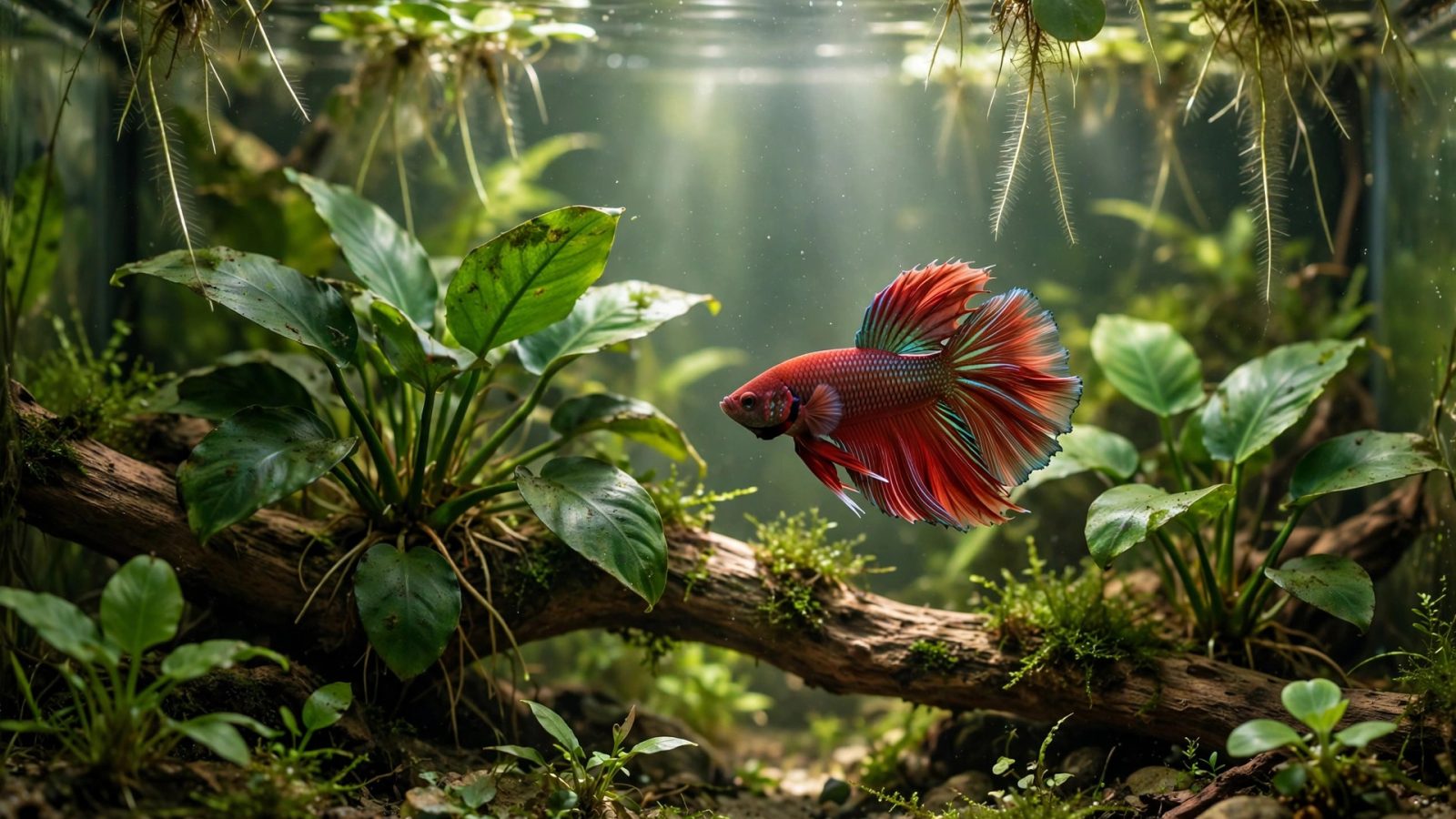
A betta in a bare bowl is surviving. A betta in a planted tank is living — patrolling shaded lanes between leaves, resting on a broad anubias leaf near the surface, weaving through floating roots, and building bubble nests under a frogbit canopy. This planted betta tank setup guide walks you through the complete beginner build: the right tank size, heater, filter, substrate, plants, and the planting order that gets you a thriving ecosystem instead of an algae farm.
Everything here is chosen for one reader: a beginner setting up their first (or first proper) betta tank. No CO2 injection, no expensive controllers, no aquascaping contest ambitions — just a healthy, beautiful tank your betta will genuinely enjoy. If you want the ultra-simple equipment-light version, see our low-tech planted tank setup; if you want to understand the natural-method philosophy behind soil-based builds, read the Walstad method explained.
Why Planted Beats Bare for Bettas
Wild bettas inhabit shallow, vegetation-choked waters — rice paddies, marshes, floodplains. Plants aren’t decoration to them; they’re habitat. In a planted tank you get:
- Lower stress. Broken sightlines and overhead shade make bettas feel secure. Secure bettas show better color, eat more confidently, and flare less at phantom threats.
- Better water quality. Plants consume ammonia, nitrite, and nitrate directly. In a well-planted 5-gallon, nitrate climbs far slower than in a bare tank.
- Natural behavior. Bubble-nest building, leaf-resting, root-weaving — these behaviors mostly appear when the environment invites them.
- Oxygen and surface habitat. Floating plants in particular create the shaded surface zone bettas evolved to live under. Our floating plants for betta tanks guide covers the seven best species.
Equipment List: Everything You Need
Tank: 5 Gallons Minimum
Five gallons is the practical minimum for a heated, filtered, planted betta tank. It holds temperature stable, dilutes waste, and gives plants room to grow without constant pruning. Ten gallons is even better if you have the space — everything gets easier with volume. Avoid bowls and anything under 5 gallons: temperature swings wildly, waste concentrates fast, and there’s no room for both a heater and plants.
A standard rectangular 5.5-gallon or a 10-gallon gives the best footprint for planting. Cube-style tanks look sleek but offer less horizontal swimming room, which bettas use more than vertical space.
Heater: Adjustable, 25–50 Watts
Bettas need 76–80°F (24–27°C) consistently. Room temperature isn’t enough in most homes — overnight drops into the low 70s stress bettas and suppress their immune systems. Buy an adjustable heater (25W for 5 gallons, 50W for 10), not a preset one; presets drift and can’t be calibrated. Place it near the filter outflow for even heat distribution, and add a cheap stick-on thermometer at the opposite end to verify.
Filter: Gentle Sponge Filter or Baffled HOB
Bettas come from near-still water and struggle in strong current. A sponge filter driven by a small air pump is the classic betta choice: gentle flow, excellent biological filtration, no intake to trap fins, and the bubbling provides surface agitation. For a 5-gallon, a single nano sponge filter suffices; for 10 gallons, use a larger one or two nanos.
A hang-on-back (HOB) filter also works if you baffle the outflow — a sponge block over the lip or a commercial baffle cuts current dramatically. Whatever you choose, the goal is visible but lazy water movement: plants swaying gently, not flattened.
Light: A Basic Full-Spectrum LED
You don’t need a high-end fixture. Any full-spectrum LED rated for planted tanks in the low-to-medium range works — the kind bundled with most 5- and 10-gallon kits is fine for the plants on our list. Run it 6–8 hours daily on a plug-in timer. Consistency matters more than intensity; erratic photoperiods grow algae, not plants. For the full lighting picture, see our no-CO2 plant growing guide.
Substrate: Inert Gravel or Sand + Root Tabs
For a first planted betta tank, keep it simple: 1–2 inches of inert gravel or pool-filter sand, supplemented with root tabs under heavy root feeders (swords, crypts). Inert substrates don’t alter water chemistry, which keeps parameters predictable — one less variable for a beginner. If the soil-based approach appeals to you later, our dirted tank setup guide walks through it step by step.
Choosing Plants: The Beginner Betta Palette
Pick plants that tolerate low-to-medium light, don’t need CO2, and suit a betta’s habitat. This palette covers every layer of the tank:
Background (tall, fills the rear)
- Water sprite — fast, feathery, doubles as a floating plant. Absorbs nutrients aggressively.
- Anacharis (Egeria densa) — nearly indestructible stem plant; grows in almost any conditions.
- Amazon sword (Echinodorus amazonicus) — broad leaves bettas rest on; needs root tabs; can outgrow a 5-gallon, so consider the dwarf ‘parviflorus’ variety.
Midground (the visual anchor zone)
- Anubias nana / barteri — attach to wood or rock, never bury the rhizome. Tough leaves withstand curious bettas.
- Java fern — same epiphyte rules as anubias; our Java fern care guide covers it in depth.
- Cryptocoryne wendtii — plant in the substrate; expect “crypt melt” in week one (it regrows).
Foreground (low carpet accents)
- Dwarf sagittaria — grass-like, spreads by runners, tolerates low light.
- Staurogyne repens — compact and bushy; trim tops to encourage spreading.
- Moss (Java or Christmas moss) — tie to hardscape; creates soft, natural texture.
Floating (the betta layer)
- Amazon frogbit — the classic; broad leaves for bubble nests.
- Salvinia minima — fine-textured, explosive growth, unbeatable nitrate uptake.
All of these appear on our best low-light plants for beginners list — they’re chosen specifically because they thrive under stock lighting without CO2.
Hardscape: Wood and Rock (Optional but Recommended)
A single piece of driftwood or a few smooth stones transforms a planted tank from “plants in gravel” to a natural scene — and gives epiphytes (anubias, java fern, moss) somewhere to attach. Choose aquarium-safe driftwood (spider wood, mopani, manzanita) and inert rock (dragon stone, seiryu stone will raise pH slightly — fine for bettas, but know it).
Boil or soak driftwood before adding it; new wood leaches tannins that tint water tea-colored. Tannins are harmless — even beneficial, mimicking betta blackwater habitat — but the tint surprises beginners. Soaking for a week with daily water changes removes most of it.
Step-by-Step Build
Step 1: Position and Rinse
Place the empty tank in its final spot — a full 5-gallon weighs over 50 pounds; you won’t move it later. Rinse substrate thoroughly until the water runs mostly clear, then add 1–2 inches, sloping slightly higher at the back for depth.
Step 2: Hardscape First
Arrange wood and rock before planting. Step back and look from the front — this is your last easy chance to adjust. Press root tabs into the substrate where heavy root feeders (swords, crypts) will go.
Step 3: Plant Before Filling (the Dry Start Advantage)
Planting in a nearly-empty tank is dramatically easier than planting underwater. Add just enough water to dampen the substrate, then plant:
- Stem plants and rosettes go into the substrate with tweezers, deep enough to stay anchored.
- Epiphytes (anubias, java fern) get tied or glued to wood/rock with cyanoacrylate gel super glue — it’s aquarium-safe once cured.
- Moss gets tied with thread or glued in thin patches.
Mist everything with a spray bottle as you work so leaves don’t dry out.
Step 4: Fill Slowly
Fill by pouring water over a plate or plastic bag on the substrate — this prevents cratering your carefully arranged gravel. Fill to about 80%, leaving room for displacement and the lid. Dechlorinate: use a water conditioner that neutralizes chlorine and chloramine.
Step 5: Install Equipment
Heater, filter, thermometer, light. Set the heater to 78°F and confirm with the thermometer after a few hours — heater dials are often off by a degree or two. Start the filter and baffle as needed. Float your floating plants on top.
Step 6: Cycle Before Adding the Betta
This is the step beginners skip and regret. A new tank has no beneficial bacteria, so ammonia from fish waste spikes to toxic levels within days. Cycle the tank first — plants help enormously here (they consume ammonia directly), but they don’t replace the cycle. Our guide to cycling a planted tank faster covers the silent-cycle method, which uses heavy planting to make the process quicker and safer. Expect 2–4 weeks; test with a liquid test kit (ammonia and nitrite at zero, some nitrate present = cycled).
Step 7: Add Your Betta
Float the bag or cup for 15–20 minutes to equalize temperature, then net the betta in — don’t dump store water into your tank. Dim the lights for the first few hours. Don’t be alarmed if he hides for a day; exploration follows.
Stocking: Tankmates (Proceed Carefully)
A 5-gallon is a species tank — just the betta. In a 10-gallon planted tank, careful tankmates work: a small school of ember tetras or chili rasboras (see our schooling fish for planted tanks), plus a nerite snail or a few cherry shrimp. Dense planting is non-negotiable with tankmates — it breaks sightlines and gives everyone escape routes. Add tankmates before the betta when possible so he doesn’t treat the whole tank as established territory.
Maintenance Routine
- Weekly 25–30% water change. Gravel-vacuum open areas lightly; don’t disturb planted zones deeply.
- Thin floaters weekly. Scoop excess — this is nutrient export.
- Trim stems as needed. Replant the tops; discard or share the bottoms.
- Root tabs every 2–3 months under swords and crypts.
- Liquid fertilizer: half-dose weekly if growth stalls or leaves pale — fish waste covers most needs in a stocked betta tank.
- Test water monthly once stable (or anytime something looks off). Our planted tank water parameters guide lists target ranges.
Common Beginner Mistakes
Adding the betta on day one. The single biggest killer of beginner bettas. Cycle first — every time.
Burying anubias/java fern rhizomes. The thick horizontal stem must stay exposed or it rots. Tie or glue to hardscape.
Too much light, too long. Ten hours of bright light on a new tank grows algae, not plants. Start at 6 hours; increase only if plants show they want more.
Plastic plants with sharp edges. If you supplement with artificial plants, run pantyhose over them — if it snags, it’ll tear betta fins. Silk is safer than plastic.
100% water changes. Never. Large sudden changes shock fish and reset your bacteria. Stick to 25–30% weekly.
Frequently Asked Questions
Can I do a planted betta tank without a filter? Heavily planted bowls and vases exist (the Walstad approach), but for beginners a filter adds critical stability margin. Learn the rules with a filter before experimenting without one.
How many plants do I need? More than you think. Aim for roughly 70% visual coverage at planting — the “sparse and hopeful” look invites algae. Our planting density guide gives the rule of thumb.
My betta flares at the plants. Is that bad? Occasional flaring at a new object is normal curiosity. Constant flaring at one spot suggests a reflection or something resembling another betta — rearrange that area.
Do I need CO2? No. Every plant on our list thrives without injected CO2. CO2 is an upgrade path for later, covered in our high-tech setup guide.
The Bottom Line
A planted betta tank isn’t harder than a bare one — it’s more forgiving. Plants buffer water quality, reduce stress, and turn maintenance into gardening instead of chemistry. Start with 5+ gallons, heat to 78°F, filter gently, light 6–8 hours, plant heavily from day one, and cycle before adding your fish. Do that, and you’ll wonder why anyone keeps bettas any other way.
Aquascaping Your Betta Tank: Layout Principles
A planted betta tank should look intentional, not just “plants in gravel.” Three layout principles from aquascaping translate directly:
- Rule of thirds. Place your focal point (best wood piece, largest anubias) at an intersection of imaginary thirds lines — not dead center. Centered focal points look static; off-center looks natural.
- Triangle composition. Arrange hardscape and tall plants in a rough triangle — high on one side, sloping to low on the other. This creates the sense of depth that makes small tanks look bigger.
- Layer by height. Tall background, medium midground, low foreground — the classic three bands. In a 5-gallon, these bands might be 3 inches deep each; that’s fine, the principle scales.
Betta-specific consideration: leave open swimming lanes. Bettas patrol; a tank packed wall-to-wall with no open water frustrates them. The 70/30 planted-to-open ratio from our density guide applies — dense, but with breathing room.
Lighting Details: Getting It Right
The kit LED on most 5-gallon tanks is low-intensity — perfect for our plant list. If you upgrade the light, stay in the low-medium range; a betta tank doesn’t need (or want) high light. Warning signs of too much light: algae within two weeks, plants growing leggy toward the light rather than bushy, and your betta hiding constantly — bright overhead light without shade stresses them.
Use a timer religiously. Bettas, like plants, thrive on routine — consistent photoperiods regulate their activity cycles. Random on/off schedules stress fish measurably.
Feeding in a Planted Tank
Plant cover changes feeding dynamics: food drifts into plants where the betta can’t find it, then rots. Solutions: feed in the open lane (use a feeding ring if you have floaters), feed small amounts twice daily rather than one big feeding, and remove uneaten food after 3 minutes with a turkey baster. A planted tank’s ecosystem handles minor overfeeding better than a bare tank, but don’t test it.
Seasonal and Long-Term Care
Summer: Room temperatures above 82°F stress bettas and accelerate everything (metabolism, algae, plant growth). If your tank creeps past 80°F, reduce the photoperiod an hour and increase surface agitation slightly for oxygen.
Plant refresh (every 6–12 months): Stem plants get leggy; crypts outgrow their spots; anubias rhizomes get long. An annual “renovation” — trimming hard, replanting tops, dividing overgrown rosettes — rejuvenates the scape. Do it in stages (half the tank at a time) to avoid destabilizing the ecosystem.
Equipment replacement: Heaters fail — usually stuck ON (cooking the tank) or OFF. Replace heaters every 2–3 years proactively; it’s the cheapest insurance in the hobby. Sponge filters last indefinitely; rinse, don’t replace.
Upgrading Later: What’s Worth It
Once your planted betta tank is thriving, tempting upgrades include:
- Better light — only if you want red plants or faster growth; otherwise unnecessary.
- Aquasoil substrate — richer growth, but requires a full teardown to install. Worth it on the next tank, rarely worth rebuilding for.
- Liquid carbon supplements — skip these with bettas; glutaraldehyde-based products can irritate labyrinth breathers at high doses, and the benefit is marginal.
- A second tank — the most common “upgrade.” Planted betta keeping is a gateway; embrace it.
Choosing Your Betta
The fish matters as much as the tank. Healthy bettas at the store: active and responsive, fins held open (not clamped), clear eyes, no white spots or fuzzy patches, and interest in food. Avoid bettas lying on the bottom, gasping, or with pineconed scales. Males display more dramatically; females suit community setups better. Either sex thrives in a planted tank — the environment, not the sex, determines quality of life.
Plakat vs. long-fin: Short-finned plakats swim more actively and handle gentle filter flow better; long-finned halfmoons and rosetails are more ornamental but weaker swimmers — keep flow minimal and avoid tall tanks where they struggle to surface. In a planted tank with resting leaves near the surface, long-fins do beautifully.
Tank Placement
- Stable surface: A full 5-gallon weighs 50+ lbs; 10 gallons 100+. Use a dedicated stand or solid furniture — not a wobbly desk.
- Away from windows: Direct sunlight causes temperature swings and algae explosions. Indirect room light is fine.
- Near water access: You’ll do weekly water changes; a nearby sink or easy bucket route matters more than you’d think.
- Low traffic: Bettas startle at sudden movement. A quiet corner beats a hallway.
- Power access: Heater, filter, light — plan for 3 outlets plus the timer.
The First Week With Your Betta
Day one: dim lights, no feeding. Days two to three: small feedings, let him explore — he’ll map every leaf and cave. By week one, expect patrolling behavior, interest in you (bettas recognize their keepers), and possibly bubble-nest attempts under floaters. If he’s still hiding after five days, check temperature first (cold bettas hide), then flow (exhausted bettas hide), then water parameters. A healthy betta in a proper planted tank is visible — that’s rather the reward.
Betta Tank Myths Debunked
“Bettas like small spaces.” Wild bettas patrol territories of several square feet. They tolerate small containers; they thrive in larger planted tanks with room to patrol, explore, and claim territory. The myth persists because bettas survive neglect better than most fish — survival isn’t preference.
“Plants replace water changes.” Plants reduce nitrate accumulation dramatically, but they don’t remove hormones, dissolved organics, or replenish minerals. Weekly water changes stay mandatory — just more forgiving if you’re a day late.
“Bettas don’t need a filter with plants.” The Walstad-style filterless betta tank exists and can work — but it’s an expert technique requiring deep understanding of the ecosystem. Beginners should filter. Learn to walk the ecological high wire after you’ve walked on the ground.
“Any light works.” A desk lamp or window light grows algae reliably and plants poorly. Plants need appropriate spectrum and consistent duration — a $20 LED on a timer outperforms a $200 fixture run randomly.
When Things Go Wrong: Emergency Playbook
- Betta lethargic, clamped fins: Check temperature first (below 74°F = heater problem), then ammonia. These two cause 90% of betta illness.
- Sudden algae bloom: Cut light to 6 hours, 30% water change, manual removal. Don’t add chemicals — find the imbalance (usually light + nutrients).
- Plants melting en masse: Parameter shock — test pH, temperature, and confirm dechlorinator use. Single-species melt is adaptation; everything-at-once is environmental.
- Filter stopped: Rinse media in tank water (never tap — chlorine kills bacteria), check the impeller for debris. Keep a spare sponge filter; they’re $8 insurance.
Recommended Reading Order
New to planted bettas? Read in this order: this setup guide first, then floating plants for betta tanks (choose your canopy), then cycling a planted tank (before adding fish), then planting density (buy the right amount). That sequence takes you from empty glass to stocked tank with zero guesswork.