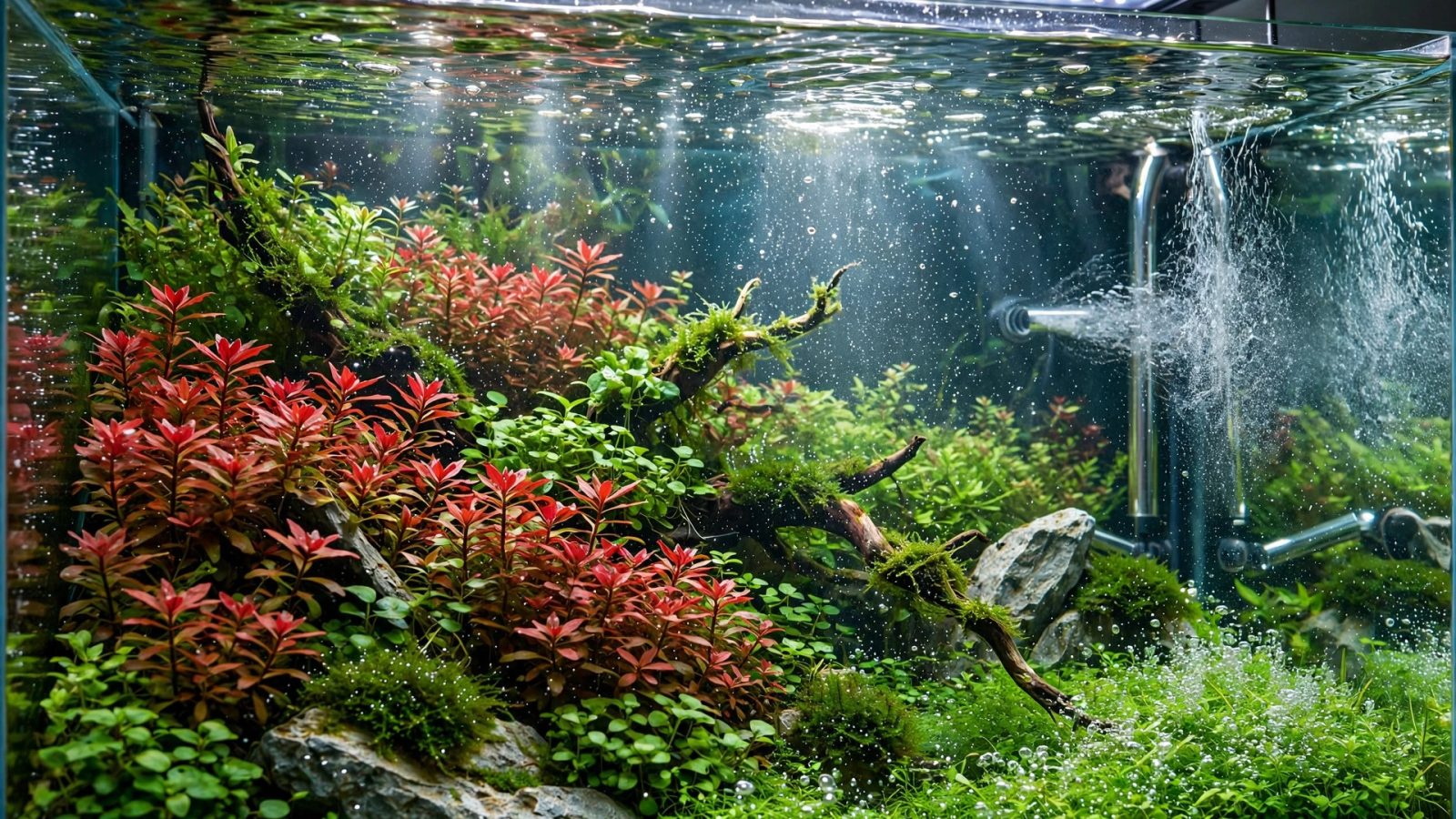
There’s a moment in every planted-tank hobbyist’s life: you see a tank with a lawn-green carpet, blood-red stems, and pearling plants streaming oxygen bubbles — and you learn it runs on pressurized CO2. High-tech planted tanks unlock the hobby’s full palette: demanding carpets, intense reds, and growth rates that turn aquascaping into a fast-moving art form. The price is complexity, cost, and a maintenance rhythm that punishes neglect.
This guide is the upgrade path. It assumes you’ve mastered the basics (if not, start with our low-tech setup guide) and covers what changes when CO2 enters the picture: equipment, the light-CO2-nutrient balance, dosing methods, and the discipline high-tech demands.
What “High-Tech” Actually Means
Technically: pressurized CO2 injection plus the strong light and rich fertilization needed to match it. The three are inseparable — that’s the central law of high-tech:
Light drives demand; CO2 and nutrients must meet it. Strong light makes plants photosynthesize fast. Fast photosynthesis needs abundant CO2 and nutrients. If light outruns supply, plants stall and algae — which needs far less CO2 than higher plants — takes over. Every high-tech failure is some version of this imbalance.
This is why CO2 is the first upgrade, not the last. Adding strong light without CO2 is the classic beginner trap: it doesn’t grow plants faster, it grows algae faster.
CO2 Equipment: What You Need
The Cylinder
A 5 lb (2.5 kg) aluminum CO2 cylinder suits most tanks up to 40 gallons for 3–6 months per fill. Paintball canisters work for nano tanks but need frequent refills — false economy above 10 gallons. Source refills from welding supply shops, fire extinguisher services, or homebrew stores (food-grade isn’t necessary; industrial CO2 is fine).
Regulator with Solenoid
The regulator drops cylinder pressure to working pressure; the solenoid (an electric valve) shuts CO2 off at night via timer. This is non-negotiable: plants don’t use CO2 in the dark, and nighttime injection can asphyxiate fish. Dual-stage regulators resist “end-of-tank dump” (a pressure spike as the cylinder empties); single-stage works if you watch the gauge.
Diffusion: Reactor vs. Diffuser
- Ceramic/glass diffusers create fine bubbles inside the tank. Cheap, visible, slightly less efficient — fine for tanks under 30 gallons.
- Inline reactors dissolve CO2 in the filter outflow tubing. Near-100% efficiency, invisible in the tank, better for larger setups.
- Atomizers produce ultra-fine mist. Efficient but clog and need cleaning.
Monitoring: Drop Checker
A glass bulb with pH indicator solution that sits in the tank: blue = too little CO2, green = ~30 ppm (target), yellow = too much. It’s slow (2-hour lag) but it’s the hobby standard sanity check. Combine with observing livestock — gasping at the surface means back off immediately.
Light: Strong, Controlled
High-tech needs genuinely strong light — but controlled strong light. A dimmable full-spectrum LED fixture is worth every penny: start at 60–70% intensity for the first month, increase only as plant mass grows. Photoperiod stays 6–8 hours; longer doesn’t help and grows algae. The ramp-up discipline matters more than the fixture brand.
Fertilization: EI Dosing Explained
High-tech tanks consume nutrients fast enough that lean dosing starves plants. The standard method is Estimative Index (EI): dose nutrients in slight excess, then reset with a 50% weekly water change. The philosophy: it’s easier to guarantee abundance and reset weekly than to perfectly match uptake.
The basic EI weekly schedule (for a ~20-gallon tank; scale proportionally):
- Macros (NPK) — potassium nitrate, monopotassium phosphate, potassium sulfate — dosed 3x weekly on alternating days.
- Micros — chelated iron + trace mix — dosed 3x weekly on the other days (separate from macros to avoid precipitation).
- Rest day — then 50% water change, which prevents accumulation.
Pre-mixed EI kits remove the chemistry homework. Dry salts are cheapest long-term. Either way, the discipline is the schedule — high-tech tanks punish skipped doses with stalled plants and algae openings.
Substrate for High-Tech
Nutrient-rich aquasoil (ADA Amazonia, UNS Controsoil, Fluval Stratum class) is the high-tech standard: it buffers pH down slightly, supplies ammonia initially (jumpstarting the cycle), and feeds roots for a year-plus. Cap isn’t needed. Budget 1–2 inches. Note: aquasoils leach ammonia for 2–4 weeks — cycle accordingly, and don’t stock until it clears. Our cycling guide covers managing this phase.
What High-Tech Unlocks (Plant Palette)
- Carpets: HC Cuba, Glossostigma, Monte Carlo — the lawn-green foregrounds that define contest tanks.
- Reds: Ludwigia ‘Super Red’, Rotala ‘Blood Red’, Alternanthera reineckii — intense coloration that needs strong light + CO2 + iron.
- Demanding stems: Rotala wallichii, Ammania gracilis, Pogostemon erectus — fast, bushy, spectacular with trimming.
- Everything low-tech grows — just 2–4x faster, denser, and more colorful.
The High-Tech Routine
- Daily: CO2 on 1–2 hours before lights, off 1 hour before lights-out (solenoid timer handles this). Glance at the drop checker — green by mid-photoperiod.
- 3x weekly: Alternate macro/micro dosing.
- Weekly: 50% water change (EI reset), glass cleaning, stem trimming and replanting, filter maintenance check.
- Ongoing: Watch livestock behavior at CO2 adjustments; increase light intensity gradually as plant mass fills in.
This is a real weekly commitment — 1–2 hours. High-tech tanks are gardens, and gardens need gardeners.
Troubleshooting
Algae despite CO2: The #1 cause is unstable CO2 — fluctuating levels stress plants and invite algae more than low-but-stable CO2. Check for: solenoid timing, cylinder running empty, diffuser clogged, surface agitation driving CO2 off (some agitation is fine; a waterfall isn’t).
Plants “pearling” but not growing: Pearling (oxygen bubbles) means photosynthesis is active, not that growth is good. If mass isn’t increasing, nutrients are likely limiting — review dosing.
Fish gasping: Too much CO2 or too little oxygen. Increase surface agitation, reduce bubble rate, ensure CO2 is off at night. Livestock safety always outranks plant growth.
Stunted tips / twisted new growth: Classic CO2 deficiency signature in stems, even with injection — usually poor distribution. Improve flow so CO2-rich water reaches all areas.
Costs: Honest Numbers
Expect roughly: cylinder + regulator + solenoid ($150–250), diffuser/reactor ($20–60), drop checker ($15), strong light ($80–200), aquasoil ($30–60), EI ferts ($20–40/year), CO2 refills ($15–30 each, 2–4x yearly). First-year total often lands $400–700 beyond the basic tank. It’s a genuine investment — which is why mastering low-tech first is the smart sequence.
Frequently Asked Questions
Can I run CO2 without strong light? You can, but it’s wasted — low light doesn’t create the photosynthetic demand that justifies CO2. Match all three or stay low-tech.
Is CO2 dangerous for fish? At proper levels (drop checker green, ~30 ppm) it’s safe. The danger is equipment failure or careless adjustment — always change bubble rates gradually and watch livestock.
DIY CO2 (yeast/sugar) instead? Works for nano tanks as an experiment, but output fluctuates as the mixture ages — and fluctuation is the enemy. Pressurized is the only stable option for tanks that matter to you.
Can I convert my low-tech tank to high-tech? Yes — it’s the natural progression. Add CO2 first, increase light second, start EI third, over 3–4 weeks. Don’t change everything on day one; the tank needs to adapt.
The Bottom Line
High-tech is the hobby’s deep end: pressurized CO2, strong dimmable light, EI dosing, rich substrate, and a weekly discipline that keeps the triangle balanced. The reward is the full plant palette at 3x speed — carpets, reds, and contest-grade density. Earn it by mastering low-tech first; then upgrade deliberately, change one variable at a time, and respect the triangle. Light drives, CO2 and nutrients supply, and stability rules everything.
CO2 Tuning: The First Month Protocol
Getting CO2 right is a process, not a setting. Week by week:
Week 1: Start at 1 bubble per second (for 20 gallons — scale roughly with size). Lights at 60% intensity, 6-hour photoperiod. Drop checker should reach light-green by mid-photoperiod. Watch fish in the evenings — any surface gasping means reduce immediately.
Week 2: If plants show new growth and fish are comfortable, increase to 1.5 bps. This is the adjustment rhythm: small increases, 3–4 days observation between changes. Never double the rate in one jump.
Weeks 3–4: Settle at the rate where the drop checker is solid green by hour 3 of the photoperiod and fish behave normally. Note the bubble count — that’s your baseline. Increase light intensity to 70–75% as plant mass fills in.
The target isn’t a number — it’s the maximum CO2 your livestock tolerates comfortably. Every tank differs. Shrimp are more CO2-sensitive than fish; if you keep shrimp, run slightly leaner.
Distribution: The Overlooked Half of CO2
Injecting CO2 means nothing if it doesn’t reach the plants. Every leaf should gently sway in current carrying CO2-rich water. Practical checks:
- Place the diffuser/reactor output near the filter intake or in the outflow path — the filter distributes it tank-wide.
- Eliminate dead spots behind hardscape with a small circulation pump if needed.
- Surface agitation should ripple, not churn — you want oxygen exchange without blasting CO2 out. The “oil slick” (protein film) some high-tech tanks develop signals too little surface movement.
- Stunted growth in one area while the rest thrives = distribution problem, not a CO2 shortage. Fix flow before increasing injection.
EI Dosing in Practice: Mixing and Measuring
For those mixing dry salts: a typical 20-gallon weekly dose is roughly 1/4 tsp KNO3, 1/16 tsp KH2PO4, 1/16 tsp K2SO4 (macros, 3x weekly) and 1/16 tsp CSM+B or similar trace mix (micros, 3x weekly). Dissolve each dose in tank water before adding — dry powder landing on leaves can burn them. Pre-mix a month’s worth into pump bottles if daily measuring annoys you; that’s what most long-term EI users do.
Signs of deficiency vs. excess: Deficiency shows as stalled growth, pale new leaves (iron), pinholes in old leaves (potassium), or twisted tips (calcium/CO2). True excess is rare under EI because the weekly 50% reset prevents accumulation — if algae appears, suspect CO2 instability or light excess before blaming ferts.
The High-Tech Algae War
High-tech algae is almost always a CO2 or maintenance failure, not a mystery:
- Green dust on glass: Let it complete its lifecycle (3–4 weeks) without wiping — wiping resets it. Then clean once. Counterintuitive but well-documented.
- Staghorn/thread: CO2 fluctuation or low levels. Stabilize injection, check cylinder level, clean diffuser.
- BBA: Organic decay + CO2 instability. Remove decaying leaves promptly (high-tech tanks generate more trimmings — don’t let them rot), stabilize CO2.
The high-tech mantra: stability, cleanliness, consistency. Stable CO2, clean filters, consistent dosing and water changes. Tanks that get all three rarely get algae; tanks missing one fight it constantly.
Trimming and Replanting: The Weekly Ritual
High-tech stems grow inches per week. The technique: cut stems 2–3 inches above the substrate, replant the healthy tops, discard the leggy bottoms (or let them resprout). Replant in groups — single stems look sparse; groups of 5–7 create the dense bushes that define high-tech scapes. Uproot and replant the whole group monthly to prevent bottoms from rotting.
Carpets need mowing: trim HC and Monte Carlo with curved scissors, siphon the cuttings (they rot if left). This feels wrong the first time — cutting a carpet you waited months for — but mowing triggers the lateral growth that makes carpets dense.
Is High-Tech Right for You? A Checklist
- ✓ You’ve run a successful low-tech tank for 6+ months
- ✓ You can commit 1–2 hours weekly, every week
- ✓ You want specific plants that need CO2 (not just “better growth”)
- ✓ The $400–700 first-year cost fits your budget
- ✓ You enjoy process and tinkering, not just results
If that’s you, welcome to the deep end — it’s the most rewarding corner of the hobby. If not yet, your low-tech tank will keep you happy while you learn. There’s no shame in the shallow end; the plants don’t know the difference.
Regulator Deep-Dive: What to Buy
The regulator is the component worth overspending on — it’s the safety-critical part holding back 800 PSI. What matters:
- Dual-stage: Two pressure-reduction stages prevent end-of-tank dump (the pressure spike as the cylinder empties that can gas your fish). Worth the premium.
- Solenoid quality: Should click cleanly and seal completely. Cheap solenoids leak — a slow overnight leak into a small tank kills fish silently.
- Needle valve precision: Fine adjustment down to 1 bubble per 2–3 seconds. Coarse valves make nano-tank CO2 nearly untunable.
- Bubble counter: Built-in or inline — you need to see the rate. Fill with mineral oil or glycerin, not water (water evaporates; oil doesn’t).
Budget all-in-one kits ($80–120) work but cut corners on exactly these points. A quality regulator ($120–180) on a used cylinder is the experienced buy.
Safety: CO2 Done Responsibly
- Secure the cylinder. A falling CO2 cylinder is a missile. Strap or chain it upright, always.
- Check for leaks with soapy water on every connection at setup and yearly. A slow leak wastes money; a fast leak in a small room is a (minor) asphyxiation risk — ventilate the stand area.
- Never exceed livestock tolerance. The drop checker is a guide; fish behavior is the law. Gasping, lethargy, or hanging at the surface = reduce CO2 immediately, increase surface agitation.
- Solenoid on a timer, verified. Confirm it actually closes — listen for the click at lights-out for the first week. A stuck-open solenoid gasses the tank overnight.
- Keep a spare cylinder or refill plan. Running out mid-week causes the CO2 fluctuation that triggers algae. Refill at 1/4 tank, not empty.
Carpet Masterclass
The carpet is high-tech’s signature challenge. Species-specific notes:
- Monte Carlo: The forgiving carpet. Plant tissue-culture portions 1 inch apart, high light, CO2 at full tilt. Fills in 6–10 weeks. Tolerates some shade.
- HC Cuba: The demanding one. Needs intense light, rich CO2, and consistent nutrients. Melts if conditions waver. The reward: the finest-textured lawn in the hobby.
- Dwarf hairgrass: Easiest — spreads by runners aggressively. Mow regularly or it grows tall and floppy. Good “first carpet” before attempting HC.
- Glossostigma: Fast horizontal spread under strong light; climbs upward if light is insufficient (the classic failure mode).
Universal carpet rules: plant small portions close together (patience beats large clumps), keep nutrients rich from day one (carpets starve easily), and mow early and often — the first trim feels destructive but triggers the lateral growth that creates density.
Transitioning Plants from Emersed to Submerged
Most commercial plants grow emersed (out of water) in nurseries — they arrive with round, waxy leaves that will melt underwater as submerged-form leaves replace them. In high-tech tanks this transition is fast (2–3 weeks) because CO2 accelerates it, but it’s still alarming: the plant looks like it’s dying while it’s actually adapting. Don’t remove “dying” plants for at least three weeks; new submerged growth emerges from the base. Tissue-culture plants skip some of this shock (they’re grown sterile and adapt faster) — worth the premium for carpets especially.
High-Tech FAQ Additions
How long does a CO2 cylinder last? A 5 lb cylinder on a 20-gallon at 2 bps lasts roughly 3–4 months. Nano tanks sip; 75-gallon tanks gulp. Track your refill dates — running dry mid-week is the classic fluctuation trigger.
Can I run CO2 on a timer with the lights? Yes — and you should. CO2 on 1–2 hours before lights, off 1 hour before lights-out. The solenoid makes this automatic. Never run CO2 24/7 in a stocked tank.