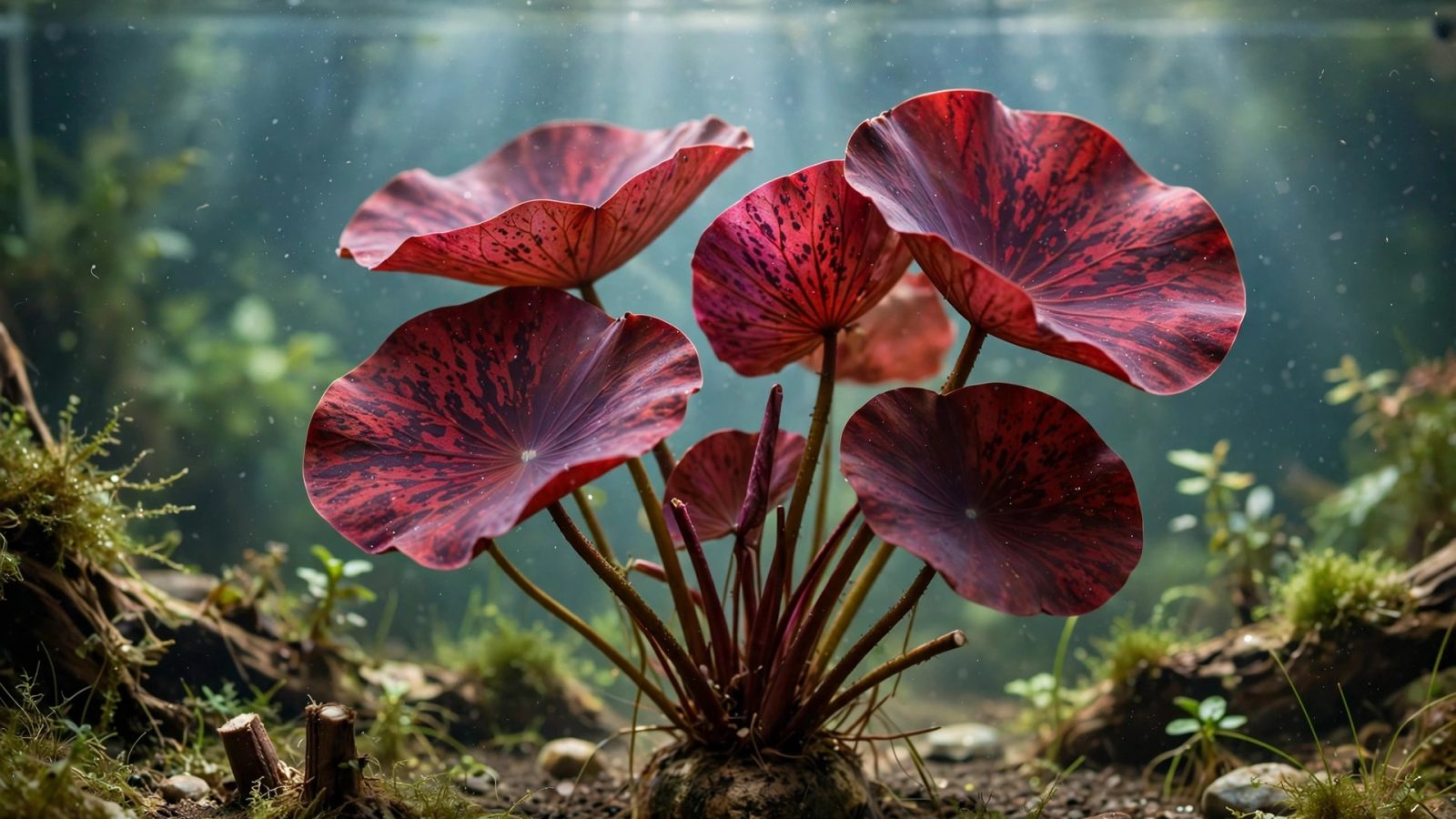
Red tiger lotus care delivers what few aquarium plants can: genuine red color without demanding high-tech equipment. Nymphaea zenkeri grows from a bulb into a spectacular rosette of deep red-bronze leaves — arrow-shaped, often speckled, and dramatically different from anything else in the planted tank. It is the shortcut to the red-plant look that beginners assume requires CO2 injection and expensive lighting.
The catch is vigor. A happy tiger lotus grows astonishingly fast and sends lily pads to the surface that shade everything below. Left alone it becomes a beautiful monster. This guide covers bulb handling (the step everyone gets wrong), planting depth, pruning surface leaves, and keeping the red color vivid.
Red Tiger Lotus Care at a Glance
| Parameter | Recommendation |
|---|---|
| Scientific name | Nymphaea zenkeri |
| Light | Medium (30–50 PAR); red color intensifies with more light |
| Temperature | 72–82°F (22–28°C) |
| pH | 6.0–7.5 |
| Water hardness | Soft to moderately hard |
| CO2 | Not required |
| Fertilizer | Heavy root feeder — root tabs essential |
| Substrate | 2–3 inches; nutrient-rich preferred |
| Growth rate | Fast once established — very fast |
| Placement | Midground focal point; give it 8+ inches of space |
| Difficulty | Easy to moderate |
The Bulb: Handling and Planting
Red tiger lotus is sold as a dormant bulb — sometimes sprouted, sometimes not. Bulb handling has one critical rule: never bury the bulb completely. A fully buried bulb rots. Instead:
- If the bulb is unsprouted, place it on the substrate surface and wait. Sprouting takes 1–4 weeks. A firm bulb is alive; a soft, squishy bulb is dead — discard it.
- Once sprouted with roots and a few leaves, gently press the bulb one-third to one-half into the substrate, with the sprout pointing up. The top of the bulb stays exposed.
- Do not remove the bulb even after the plant is large — it is the energy reserve. Old bulbs can sprout new growth points for years.
Some keepers grow the bulb in a separate container until sprouted, then transplant. This works fine and lets you verify viability before committing tank space. For more on the red-plant palette, see our red aquarium plants for beginners roundup.
Light and Red Coloration
Tiger lotus is adaptable to medium light, but red intensity scales with light. Under medium light you get attractive bronze-red leaves; under higher light the reds deepen dramatically. Iron availability matters too — consistent iron (via root tabs or liquid dosing) supports the red pigmentation. Pale, greenish new leaves usually mean “more light and iron, please.”
That said, do not blast it. Excessive light on a fast-growing lotus just means faster surface-leaf production and more pruning work. Medium to medium-high light with good iron is the sweet spot for color without chaos.
Feeding a Hungry Bulb Plant
Like Amazon swords, tiger lotus is a heavy root feeder with an extensive root system. In inert substrate, place 2–3 root tabs in a ring around the bulb (not touching it) and refresh every 2–3 months. In aquasoil, it feeds happily until the soil depletes. Supplement with a comprehensive liquid fertilizer — the big leaves absorb plenty from the water column too.
A starving lotus tells you clearly: small new leaves, faded color, and stalled growth despite good light. The answer is always food at the roots first.
Pruning: Controlling the Surface Assault
This is the real work of red tiger lotus care. The plant’s instinct is to send round lily pads to the surface, where they spread, shade the tank, and signal the plant to stop producing the attractive underwater leaves. To keep the bushy underwater form:
- Remove surface-bound leaves early. You can spot them: long stems shooting upward with small round leaves. Snip the stem at the base as soon as you see them heading up.
- Prune weekly during fast growth. In peak condition a lotus produces several new leaves weekly. Stay ahead of it.
- Remove old outer leaves as they age, cutting stems at the bulb. This keeps the rosette compact and directs energy to new red growth.
- Want flowers? Let one pad reach the surface and it may bloom — beautiful, but the plant will then prioritize surface growth. Most keepers prune for the underwater form.
Consistent pruning trains the plant to stay low and bushy. Neglected lotus becomes a surface mat that starves everything below of light — the most common complaint from lotus owners, and entirely preventable.
Growth Rate and Placement
Once established, growth is explosive — several new leaves per week is normal. Give the plant an 8–12 inch radius as a midground focal point. It pairs beautifully with green plants: the red-bronze rosette against java fern or anubias on nearby hardscape is a classic contrast planting.
In small tanks under 20 gallons, think carefully — a vigorous lotus can dominate. Either commit to heavy pruning or choose it as the single centerpiece plant, which honestly looks spectacular.
Propagation
Mature bulbs develop daughter bulbs alongside the parent. When a daughter has its own sprout and roots, gently separate it and plant as a new specimen. The parent bulb also continues producing — a single purchase can become several plants over a year. Some keepers report the original bulb sprouting new growth even after the main plant is removed; never throw away a firm bulb.
Common Red Tiger Lotus Problems
Bulb rotting
Caused by burying the bulb fully or by a bulb that was already dead. Keep the top exposed, ensure the bulb is firm at purchase, and remove any mushy tissue promptly before it fouls the water.
Leaves turning green instead of red
Insufficient light or iron. Increase light intensity and ensure iron-rich feeding. Some green in older leaves is normal; new growth should show red.
All leaves going to the surface
Under-pruning, or the plant responding to low light by reaching up. Prune surface shoots consistently and verify the underwater leaves get adequate light.
Sudden die-back
Lotus occasionally go dormant, shedding leaves for weeks before regrowing from the bulb. If the bulb stays firm, wait — new sprouts usually follow. This is normal bulb-plant behavior, not a care failure. See why plants melt for how dormancy differs from true melt.
Algae on broad leaves
Big leaves near the light collect algae. Prune the worst leaves, keep the photoperiod at 7–8 hours, and add nerite snails or Amano shrimp.
Understanding Lotus Dormancy
Red tiger lotus occasionally goes dormant — shedding all leaves and retreating to the bulb for weeks or months. This alarms keepers who assume the plant is dead, but it is a natural bulb-plant rhythm:
- Triggers: seasonal light changes, temperature drops, or simply the plant’s internal clock. Some lotus go dormant annually; others never do.
- What to do: nothing. Leave the firm bulb in place, maintain normal tank care, and wait. New sprouts emerge when the plant is ready — typically 3–8 weeks.
- What NOT to do: do not discard the bulb, do not “check” it by digging it up (disturbing dormancy can kill it), and do not overhaul your fertilization in response.
- Distinguishing dormancy from death: a dormant bulb is firm and solid; a dead bulb is soft, mushy, or hollow. The squeeze test never lies.
Some keepers deliberately induce dormancy by cooling the tank slightly in winter, mimicking seasonal cycles. This is optional — the plant manages its own schedule perfectly well.
Companion Planting with Tiger Lotus
The lotus’s bold red rosette demands thoughtful neighbors:
- Best contrasts: fine-textured green plants like java moss on nearby wood, or vallisneria ribbons behind it — the fine-vs-bold texture contrast is striking.
- Color echoes: a second red accent (like Ludwigia stems or Alternanthera) at the opposite end of the tank creates balance. One red plant is an accent; two is a composition.
- Avoid: planting other aggressive root-feeders within 6 inches — they compete underground and both suffer. Give the lotus its territory.
- Foreground: dwarf sagittaria or monte carlo in front of a lotus creates the classic tall-red-behind-short-green composition.
Maximizing Red Coloration
Beyond basic light and iron, advanced color tips:
- Limit nitrogen slightly: lean nitrate levels (5–10 ppm) intensify reds in many plants, lotus included. Do not starve the plant — just avoid the nitrate excess that pushes everything green.
- Strong red-spectrum light: fixtures with good red output render and enhance red pigmentation better than cool-white-only lights.
- Prune green reversions: occasionally a lotus throws a green leaf. Remove it — the plant is hedging its bets, and pruning reinforces the red form.
- Young leaves are reddest: a constantly pruned lotus producing fresh leaves shows more red than a neglected one with aging foliage. Another reason the pruning schedule matters.
Tiger Lotus in Different Tank Styles
- Community tank centerpiece: a single lotus as the focal point, surrounded by schooling fish. The red rosette draws the eye; the fish provide movement. Classic and foolproof.
- Biotope-inspired: pair with vallisneria and driftwood for a slow-river feel. The lotus reads as a marginal plant colonizing the shallows.
- High-tech show tank: the lotus holds its own among demanding stems — its bold form contrasts with fine textures, and the high light intensifies its reds to maximum.
- Shrimp tank accent: in larger shrimp tanks (20+ gallons), a small lotus provides shade and grazing surfaces. Prune aggressively to prevent light blockade.
Buying Bulbs: Quality Indicators
- Firmness: the squeeze test — solid is alive, soft is dead. No exceptions.
- Size: larger bulbs (golf-ball sized) have more energy reserves and establish faster than small ones.
- Sprouted vs. dormant: sprouted bulbs cost more but eliminate the waiting game and let you verify viability immediately. Dormant bulbs are cheaper but a gamble — buy from reputable sellers.
- Variety verification: true Nymphaea zenkeri ‘Red’ produces red leaves from the start. If a “red tiger lotus” grows only green leaves, it may be mislabeled — give it 2–3 months and good light before judging, but know that mislabeling happens.
Red Tiger Lotus FAQs
Red vs. green tiger lotus — what’s the difference?
Same species (Nymphaea zenkeri), different color forms. The red form stays bronze-red under medium-plus light; the green form is cheaper and even more vigorous. Both want identical care — bulb resting on the substrate, root tabs for the hungry roots, regular pruning. If your “red” lotus keeps throwing green leaves, raise the light intensity before blaming the bulb.
My lotus lost all its leaves. Is the bulb dead?
Probably dormant, not dead. Lift the bulb and squeeze gently — firm means alive, mushy means compost it. A firm bulb left in place usually resprouts within weeks, especially after a water change or temperature shift triggers it. Tiger lotus dormancy alarms every keeper once; the second time, you just wait.
The Bottom Line
Red tiger lotus care is a bargain: bulb on the substrate (never buried), root tabs for the hungry roots, medium-plus light for the reds, and weekly pruning to keep it underwater and bushy. In exchange you get the most dramatic color-per-dollar in the hobby — a plant that looks high-tech while asking for low-tech care. Just respect its vigor. The lotus does not do “subtle,” and neither should your pruning scissors.