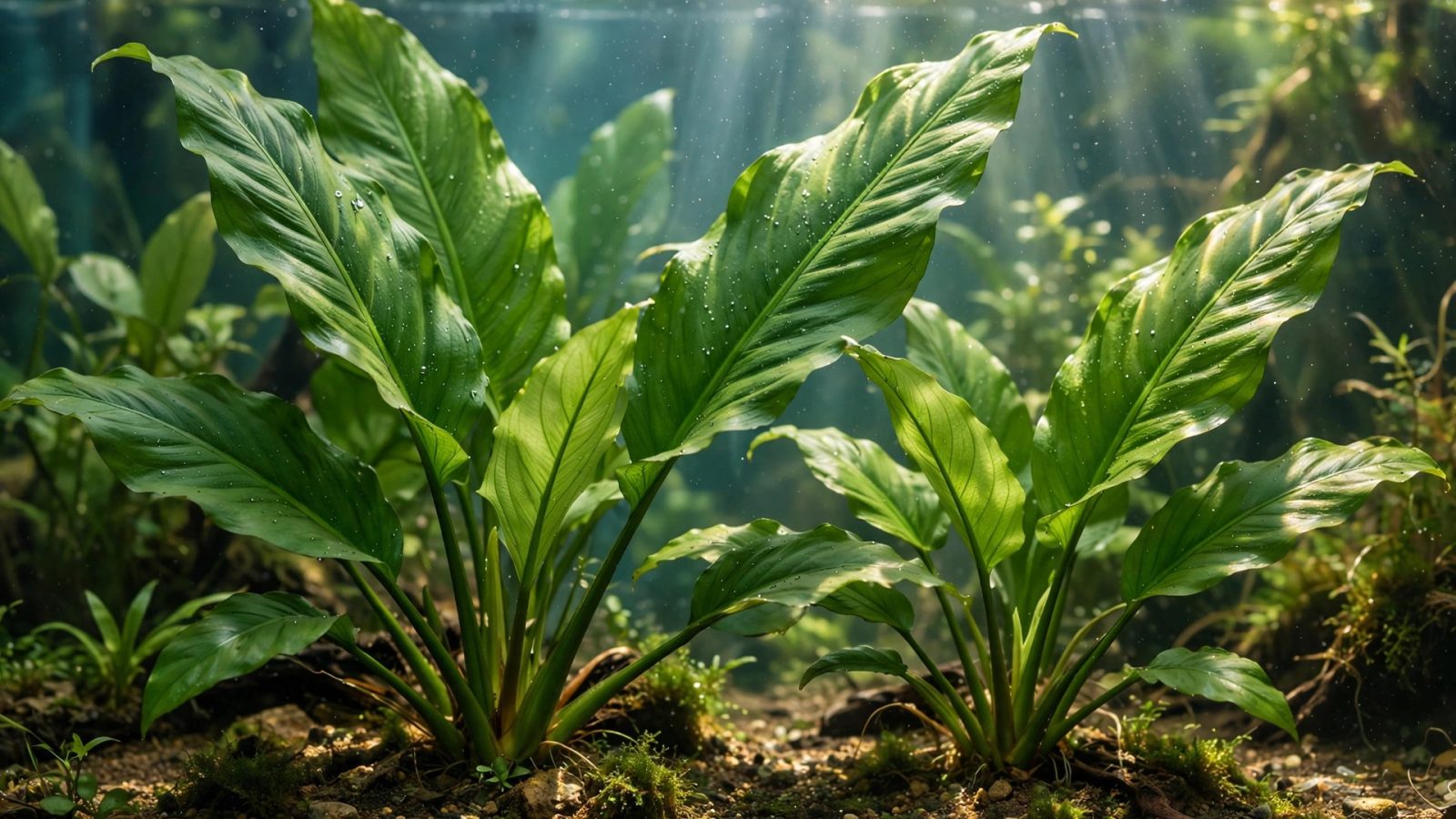
Amazon sword care rewards the keeper who plans for size. These dramatic rosette plants are among the most popular background plants in the hobby — broad, arching leaves that turn an empty back corner into a lush green wall. But they are also heavy root feeders that outgrow small tanks, and most beginners underestimate both their appetite and their eventual footprint.
Get the fundamentals right — rich substrate or root tabs, moderate light, and room to spread — and an Amazon sword becomes the backbone of your aquascape for years. This guide covers sizing, substrate, feeding, pruning, propagation by runners, and the problems that crop up when swords go hungry.
Amazon Sword Care at a Glance
| Parameter | Recommendation |
|---|---|
| Scientific name | Echinodorus amazonicus (and related Echinodorus spp.) |
| Light | Medium (30–50 PAR); tolerates low light but grows slowly |
| Temperature | 72–82°F (22–28°C) |
| pH | 6.5–7.5 |
| Water hardness | Soft to moderately hard |
| CO2 | Not required; benefits from it |
| Fertilizer | Heavy root feeder — root tabs essential in inert substrate |
| Substrate | Nutrient-rich substrate ideal; minimum 2–3 inches deep |
| Growth rate | Moderate to fast once established |
| Placement | Background or midground focal point; needs 8–12 inches of space |
| Max size | 16–20 inches tall, 12+ inches wide (varies by species) |
| Difficulty | Easy to moderate |
Understanding Amazon Sword Size
The number one mistake in Amazon sword care is planting it in too small a tank — or too close to the front glass. A mature Amazon sword reaches 16–20 inches tall with leaves arching a foot wide. In a 10-gallon tank, a single sword can dominate the entire scape within a year. In a 55-gallon or larger, it becomes the majestic background centerpiece it was meant to be.
Plan accordingly: give each sword an 8–12 inch radius of clear space, and position it in the background or as a midground focal point in larger tanks. If your tank is under 20 gallons, consider smaller Echinodorus relatives like Echinodorus parviflorus ‘Tropica’ or the compact Echinodorus ‘Red Flame’, which stay under 8 inches. Dwarf sagittaria also makes a good smaller alternative — see our dwarf sagittaria care guide for a foreground runner that stays manageable.
Substrate: The Foundation of Sword Care
Amazon swords are heavy root feeders — they pull most of their nutrients through an extensive root system rather than from the water column. Substrate choice matters more for swords than for almost any other common plant:
- Best: a nutrient-rich aquasoil 2–3 inches deep. Swords root deeply and spread runners through it.
- Good: inert sand or gravel with root tabs pushed into the substrate around the plant’s base. This is the most common successful setup.
- Avoid: shallow substrate (under 2 inches) — the root mass lifts the plant out — and bare-bottom tanks, where swords simply cannot feed.
For a deeper dive on substrate options, our aquasoil vs sand vs gravel comparison breaks down the trade-offs for planted tanks.
Light and CO2 Needs
Amazon swords want medium light — roughly 30–50 PAR. They survive in low light but grow slowly, stay smaller, and develop longer, leggier leaves as they stretch toward the lamp. Under medium light with good feeding, expect steady production of broad new leaves from the central crown.
CO2 is not required. Swords grow well in low-tech setups as long as they are fed at the roots. Injected CO2 speeds growth and produces larger, more robust leaves, but it also speeds up nutrient consumption — if you add CO2, increase root-tab frequency to match. For most keepers, the low-tech approach without CO2 works perfectly well for swords.
Fertilizer: Feeding a Hungry Plant
Root tabs are non-negotiable for Amazon swords in inert substrate. Push 2–3 tabs into the substrate in a ring around the plant’s base (not directly under the crown, which can burn new roots), and replace them every 2–3 months. A sword showing pale new leaves, pinholes in older leaves, or stalled growth is almost always telling you its root tabs are exhausted.
Liquid fertilizer helps too — swords do absorb some nutrients through their leaves — but it is secondary. If you only dose the water column and skip root tabs, your sword will slowly starve while your stem plants thrive. The liquid fertilizer vs root tabs guide explains which plants need which approach.
Planting an Amazon Sword
Swords are usually sold as potted plants grown emersed. To plant:
- Remove the pot and gently rinse the rockwool from the roots.
- Trim any damaged or mushy roots, and remove the outer emersed leaves if they look ragged — the plant will shed them anyway.
- Dig a depression in the substrate, spread the roots outward and downward, and cover them while keeping the crown (where leaves meet roots) just at or slightly above the substrate surface. A buried crown rots.
- Push root tabs into the substrate around the planting spot.
Expect transition melt over the first 2–4 weeks: the broad emersed leaves dissolve as the plant grows narrower submersed leaves. This is normal. Do not uproot the plant to “check” on it — leave the crown alone and new growth will emerge from the center.
Pruning and Maintenance
Sword maintenance is straightforward: remove old leaves, manage size, and stay ahead of algae on the big leaf surfaces.
- Remove outer leaves as they age, yellow, or develop algae. Cut the leaf stem as close to the crown as possible with sharp scissors. Never pull leaves off — you can damage the crown.
- Control size by removing the largest outer leaves regularly. You cannot trim a leaf shorter (cut leaves do not heal and look ragged), so size control means removing whole leaves.
- Thin the plant if the center becomes congested. A sword with 20+ leaves shades its own inner growth; removing a few outer leaves improves circulation and light penetration.
Propagation: Runners and Daughter Plants
Healthy, well-fed Amazon swords propagate themselves by sending out long flower stalks / runners. Underwater, these runners develop small daughter plants at nodes along their length instead of flowers. When a daughter plant has several leaves and its own small root system, you have two options:
- Pin the runner to the substrate where you want the new plant, let it root for 2–3 weeks, then snip the runner.
- Cut the daughter plant from the runner and plant it directly as a new specimen.
A single happy sword can produce a runner with half a dozen daughters — free plants for your tank or fellow hobbyists. If you do not want more swords, simply trim the runner off at the base when it appears.
Common Amazon Sword Problems
Transparent or melting leaves after planting
Almost always emersed-to-submersed transition melt. The old leaves were grown in air; the plant is replacing them with underwater foliage. Wait 3–4 weeks and look for new growth from the crown. See why aquarium plants melt for the full explanation.
Yellow leaves with green veins
Classic iron deficiency — common in swords because they are such heavy feeders. Add root tabs containing iron, or dose an iron supplement. New leaves should emerge green.
Pinholes in older leaves
Potassium deficiency. The plant is pulling mobile potassium from old leaves to feed new growth. Increase root-tab feeding and consider a potassium-containing liquid fertilizer. Our nutrient deficiency guide has photos of each symptom.
Leaves turning brown at the edges
Often a combination of old age and insufficient feeding. Remove the worst leaves and refresh root tabs. If it affects new growth too, check for a buried crown or deteriorating water quality.
Stunted growth, small new leaves
The plant has exhausted its food supply. In aquasoil tanks older than a year, the substrate’s nutrients deplete — add root tabs even in “nutrient-rich” substrate that is past its prime.
Amazon Sword Varieties Worth Knowing
- Echinodorus amazonicus — the classic, 16–20 inches, bright green.
- Echinodorus bleheri — broader leaves, similar size, very common in stores.
- Echinodorus ‘Ozelot’ — green leaves with dark spots; striking and hardy.
- Echinodorus ‘Red Devil’ / ‘Red Flame’ — reddish new leaves, more compact (8–12 inches).
- Echinodorus parviflorus ‘Tropica’ — compact 6–8 inch sword for smaller tanks.
Amazon Swords in Different Tank Sizes
Sword selection should start with tank dimensions, not aesthetics:
- 10–20 gallons: skip the big amazonicus. Choose Echinodorus parviflorus ‘Tropica’ (6–8 inches) or E. ‘Red Flame’ (8–10 inches). One plant maximum — it will still dominate.
- 29–40 gallons: a single E. amazonicus or E. bleheri works as a background anchor. Give it the back corner and 10 inches of clearance.
- 55+ gallons: the sword’s natural habitat. Plant 2–3 as a background group, spacing them 12 inches apart. They will merge into a dramatic green wall within a year.
- 75+ gallons / tall tanks: consider Echinodorus ‘Ozelot’ or giant E. cordifolius for true specimen-plant impact. These can reach 24+ inches.
The universal mistake is buying for the tank you have today without picturing the plant in 12 months. Swords grow toward their genetic potential relentlessly — plan for the adult, not the juvenile in the pot.
Seasonal Growth Cycles
Amazon swords follow a subtle seasonal rhythm even indoors. Growth peaks in spring and summer (longer days, warmer water) and slows in winter. Do not panic at winter slowdown — it is normal. Reduce root-tab frequency slightly in the slow season; the plant needs less food when growing less. Spring is the ideal time for major pruning, division, or relocation, when the plant’s energy reserves are highest and recovery fastest.
Advanced Troubleshooting
Emersed growth and flowering
In open-top tanks, swords sometimes send leaves above the waterline and even flower — tall stalks with small white blooms. This is healthy and spectacular. Emersed leaves are broader and tougher than submersed ones. If you dislike the look, trim the stalk; if you enjoy it, let it bloom — the plant is thriving.
Crown rot vs. normal shedding
Learn to distinguish them: normal shedding affects outer leaves one at a time, with firm crown tissue underneath. Crown rot softens the central growing point itself — the newest leaves pull out easily and smell bad. Crown rot is usually fatal; shedding is routine maintenance. When in doubt, sniff the crown.
Allelopathic slowdown near other swords
Densely planted swords can mildly suppress each other through root competition. If a sword stalls while its neighbors thrive, it may be losing the underground battle. Thin the group or add root tabs between them.
The Root Tab Routine: A Feeding Calendar
Amazon swords are heavy root feeders, and “heavy” is not a vague suggestion — a mature sword can strip the nutrients from its root zone in a couple of months, then stall while the rest of the tank looks fine. The fix is a boring, repeatable root-tab routine. Here is one that works:
- At planting: push two to three root tabs into the substrate in a ring around the crown, a couple of inches out from the base. This front-loads the establishment phase when the plant is building its root mass.
- Monthly: add one tab per large plant, alternating sides so you replenish the whole root zone over time. Set a phone reminder — “monthly” is the schedule everyone intends and nobody keeps without one.
- After heavy pruning: when you remove a mass of old leaves, the plant redirects energy into new growth and burns through stored nutrients faster. One extra tab after a big prune prevents the pale-new-leaves stall that follows.
- Watch the new leaves: they are your dashboard. Deep green and broad means the routine is working; pale or undersized new growth means feed more or replace tabs sooner.
Pair the tabs with a modest liquid fertilizer for the water column — swords do take up nutrients through their leaves — but never try to feed a sword on liquid fertilizer alone. Foliar feeding cannot deliver the iron and macros a big rosette demands through its roots, and the classic deficiency pattern of yellow leaves with green veins plus pinholes is almost always a root-zone problem. Tabs are cheap; a stalled centerpiece plant is the expensive mistake. For the full feeding strategy, see our aquarium plant fertilizer schedule.
The Bottom Line
Amazon sword care is simple once you respect the plant’s two big needs: food at the roots and room to grow. Give it deep substrate with fresh root tabs, medium light, and space to spread, and it will anchor your aquascape with broad green leaves for years. Starve it or crowd it, and it will tell you exactly what’s wrong — pale leaves, pinholes, stalled growth — all fixable with a trip to the root-tab jar. Few plants reward basic feeding this dramatically.