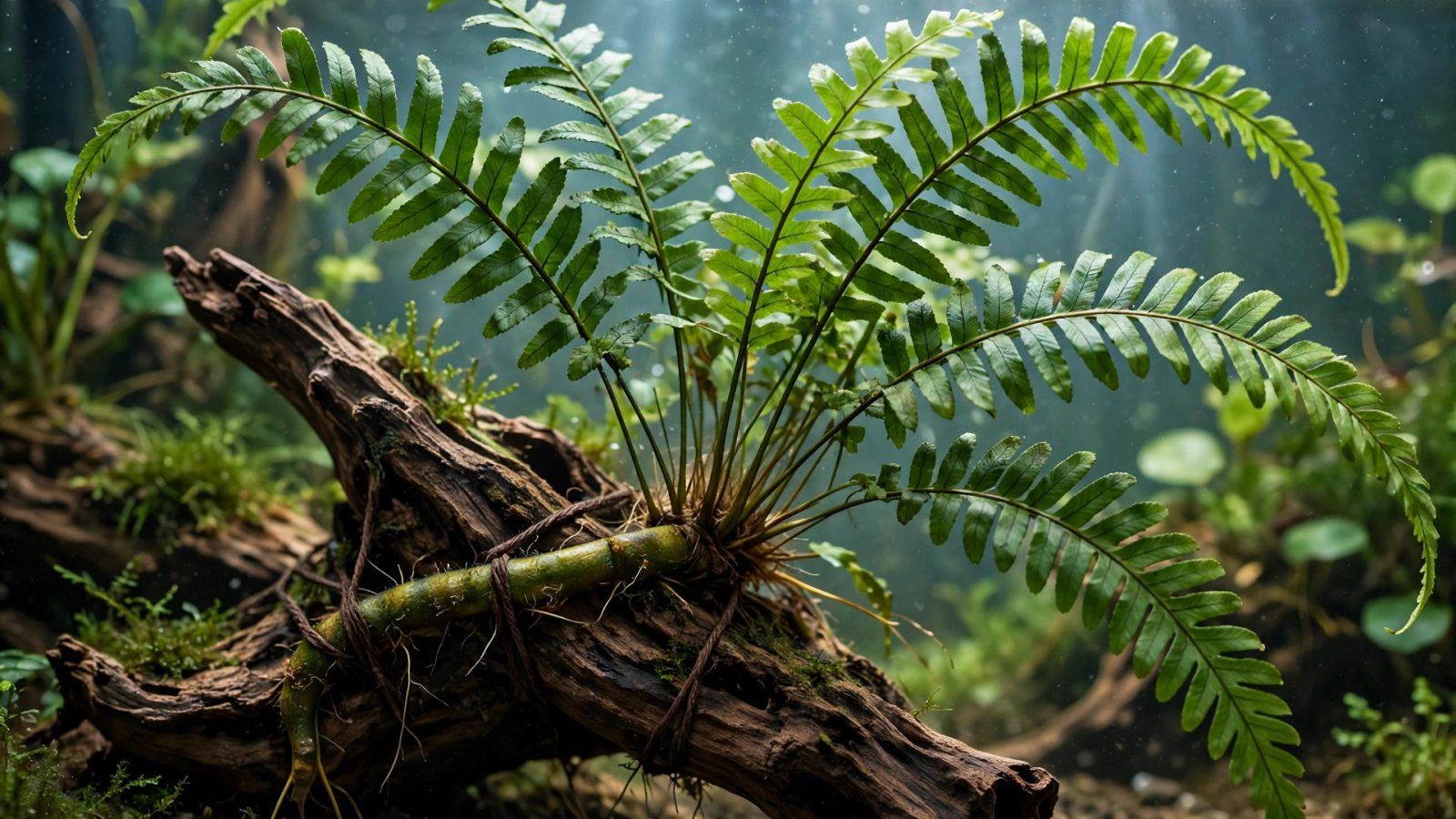
Java fern is one of the easiest aquarium plants you can own. It survives low light, grows fine without injected CO2, and forgives beginners who forget to fertilize. If you’ve ever killed every plant you’ve tried, java fern is the one to start with.
That said, “easy” doesn’t mean “un-killable.” Most java fern problems trace back to the same handful of mistakes: burying the rhizome in the substrate, blasting it with too much light, or planting it in a brand-new tank and panicking when old leaves melt. Get the handful of care basics right and java fern will steadily grow into lush green tufts on your driftwood and rocks.
This guide covers everything: lighting, CO2, fertilizer, planting technique, propagation, the popular varieties, and how to fix the most common problems.
Java Fern Care at a Glance
| Parameter | Recommendation |
|---|---|
| Scientific name | Microsorum pterotoides |
| Light | Low to medium (roughly 15–35 PAR) |
| Temperature | 68–82°F (20–28°C); best around 72–77°F |
| pH | 6.0–7.5 |
| GH / KH | Soft to moderately hard; adaptable, 3–8 dGH is ideal |
| CO2 | Not required; grows well without it |
| Fertilizer | Light liquid all-in-one dosing; water-column feeder |
| Growth rate | Slow to moderate |
| Placement | Attach to driftwood, rock, or decor — midground to background |
| Difficulty | Easy — excellent beginner plant |
Lighting for Java Fern
Java fern does best in low to medium light, around 15–35 PAR at the leaf level. It will grow under basic stock aquarium LEDs — the kind that ship with entry-level kits — and it actually prefers staying on the dimmer side. Unlike carpeting plants or red stem plants, it has no interest in high-intensity lighting rigs.
A photoperiod of 6–8 hours per day is the sweet spot for most tanks. Eight hours is plenty for healthy growth; shorter photoperiods work fine too if you’re fighting algae. Consistency matters more than length, so use a timer rather than flipping the light on and off by hand.
Too much light is one of the most common ways people stress java fern. Warning signs include:
- Leaves turning brown or developing dark, scorched patches
- Green spot algae or black beard algae coating the slow-growing leaves
- New leaves coming in pale, thin, or translucent
If you see these signs and your light is strong, either dim it, raise the fixture higher above the water, or shorten the photoperiod. Java fern also appreciates a bit of shade — placing it under the canopy of a taller plant or a piece of overhanging driftwood mimics the dappled light of its natural Southeast Asian stream habitats. It belongs on every list of low-light aquarium plants for beginners for good reason.
Does Java Fern Need CO2?
No. Java fern grows perfectly well without injected CO2, and that is one of its biggest selling points. In a low-tech tank with moderate stocking, the CO2 produced by fish respiration and the natural breakdown of organic matter is enough to keep it growing steadily.
So what does added CO2 actually do for java fern? It speeds up an already slow grower. With CO2 injection you can expect slightly larger leaves, a deeper green color, and faster production of new leaves and plantlets. But the difference is modest compared to what CO2 does for demanding stem plants — java fern never needs it to thrive.
A note on liquid carbon products (glutaraldehyde-based “liquid CO2”): they are not a true substitute for CO2 gas, but many hobbyists dose them in low-tech tanks as a mild algae deterrent. Java fern tolerates normal doses, but sensitive plants can react badly to overdosing, so start at half the label dose and watch your livestock. For more on low-tech setups, see our guide to growing aquarium plants without CO2.
Fertilizer: What Java Fern Actually Needs
Java fern is a water-column feeder — it absorbs nutrients directly from the water through its leaves and rhizome, not through its roots. This is a crucial detail: root tabs pushed into the substrate do almost nothing for it. What it wants is a liquid fertilizer dosed into the water column.
A liquid all-in-one fertilizer containing both macros (nitrogen, phosphorus, potassium) and micros (iron, manganese, and other trace elements) covers everything java fern needs. In a low-tech tank, dose on the lean side: typically once or twice a week at half to full label strength, adjusted to your fish load. A heavily stocked tank already supplies nitrogen and phosphorus through fish waste, so you may need less; a lightly stocked tank needs more.
Signs your java fern is hungry include slow, stunted new growth, older leaves yellowing from the edges inward (often a potassium or nitrogen shortfall), and new leaves emerging pale. That said, don’t confuse deficiency with the plant’s normal behavior — java fern frequently sacrifices old leaves while adapting to a new tank. If only the oldest leaves are affected and new growth looks healthy, that’s normal cycling, not a deficiency. Nutrient deficiencies in slow-growing rhizome plants look similar across species; compare with how anubias leaves turning yellow for a useful reference on diagnosing leaf symptoms.
One more caution: more fertilizer is not better. Overdosing in a low-light, no-CO2 tank just feeds algae. Start lean, increase gradually, and let the plants tell you what they need.
How to Plant Java Fern (Don’t Bury the Rhizome)
This is the single most important section of this guide. Java fern’s rhizome — the thick horizontal stem that the leaves grow from — must stay above the substrate. Bury it, and it rots. A rotting rhizome is the number one cause of “my java fern died within a month.”
Instead of planting it in the substrate, attach java fern to hardscape. Three reliable methods:
- Tie it on. Use cotton thread, fishing line, or dark sewing thread to bind the rhizome gently to driftwood or rock. Cotton thread rots away on its own after a few months, by which time the roots have grabbed hold.
- Glue it. A small dab of cyanoacrylate super glue gel (the plain kind, no additives) on the rhizome, pressed against dry hardscape for 30 seconds, holds firmly. It’s aquarium-safe once cured and is the fastest method.
- Wedge it. Tuck the rhizome into a crack or crevice in driftwood or between stacked rocks. No ties, no glue — just make sure it’s snug enough not to float away.
Placement-wise, java fern works beautifully as a midground accent tied to wood, or as a background filler in smaller tanks. Give each portion a little space: leaves that are crammed together trap detritus and block light from reaching the inner leaves. Because it doesn’t need substrate at all, java fern is also perfect for bare-bottom or sand-only tanks where rooted plants struggle.
Propagation
Java fern practically propagates itself. Mature leaves develop tiny plantlets — complete miniature ferns with their own leaves and roots — along their edges and tips. Once a plantlet has a few small leaves and visible roots (usually 1–2 inches tall), gently pluck or snip it off the mother leaf and attach it to new hardscape with thread or glue.
Interestingly, plantlet production often ramps up when the mother leaf is stressed or aging. Those black-spotted old leaves people worry about? They’re frequently busy making babies. Don’t trim a spotted leaf that’s sprouting plantlets until the babies are big enough to remove.
The second method is rhizome division. Take a healthy clump and cut the rhizome into sections with a sharp blade or scissors, making sure each section has several leaves and some roots. Attach each piece separately. This is the fastest way to fill out a scape, and a single store-bought portion can become three or four plants within minutes.
Java Fern Varieties
Once you’re comfortable with the standard form, the named varieties add texture and variety without any change in care requirements:
- Narrow leaf java fern — thinner, straighter leaves than the standard type, giving a grassier, more delicate look. Great for smaller tanks where the broad standard leaves feel oversized.
- Windeløv (lace) java fern — leaf tips split into fine, branching “fingers” like tiny antlers. A striking texture plant for the midground; grows a touch slower than the standard form.
- Trident java fern — leaves fork into three (sometimes more) pointed lobes, almost like a trident head. Compact and distinctive, and a favorite for nano aquascapes.
All three share identical care needs — same light, same fertilizer approach, same plant-it-on-wood rule. Mix them in one tank for a varied look with zero extra effort.
Common Java Fern Problems
Brown or black spots on leaves. Small dark spots that eventually sprout plantlets are reproductive structures, not disease — leave them alone. But large spreading brown patches, especially on new growth, usually mean too much light or, less commonly, a nutrient imbalance. Fix: reduce light intensity or photoperiod, and check that you’re dosing a complete liquid fertilizer.
Melting after planting. Newly added java fern often sheds some or all of its old leaves within the first few weeks. This is transplant shock as the plant adapts to your water — the rhizome is usually fine. Fix: do nothing drastic. Leave the rhizome in place, keep conditions stable, and wait for new leaves to emerge from the rhizome, which can take 2–4 weeks.
Algae coating the leaves. Java fern’s slow growth makes its broad leaves prime real estate for green spot algae, black beard algae, and hair algae, especially under strong light. Fix: dial the light back to 6–8 hours, consider adding algae-eating crew (nerite snails, Amano shrimp, Siamese algae eaters for BBA), and remove badly coated leaves to deny the algae a foothold. Never scrub delicate leaves aggressively — trim and regrow instead.
Rhizome rot. The rhizome turns brown, mushy, and foul-smelling — almost always because it was buried in substrate or wedged so tightly it couldn’t get water flow. Fix: unbury it immediately, trim away all mushy tissue with clean scissors back to firm green rhizome, and reattach the healthy portion above the substrate. If the whole rhizome is mush, the plant is lost.
Frequently Asked Questions
Can java fern grow without CO2?
Yes — java fern is one of the best plants for tanks without injected CO2. It grows steadily in low-tech setups using the CO2 naturally produced by fish and organic breakdown. Added CO2 speeds growth and deepens color slightly, but it is never required.
Can you plant java fern in substrate?
Not the rhizome. Burying the thick horizontal rhizome causes it to rot and kills the plant. The thin black roots can touch or lightly sit in the substrate, but the rhizome itself must stay exposed above it — attach the plant to driftwood or rock instead.
Why is my java fern turning brown?
The most common causes are too much light, transplant melt in a new tank, or an old leaf naturally dying off while producing plantlets. Check your light intensity and photoperiod first; if only old leaves are browning while new growth looks green and healthy, the plant is fine.
How fast does java fern grow?
Slowly to moderately — expect a new leaf every week or two per rhizome in good conditions, faster with CO2 and regular fertilization. It is a long-game plant: a small portion becomes a lush clump over several months, not weeks.
Does java fern need fertilizer?
It benefits from it but survives without it for a long time. Because it’s a water-column feeder, use a liquid all-in-one fertilizer dosed once or twice weekly rather than root tabs. In stocked tanks, start at half dose and adjust based on growth and algae.
Can java fern grow out of water?
Yes, in humid conditions — java fern grows emersed in the wild along stream banks. In a high-humidity terrarium or paludarium it will grow above the waterline, though the leaves often look slightly different from submerged growth. It won’t survive in dry room air.
Java fern earns its reputation as the beginner’s plant honestly: give it modest light, keep the rhizome out of the substrate, dose a little liquid fertilizer, and it will reward you with years of steady, low-maintenance growth. Start with one portion tied to a nice piece of driftwood, and let the plantlets do the rest.