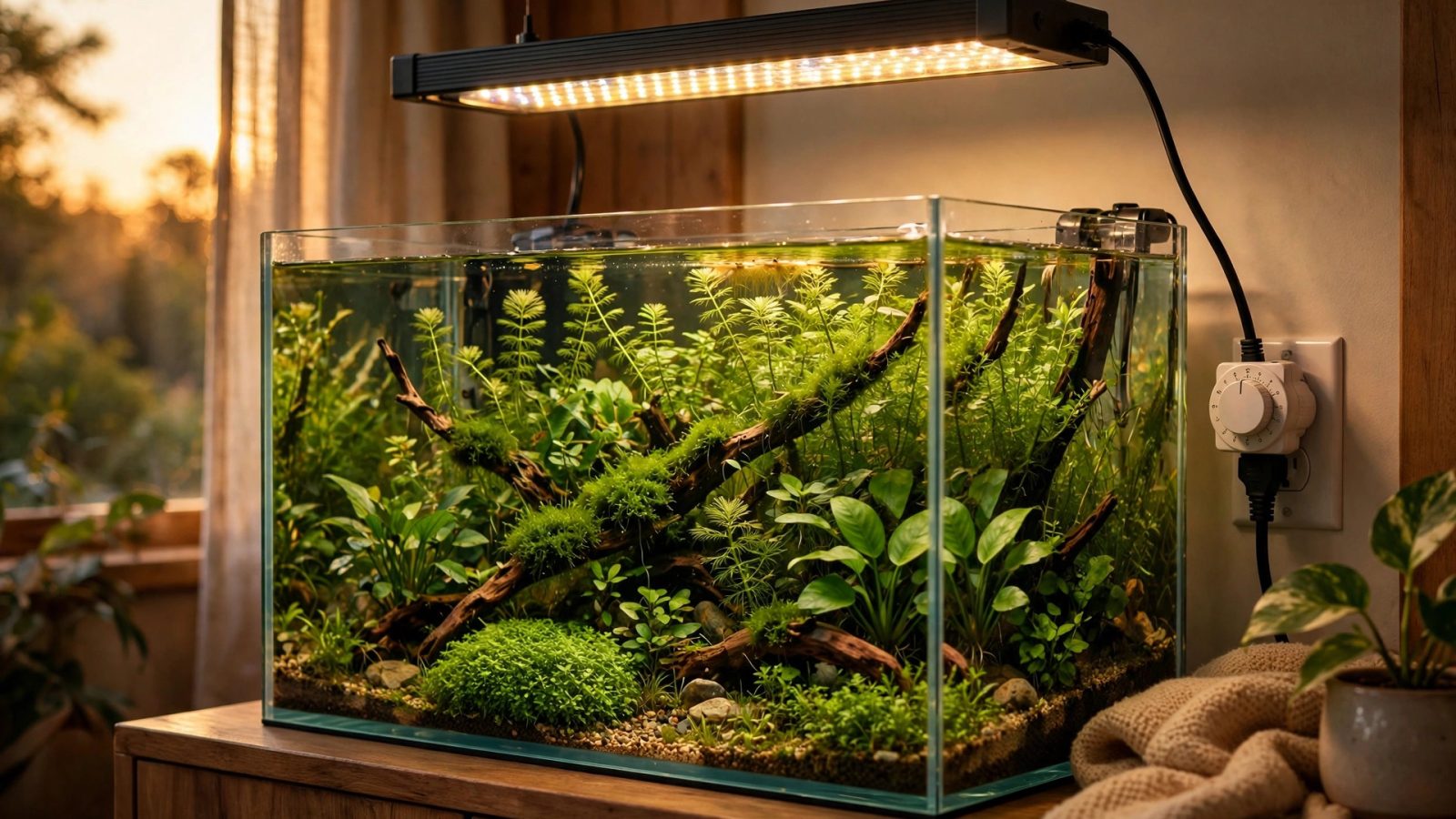
When your aquarium light turns on and off matters almost as much as how bright it is. Plants run on circadian rhythms — they prepare photosynthetic machinery before dawn and shut down after dusk. A thoughtful light schedule aligns with that biology, discourages algae, and fits your viewing life. This guide covers optimal photoperiods, timing strategies, the famous “siesta” method, and how to set up timers properly.
The Standard: 6–8 Hours on a Timer
For the vast majority of planted tanks, 6 to 8 hours of light per day, at the same time every day, controlled by a timer is the entire strategy. Everything below is refinement of this baseline.
- New tanks (first month): start at 6 hours. Immature biology + full photoperiod = algae.
- Established low-tech: 7 hours is the long-term sweet spot.
- Established high-tech with CO2: 8 hours, sometimes 9 once everything is dialed in.
Buy an outlet timer ($8–12) before you buy anything else for your light. Manual switching guarantees inconsistency — late nights, forgotten mornings — and plants punish inconsistency with stalled growth and algae openings. If you’re also running CO2, the timer becomes doubly important — see our complete CO2 guide for how light and gas timing work together.
When Should the Photoperiod Fall?
Plants don’t care what the clock says; they care about consistency. But you care, because you want to see your tank. Two common strategies:
- Daytime block (e.g., 10am–6pm): aligns with natural daylight, simplest for maintenance routines. Downside: you’re at work for most of it.
- Evening block (e.g., 2pm–10pm): the tank is lit when you’re home to enjoy it. The most popular choice among working hobbyists. There’s no biological penalty — plants adapt to any consistent 24-hour cycle.
Avoid splitting the difference awkwardly (like 9am–5pm when nobody’s home). Put the light where your eyes are.
The Siesta Method: Does It Work?
The “siesta” schedule splits the photoperiod into two blocks with a 2–4 hour dark gap midday (e.g., 8am–12pm, dark 12–4pm, 4pm–8pm). The theory: the dark pause lets CO2 rebuild from fish and bacterial respiration, giving plants a second wind while denying algae continuous light.
The honest assessment:
- It can modestly help low-tech tanks without CO2, where midday CO2 depletion is real. The pause lets levels recover.
- It’s largely pointless in CO2-injected tanks — your injection already holds CO2 steady, so the siesta solves a problem you don’t have.
- The evidence is anecdotal, not scientific. It doesn’t hurt, but don’t expect miracles.
- It complicates timer setup and can annoy household members (“why is the tank dark at lunch?”).
Verdict: a reasonable experiment for low-tech algae troubles, unnecessary complexity otherwise. Fix the actual imbalance (usually too much light — see signs of too much light) before restructuring your schedule.
Sunrise/Sunset Ramping: Nice but Optional
Many modern LEDs offer 15–30 minute ramp-up/down periods mimicking dawn and dusk. Benefits are real but modest:
- Fish stress: the main win. Lights snapping on startles fish; ramping is gentler. Meaningful in tanks with skittish species.
- Plant benefit: minimal. Plants don’t need dawn simulation to photosynthesize.
- Algae effect: negligible either way at these timescales.
Don’t count ramp time toward your photoperiod at full intensity — but don’t overthink it either. If your light has the feature, use 15-minute ramps. If not, a timer’s hard on/off grows plants identically.
Syncing Light With CO2 Timing
In injected tanks, CO2 and light schedules are a pair. The standard protocol (detailed in our complete CO2 guide):
- CO2 ON: 1–2 hours before lights on
- Lights ON: photoperiod start (timer)
- CO2 OFF: 1 hour before lights off
- Lights OFF: photoperiod end (timer)
Set both timers in the same session so the offsets stay correct. If you change your viewing schedule seasonally, move both together.
Adjusting the Schedule: When and How
Algae appears
First response: cut the photoperiod by 1–2 hours (e.g., 8 → 6). Don’t change intensity and duration simultaneously — adjust duration first, wait two weeks, then reassess. Duration cuts are the gentlest intervention available.
Plants stall after the tank matures
If growth was good then slowed with no other changes, try adding an hour — but only if CO2 and fertilizer are already adequate. More light on a nutrient-limited tank grows algae, not plants.
Seasonal ambient light changes
A tank near a window gets more ambient light in summer. You don’t need to change the artificial schedule, but watch for algae upticks — ambient light counts toward total energy even though it doesn’t help plants much.
Vacation
Reduce to 6 hours while away. Less light = less growth = less that can go wrong. Your timer handles it; just adjust before you leave and restore on return.
Common Scheduling Mistakes
- No timer (“I’ll just remember”): you won’t, consistently, for years. Automate it.
- Changing the schedule weekly: plants need 2–3 weeks to adapt to any change. Constant fiddling keeps them perpetually stressed.
- Leaving lights on for guests: the occasional evening extension is harmless; making it a habit is not.
- Counting room light as photoperiod: ambient room light doesn’t drive meaningful photosynthesis but the “lights on” confusion leads people to run short photoperiods. Judge by the aquarium lamp.
- 24/7 “moonlight” modes: dim blue night modes still register to plants and algae. True darkness at night matters — turn it fully off.
The Bottom Line
Pick a 6–8 hour block that suits your viewing, put it on a timer, sync your CO2 if you inject, and leave it alone. The best light schedule is the boring one — consistent, automatic, and adjusted only in response to what your plants and algae tell you over weeks, not days.
Automation Setups: Timers and Smart Plugs
Three tiers of light automation:
- Mechanical outlet timer ($8–12): pins or dials, dead reliable, no WiFi to fail. The workhorse. Downside: adjusting the schedule means fiddling with tiny pins; power outages shift the timing.
- Digital outlet timer ($12–20): button-programmed, battery backup for settings, multiple on/off programs (useful for siesta schedules). The sweet spot for most hobbyists.
- Smart plug ($15–25): phone-controlled, easy schedule changes, vacation mode. Requires WiFi and an app account. Excellent for multiple tanks — one app controls everything. The risk: if your WiFi drops, some models default to off (safe) while others freeze in their last state.
- Built-in fixture controllers: premium lights (Fluval, Chihiros, Twinstar with controller) handle timing internally with ramping. The most elegant solution — and the most expensive.
Whatever you choose, plug the light into the timer — not the filter. And label your timers: in a multi-tank fish room, “Timer 3” means nothing at 11pm when you’re troubleshooting.
Managing Multiple Tanks
Fish rooms complicate scheduling. Practical approaches:
- Stagger photoperiods so you’re not doing maintenance on all tanks simultaneously — e.g., display tank 2–10pm, quarantine 10am–6pm.
- Group by type: all low-tech tanks on one timer/power strip, all high-tech on another. One schedule change updates the whole group.
- Centralize CO2 timing with high-tech lights — if CO2 and lights share a power strip on one timer (CO2 offset via its own timer), you can’t accidentally desync them.
Dealing With Power Outages
Outages disrupt the photoperiod — a 6-hour blackout midday isn’t a crisis, but multi-day outages need management. Plants tolerate 2–3 days of darkness far better than fish tolerate the associated filter stoppage (that’s the real emergency — keep filter media wet and oxygenated). When power returns, resume the normal schedule immediately rather than “making up” lost light. One odd day doesn’t derail plant rhythms; a week of fiddling does.
Light Schedules for Special Situations
Breeding tanks
Many species spawn at dawn. A 30-minute ramp starting before the main photoperiod simulates sunrise and can trigger spawning behavior in tetras and rasboras. Keep the total photoperiod standard — it’s the dawn simulation that matters, not extra hours.
Quarantine/hospital tanks
Dim light, short photoperiod (4–6 hours). Stressed or medicated fish benefit from low stimulation, and there are no plants to consider. A simple clip-on at minimum is plenty.
Algae-treatment blackouts
The 3–5 day total blackout (tank wrapped, no light) is a legitimate last resort for severe green-water or cyanobacteria outbreaks. Plants tolerate it; algae doesn’t. But it’s a reset button, not a schedule — return to a proper photoperiod immediately after, and fix the underlying imbalance or the algae returns within weeks.
Tanks in bright rooms
If the tank gets significant indirect daylight, shift the artificial photoperiod to evening hours so total daily light stays reasonable. You can’t control the sun, but you can avoid stacking 8 hours of fixture light on top of 6 hours of bright ambient.
Timer Troubleshooting
- Light doesn’t follow the schedule: check AM/PM on digital timers — the #1 cause. Then verify the fixture’s own power switch is ON (the timer can’t power a switched-off light).
- Schedule drifts after outages: mechanical timers stop during outages and resume offset. Reset the dial after any outage. Digital timers with battery backup hold settings — worth the small premium.
- Smart plug goes offline: most revert to their last state or off. If yours defaults to ON, a WiFi outage means lights stuck on — set an automation fallback or use a plug with local scheduling that doesn’t need cloud.
- Two timers conflict: in CO2 setups, label timers clearly (LIGHT vs CO2). A swapped timer runs CO2 all night — the drop checker will warn you, but labeling prevents it.