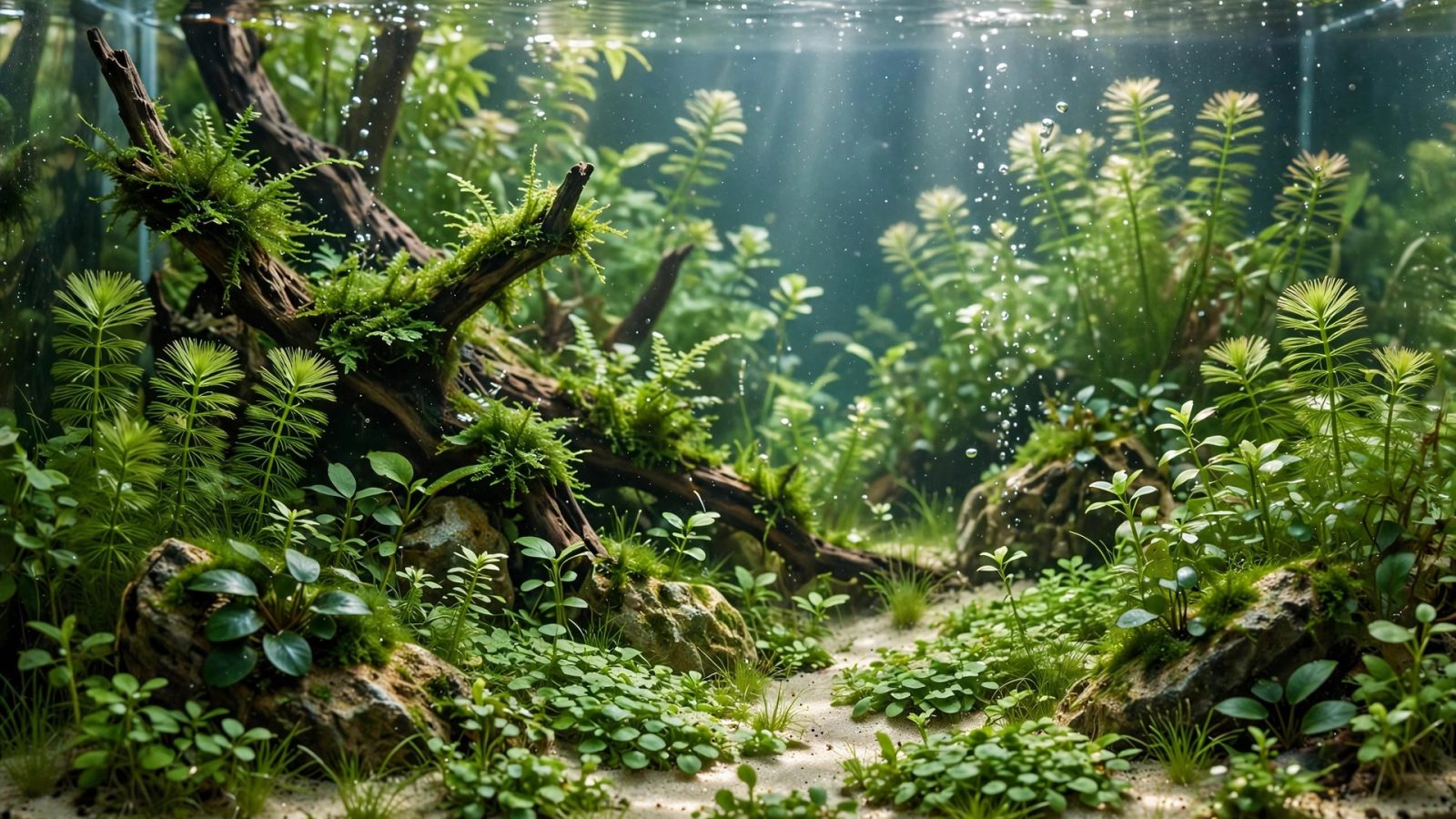
How long does an aquascape take to fill in? The honest answer: 2–3 months for most layouts to look “finished,” with wide variation by plant choice, CO2, and style. Understanding realistic timelines prevents the #1 beginner heartbreak — tearing down a perfectly good scape at week four because it doesn’t look like the inspiration photo yet. Here’s what to expect, plant by plant and style by style.
The Short Answer (by Style)
- Carpet-focused (iwagumi): 8–12 weeks with CO2; 4–6 months low-tech. See the iwagumi guide and low-tech carpet method.
- Stem-heavy (Dutch, triangle): 6–10 weeks — stems grow fast and fill quickly with trimming.
- Jungle: 8–12 weeks to lush; the style wants overgrowth, so it looks intentional sooner. See jungle aquascaping.
- Epiphyte/Anubias scapes: 4–6 months — slow growers take their time, but the hardscape carries the layout meanwhile.
- Moss-dominant: 3–5 months for full moss coverage.
Fill-In Timelines by Plant Type
Carpeting plants
- Monte Carlo: 6–10 weeks CO2 / 3–5 months low-tech (faster with dry-start)
- Dwarf hairgrass: 8–12 weeks CO2 / 4–6 months low-tech
- HC Cuba: 6–10 weeks CO2 (don’t attempt low-tech)
- Marsilea hirsuta: 3–5 months even with CO2 — slow but sure
- Glossostigma: 4–8 weeks — the speedster, high-maintenance
Stem plants
- Fast stems (Rotala rotundifolia, Limnophila, Hygrophila polysperma): 3–6 weeks to full bushes with weekly trimming
- Medium stems (Ludwigia, Bacopa): 6–10 weeks
- Slow stems (Alternanthera reineckii, Ammannia): 10–16 weeks
Rosettes and epiphytes
- Amazon swords: 2–4 months to specimen size (faster with root tabs)
- Cryptocorynes: 2–3 months; they sulk for weeks after planting, then take off — don’t move them
- Java fern / Anubias: 3–6 months for significant mass; buy larger portions to shortcut
- Bucephalandra: 6–12 months — the slowest common plant; plan accordingly
- Vallisneria: 6–10 weeks to surface in most tanks — deceptively fast
The Growth Curve: What Each Month Looks Like
Month 1 — Establishment (looks worse before better)
Tissue-culture plants melt emersed leaves. Stems look sparse. Diatoms dust everything. This is normal. Runners and new submerged leaves appear in weeks 3–4. Do not rescape; do not add more light “to help.” Keep parameters stable and wait.
Month 2 — Acceleration
Established root systems start compounding — each plantlet becomes a colony. Carpets knit, stems need first serious trims, the layout’s intended shapes emerge. Algae pressure drops as plants dominate nutrient uptake. This is when the tank starts photographing well.
Month 3 — Maturity (most styles)
Full coverage, dense growth, the layout reading as designed. Maintenance shifts from “grow-in” mode to “keep it sharp” mode. Judge your scape here — not at week three.
Months 4–6 — Peak and evolution
Slow growers (Buce, Anubias, mosses) hit their stride. The scape develops the aged, settled character that separates good tanks from great ones. Some layouts peak here and need rejuvenation (carpet replanting, stem resets) around month 8–12.
5 Factors That Speed Up (or Slow Down) Fill-In
- CO2 injection — the single biggest accelerator; roughly halves carpet and stem timelines.
- Initial planting density — doubling day-one plant mass more than halves time to full coverage. The best money in the hobby.
- Light adequacy — enough PAR at the substrate (not more than needed). Underlit carpets stall; correctly lit ones run.
- Substrate nutrition — fresh aquasoil vs. exhausted year-old substrate is a visible growth-rate difference.
- Temperature — most plants grow fastest at 22–26°C; cold tanks are slow tanks.
When to Worry (vs. When to Wait)
Wait if: plants are growing but slowly; new leaves look healthy; it’s been under 8 weeks. Patience is the treatment.
Act if: plants are melting with no new growth after 3–4 weeks (check light, nutrients, and whether rhizomes are buried); algae is smothering new growth (reduce light, increase water changes); stems grow tall but bare at the base (more light, harder trims).
Frequently Asked Questions
How long do aquarium plants take to establish?
2–4 weeks for roots to anchor and new submerged growth to start; 2–3 months for the full, filled-in look in most styles.
Why is my aquascape not filling in?
The usual suspects: too little light at the substrate, no CO2 with demanding species, sparse initial planting, or buried rhizomes. It’s rarely “bad luck” — it’s usually one fixable factor.
Should I add more plants if my scape looks empty at week 4?
Yes — if there are genuinely bare areas, filling them now beats waiting. But don’t tear down what’s growing; supplement, don’t restart. See beginner mistakes #10 on rescaping too often.
Speeding Up Fill-In: What Actually Works
Ranked by impact, the legitimate ways to fill faster:
- Plant more on day one. Nothing else comes close. Double the plants, halve the wait — the math is nearly linear for carpets and stems.
- Add CO2. Pressurized CO2 roughly doubles growth rates across the board. The best equipment money in a grow-in phase.
- Dry-start carpets. 4–8 weeks of emersed growth with unlimited atmospheric CO2, zero algae. See the dry-start protocol.
- Optimize light. Enough PAR at the substrate (measure or estimate honestly), consistent photoperiod. Underlit tanks stall; correctly lit tanks run.
- Fresh aquasoil. New soil grows plants visibly faster than year-old depleted soil. Time rescapes to fresh substrate when you can.
- Warm water. 24–26°C for tropical species. Cold tanks (under 20°C) grow at half speed.
- Buy bigger portions. Potted plants over tissue culture for instant mass (but quarantine for pests); large Anubias/Java fern rhizomes over tiny ones.
What doesn’t speed things up: more fertilizer than plants can use (feeds algae), longer photoperiods (same), “growth booster” additives (marginal at best), or rescaping (resets the clock — see beginner mistake #10).
Fill-In Expectations: Style Gallery
Week 2 vs. Week 12: the stem tank
Week 2: sparse sticks with a few leaves. Week 6: bushes needing first hard trim. Week 12: dense, layered, finished. Stems are the fastest gratification in the hobby — the Dutch style exists partly because stems reward effort so quickly.
Week 2 vs. Week 12: the iwagumi
Week 2: grid of tiny plantlets in bare soil (underwhelming). Week 6: runners connecting, ~40% coverage. Week 12: knit carpet, stones looking settled. The iwagumi tests patience precisely because weeks 2–6 look like nothing is happening.
Month 2 vs. Month 6: the epiphyte scape
Month 2: hardscape with small plants attached (the hardscape carries it). Month 6: rhizomes thickened, moss spread, the “colonized” look arriving. Slow growers reward those who buy generous initial portions.
The Patience Protocol
Practical tactics for surviving the wait:
- Monthly photos, not daily staring. Put a recurring calendar reminder; compare month-over-month.
- One change at a time. If growth stalls, adjust one variable (light or ferts or CO2), wait two weeks, assess. Shotgun changes teach nothing.
- Keep a journal. Dates, trims, dosing, observations. Your future self — and any forum you ask for help — needs this data.
- Start tank #2. Seriously. A second small tank (even a nano) divides the impatient staring and doubles the learning.
Per-Plant Cheat Sheet
Quick reference — time from planting to “looks intentional”:
- Glossostigma: 4–6 weeks — the sprinter
- Fast stems (Rotala, Limnophila): 3–6 weeks
- Vallisneria: 6–10 weeks to surface
- Monte Carlo: 6–10 weeks CO2 / 12–20 low-tech
- Dwarf hairgrass: 8–12 weeks CO2 / 16–24 low-tech
- Amazon swords: 8–16 weeks to specimen size
- Crypts: 8–12 weeks (after the initial sulk)
- Java fern / Anubias: 12–24 weeks for real mass
- Mosses: 12–20 weeks for full coverage
- Bucephalandra: 24–48 weeks — the marathon runner
Design with these numbers: if your layout depends on Buce mass, buy 3× the rhizomes you’d guess. If it depends on stems, relax — they’ll be there in a month. The cheat sheet is also your shopping prioritizer: spend money on slow plants (time can’t be rushed), save money on fast ones (they’ll multiply).
New Tank Syndrome vs. Normal Grow-In
Beginners confuse two different things:
- Normal grow-in: plants melting emersed leaves but pushing new submerged growth; diatoms dusting surfaces; slow but visible progress. Treatment: patience.
- New tank syndrome (cycling issues): ammonia/nitrite spikes, livestock stress, cloudy bacterial blooms. Treatment: water changes, reduced feeding, time for the filter to mature.
They often coincide (both happen in month one), which is why beginners panic — the tank looks rough and tests badly. But they’re separate processes: the nitrogen cycle establishes in 3–6 weeks regardless of plants, and plants establish on their own schedule. Heavy planting from day one actually helps the cycle by absorbing ammonia. So plant densely, stock lightly, test weekly, and let both processes run. By week 8, both are usually resolved — which is exactly when the scape starts looking good. Not a coincidence.
More Timeline Questions
Do root tabs speed up fill-in?
For heavy root feeders (swords, crypts, Vallisneria) — noticeably, yes. For water-column feeders (Anubias, Java fern, mosses) — barely. Match the supplement to the plant’s feeding strategy; tabs under a Java fern are wasted money.
Does trimming slow down or speed up fill-in?
Speeds it up, counterintuitively. Trimming stems forces side shoots — one stem becomes three. Trimming carpets forces horizontal runners. The pruned plant bushes out instead of growing tall and bare. Never be afraid to cut; the response is always bushier.
Why do some plants melt and others don’t in the same tank?
Different species, different emersed-to-submerged transitions. Crypts melt dramatically then recover; Anubias barely notices; stems just grow. Uniform conditions, varied responses — it’s biology, not your fault. Judge each species on its own timeline from the cheat sheet above.