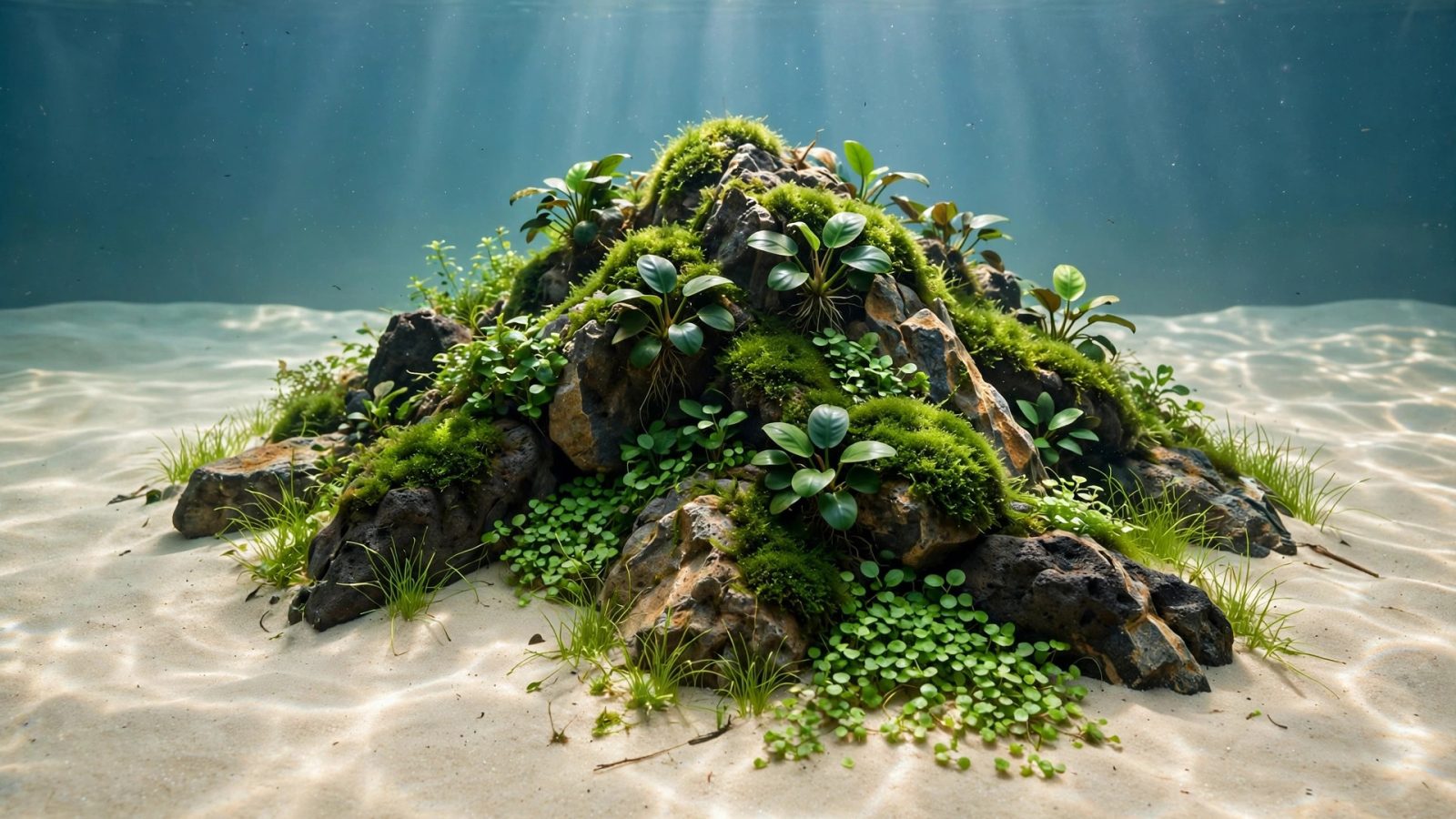
An island-style aquascape is exactly what it sounds like: a single mound of hardscape and plants rising from open substrate, surrounded by negative space on all sides — an island in an empty sea. It’s the most dramatic use of negative space in the hobby, and it turns the usual composition logic inside out: instead of filling the tank, you deliberately leave most of it empty. Get it right and the result is striking, serene, and unmistakable.
What Defines Island Style?
- One central mound — hardscape and plants concentrated in a single island, typically centered or near-center (the one layout where centered composition works, because the negative space is the composition).
- Open substrate surrounding it — usually pale sand, visible on all sides, making up 50–70% of the tank floor.
- Peak in the middle — height rises toward the island’s center and falls away in every direction, viewable from multiple sides.
- 360° design — islands suit peninsula tanks and room dividers; the scape should work from the front, sides, and often the back.
Island vs. Triangle: Choosing Your Geometry
Island and triangle composition are the two great nature-style geometries. Choose island when: the tank is viewed from multiple sides, you want maximum drama from negative space, or you love the “floating mountain” aesthetic. Choose triangle when: the tank is front-viewed only, you want a more forgiving first designed layout, or you prefer the classic nature-style look. Island is slightly harder — the 360° requirement and the discipline of leaving space empty both challenge beginners.
Building the Island: Step by Step
Step 1 — Mark the island footprint
On the empty tank floor, mark an oval or kidney shape occupying the central 30–50% of the footprint. Avoid perfect circles — organic, slightly irregular outlines look natural. The island should sit slightly off-center (toward the back-third) so the front sand expanse reads as a “beach” leading to it.
Step 2 — Build the mound
Pile lava rock rubble in mesh bags as the mound core — you need serious elevation (12–20 cm at the peak in a standard tank) and solid rock is expensive and heavy. Cap with 5–8 cm of aquasoil. The mound’s slopes should be stable: at this height, terracing with flat stones or foam retaining walls prevents slow collapse.
Step 3 — Place the peak hardscape
Set your tallest, most dramatic hardscape at the mound’s peak — a vertical stone spire, a branching root rising up, or a stacked rock formation. This is the island’s summit and the layout’s focal point. Secondary stones or wood cascade down the slopes, shrinking with distance from the peak. Because the island is viewed from all sides, check the hardscape from every angle — a composition that’s stunning front-on and awkward from the side fails the style.
Step 4 — Lay the sand sea
Surround the mound with 2–3 cm of pale sand (pool filter sand, river sand). The color contrast between dark aquasoil mound and light sand is half the visual effect. Keep a crisp boundary — a buried strip of plastic or stone edging stops the soils mixing over time. Rake the sand smooth with a fork; in island style, the empty sand is a design element, not leftover space, so it should look intentional and clean.
Step 5 — Plant the island densely
Plant the mound heavily from day one:
- Peak: tall stems or large epiphytes on the summit hardscape (Rotala, Java fern ‘Trident’, Bolbitis)
- Slopes: midground plants stepping down — crypts, Anubias, Hygrophila, Bucephalandra in crevices
- Shoreline: low carpet or small rosettes (Monte Carlo, Staurogyne repens, Cryptocoryne parva) softening where mound meets sand
- The sand stays empty. No plants in the negative space — that’s the discipline. A stray runner gets pulled.
Attachment techniques for the hardscape planting: driftwood and rocks.
Plant Selection for Islands
Islands need plants that mound well — bushy growers that build volume:
- Stems: Rotala rotundifolia, Ludwigia repens, Hygrophila polysperma (peak and upper slopes)
- Epiphytes: Java fern, Anubias barteri, Bucephalandra, mosses (on the peak hardscape)
- Rosettes: Cryptocoryne wendtii, Echinodorus ‘Ozelot’ (mid-slopes; heavy root feeders love the deep mound)
- Shoreline: Monte Carlo, Staurogyne repens, Helanthium tenellum
- Color accent: one red cluster (Alternanthera reineckii ‘Mini’, Ludwigia super red) placed off-peak for a secondary eye-stop
Maintenance: Defending the Negative Space
Island maintenance is about protecting the empty sand as much as growing the mound:
- Rake the sand weekly. Detritus shows on pale sand; a quick rake during water changes keeps it pristine.
- Pull invading runners. Carpet and stem runners constantly probe the sand — remove them before they establish.
- Trim the mound’s silhouette. The island should read as a clean mound; thin overhanging growth that blurs the shoreline.
- Vacuum gently. Hover the siphon over the sand — deep vacuuming disturbs the boundary edging.
- Resist filling the space. The eternal temptation: “just one small plant out there.” Don’t. The emptiness is the design.
Stocking an Island Tank
The open sand invites bottom-dwellers: corydoras shoals sifting the sand are the classic island-tank livestock — behaviorally perfect and visually ideal against pale substrate. Midwater, a single schooling species (ember tetras, chili rasboras, celestial pearl danios) circling the island completes the scene. Avoid diggers that’ll remodel your shoreline (large cichlids) and plant-eaters that’ll prune the mound.
Island Mistakes
- Island too small. A timid mound in a big tank looks lost — commit to 30–50% of the footprint.
- Perfect circle footprint. Organic, irregular outlines; nature doesn’t do geometry.
- Sand too deep or too shallow. 2–3 cm — deeper wastes space and risks anaerobic pockets; shallower shows glass.
- Plants in the negative space. The discipline of the style. Every stray gets pulled.
- Single-sided design. If the tank is viewable from multiple sides, design for all of them — walk around during the dry layout.
- Mound collapse. Tall mounds without internal support slump within months. Build the core from bagged rubble, not loose soil.
See 11 aquascaping mistakes beginners make for the general list.
Frequently Asked Questions
What is island style aquascaping?
A layout with a single planted hardscape mound surrounded by open substrate on all sides — maximum negative space, 360° viewing, one dramatic island.
How much of the tank should the island occupy?
Roughly 30–50% of the footprint, with 50–70% of the floor as open sand. Smaller reads as lost; larger stops being an “island.”
What substrate do you use for the open area?
Pale sand, 2–3 cm deep — the light color contrasts with the dark planted mound and makes the negative space glow. Keep it clean; it’s a design element.
Island Variations
The twin islands
Two smaller mounds — one dominant (60% of the hardscape), one subordinate (40%) — separated by open sand. More dynamic than a single island, but the hierarchy must be clear: equal twins compete and the composition splits. The smaller island sits at the opposite third from the main one, lower and simpler.
The ridge island
An elongated island — a ridge rather than a mound — running diagonally across the tank. Combines island negative space with triangle-like diagonal flow. Excellent for long tanks (90 cm+) where a round mound would look lost.
The bonsai island
A single dramatic bonsai-style driftwood tree as the island’s peak, moss as foliage, carpeted mound below. The most artistic island variant — and the most demanding, since the “tree” needs regular moss trimming to hold its shape.
The blackwater island
Island hardscape + tannin-tinted water + leaf litter scattered on the sand. The amber water and botanicals make the pale sand glow and the island read as a riverbank. A striking fusion of island geometry with biotope sensibilities.
Sand Selection and Care Detail
- Best sands: pool filter sand (cheap, uniform, light), river sand (natural varied tones), aquarium-specific white sand (brightest contrast). Avoid ultra-fine play sand — it compacts and traps gas.
- Depth: 2–3 cm. Enough to look like a seabed, shallow enough to stay oxygenated with light raking.
- Cleaning: hover-siphon weekly; stir the top 1 cm monthly with a fork to prevent compaction. Malaysian trumpet snails are the secret weapon — they turn the sand for you.
- Stain control: pale sand shows everything. Diatoms in new tanks, green dust under high light — normal, and the weekly rake-and-siphon handles it. Tannins stain sand over time; embrace the patina or refresh the top layer annually.
- The boundary: check the mound-sand edging monthly. Aquasoil creeping into the sand (or vice versa) blurs the crisp line the style depends on — push strays back during water changes.
How Long Until an Island Looks Finished?
Islands mature on the mound-planter’s schedule: 2–4 months for stems and carpets to cover the mound, 4–6 months for epiphytes and mosses to colonize the peak hardscape. The sand looks “finished” on day one — which is the style’s secret advantage. You get a presentable tank immediately while the island grows in. See fill-in timelines for the full picture.
The Psychology of Negative Space
Why does an island tank feel so striking? It’s contrast psychology: the human visual system responds most strongly to edges and boundaries. An island creates the maximum possible edge — a full 360° boundary between the planted mound and the empty sand. Every centimeter of that shoreline is visual interest. A fully planted tank has no edges; the eye wanders without landing. The island gives the eye a journey: across the empty sand (anticipation), up the shoreline (arrival), to the peak (reward).
This is also why islands photograph so well — the composition reads instantly even in a thumbnail, where dense jungle tanks become green mush. If you share your tank online, island is the most photogenic style per unit of effort.
Island Aquascaping Checklist
- Island footprint marked: organic oval/kidney, 30–50% of floor, slightly off-center
- Mound core built from bagged rubble (12–20 cm peak), capped with 5–8 cm aquasoil
- Retaining structure in place (stone terracing or foam walls) so the mound holds
- Peak hardscape set: tallest, most dramatic piece, checked from all viewing angles
- Secondary hardscape cascading down slopes, shrinking with distance
- Pale sand sea laid: 2–3 cm, crisp boundary edging installed
- Mound planted densely: peak height, mid-slope steps, shoreline softening
- Sand left empty — the discipline holds
- Photoperiod 7–8 hours, CO2 if running stems at the peak
- Maintenance scheduled: weekly sand rake, runner patrol, silhouette trims
- Stocking chosen: corydoras for the sand, schooling fish for the water column
Island FAQs: Extended
Can you do an island aquascape in a small tank?
Yes — a 5-gallon island is charming. Shrink everything proportionally: a fist-sized mound, one small stone peak, Bucephalandra and Anubias ‘Petite’, Monte Carlo shoreline. The negative space ratio matters more than absolute size.
How do you keep the sand white?
You don’t, quite — it develops a natural patina. Weekly raking and siphoning keep it clean; Malaysian trumpet snails turn it for you; and an annual top-layer refresh restores brightness. Embrace slight aging — pristine-white sand is a week-one look.
Island vs. iwagumi — which is easier?
Island, slightly. Iwagumi’s stone-placement rules are stricter and its single-carpet discipline is unforgiving. Island allows mixed planting on the mound and hides imperfections in the mound’s complexity. Both demand negative-space discipline.