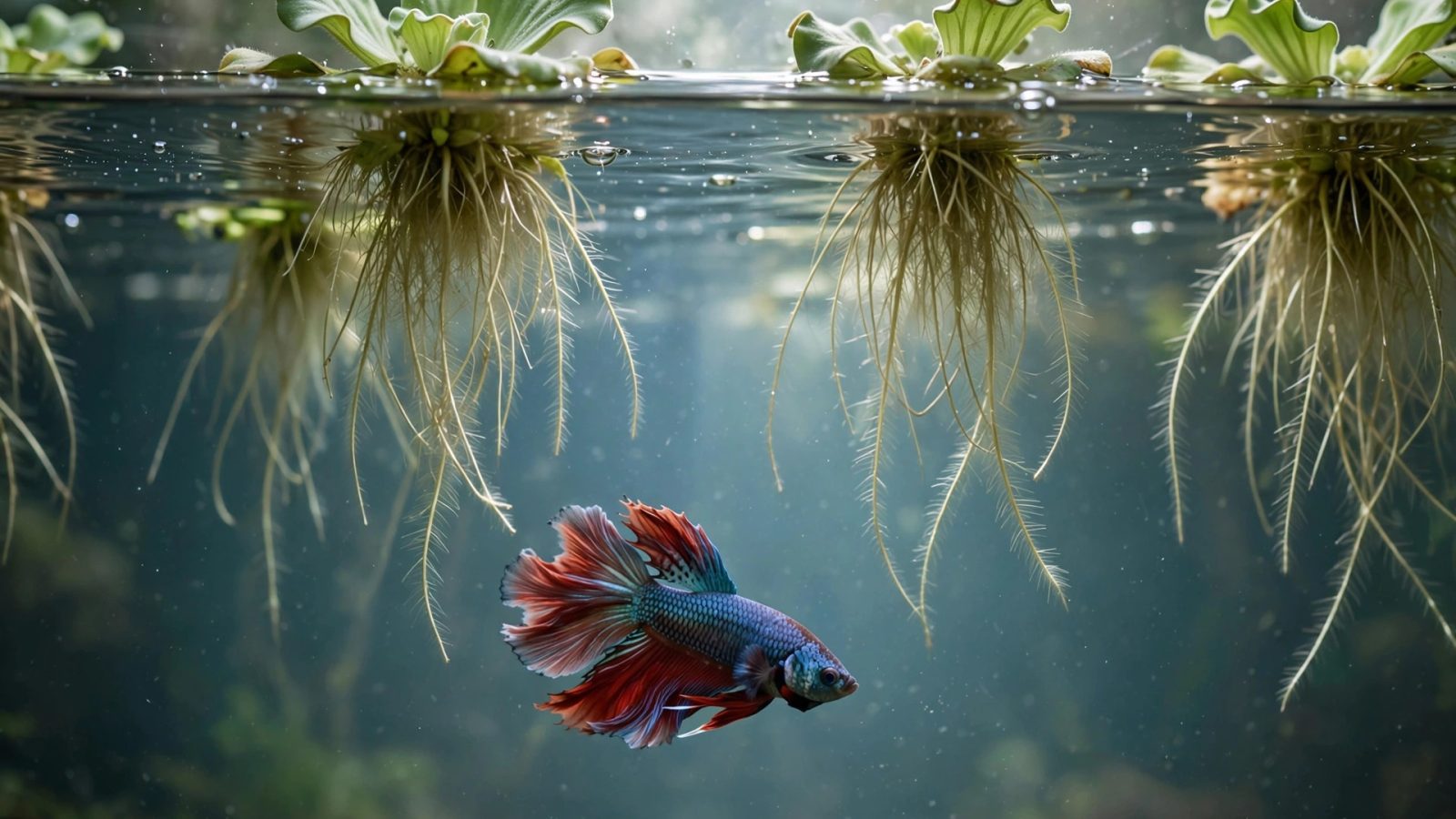
If you keep a betta, the single best upgrade you can give their tank is a layer of floating plants. Bettas are labyrinth fish, meaning they breathe air from the surface, and in the wild they live in slow-moving rice paddies and shallow pools choked with vegetation. A bare, open water surface feels exposed to a betta; a surface dotted with floating plants feels like home.
Floating aquarium plants give your betta shade, cover from perceived predators above, and sturdy anchors for bubble nests. They also soak up nitrates and phosphates directly from the water column, which keeps algae down and water quality up. Whether you’re running a filtered 10-gallon or a simple bowl-style setup, floaters are the easiest plants you’ll ever grow — they pull CO2 straight from the air, so they grow fast and ask for almost nothing in return.
Why Floating Plants Are Perfect for Betta Tanks
Bettas evolved in warm, still, heavily shaded water. Rice paddies in Southeast Asia are draped with overhanging grasses and aquatic vegetation that breaks up the sunlight and gives fish places to hide. Reproducing even a hint of that cover with floating plants visibly changes betta behavior: shy, corner-hugging fish start exploring, flare at their reflections less, and build bubble nests more readily.
That last point matters to keepers who enjoy natural behavior. Male bettas build bubble nests at the surface, and they prefer to anchor them against something — a broad floating leaf, a tangle of roots, the calm corner under a plant mat. A floating plant gives the nest structure and protects it from ripples that would otherwise scatter the bubbles.
There’s a practical payoff too. Floating plants are nutrient sponges. Because they access atmospheric CO2, they photosynthesize at full tilt and pull nitrate, phosphate, and ammonia straight out of the water, outcompeting algae. In a small betta tank where waste builds up quickly, a mat of floaters acts as a living filter — not a replacement for water changes, but a genuinely useful buffer. They also dim harsh aquarium lighting, which bettas prefer, since bright open water reads as danger to a fish that evolved under canopy shade.
The 7 Best Floating Plants for Betta Tanks
These seven are proven in betta setups, widely available, and easy enough for a first-time planted tank keeper. Listed from the most beginner-proof to the ones that need a little more attention.
Amazon Frogbit (Limnobium laevigatum)
Frogbit is the classic betta floater for good reason. Its rounded, lily-pad-like leaves sit on the surface while long, feathery roots trail 2–4 inches into the water — bettas love resting in and weaving through those roots, and males anchor bubble nests to the undersides of the leaves. It grows in low to medium light and betta temperatures (76–80°F), multiplies by sending out runners, and is easy to thin since each plantlet is large enough to grab. Keep some surface agitation away from the leaves: frogbit hates getting its tops splashed and will melt if water sits on its leaves constantly.
Dwarf Water Lettuce (Pistia stratiotes)
The dwarf variety stays small enough for nano tanks, forming velvety rosettes about an inch or two across. Its thick, ridged leaves are excellent bubble-nest anchors, and the dense root mass underneath is prime betta resting territory — you’ll often find a betta parked right in the middle of a lettuce cluster. It likes moderate light and warm water above 75°F, and it grows fast once established. In small tanks, pull out a few rosettes every week or two to keep it from covering the entire surface.
Red Root Floater (Phyllanthus fluitans)
If you want floaters that look as good as they function, this is the one. Small round leaves turn a rich red under strong light, and the bright red roots dangling below are a striking contrast — while also being exactly the kind of fine root tangle bettas enjoy exploring. It’s a little more demanding than frogbit: it wants decent light to keep its color and will fade back to green in dim setups. It tolerates betta temperatures well and spreads by runners. Thin it regularly, since it layers over itself and can smother its own lower leaves.
Common Salvinia (Salvinia minima)
Salvinia minima forms small, oval, fuzzy leaves about half an inch long that link into loose mats. It’s nearly indestructible in a betta tank — low light, warm water, minimal nutrients, it just keeps growing. The fine dangling roots are modest compared to frogbit or water lettuce, so it’s less of a nest anchor and more of a shade provider and nitrate sponge. Its main trait to know about: it grows very fast and layers into thick mats if you ignore it, so scoop a handful out weekly.
Water Spangles (Salvinia natans)
Water spangles are the European cousin of Salvinia minima and behave almost identically in the tank: small, quick-spreading leaves, minimal care requirements, excellent shade and nitrate uptake. Many keepers use the names interchangeably, and for betta purposes the choice between the two barely matters — buy whichever your shop or seller has. Like S. minima, it layers aggressively, so regular thinning is the whole maintenance routine. It’s a great pick if you want a soft, even carpet of green across part of the surface.
Duckweed (Lemna minor)
Duckweed is honest-to-goodness the easiest floating plant alive: tiny lentil-sized fronds that double in number every couple of days in a warm, lit betta tank, asking for nothing. It provides superb shade and nutrient uptake, and bettas will push through it to breathe without issue. Here’s the honest caution: duckweed is nearly impossible to remove once established. It clings to nets, arms, and equipment, hitches rides into other tanks, and can shade out everything beneath it. Many keepers love it; many regret it. If you try it, keep it corralled in a feeding ring from day one, and never dump tank water containing duckweed down a drain or into local waterways — it’s a genuine invasive species in many regions.
Hornwort as a Floating Stem (Ceratophyllum demersum)
Hornwort isn’t a true floater, but left unplanted it drifts at or just below the surface and does everything a floater does — plus more. Its dense, needle-like foliage is one of the best bubble-nest anchors of any plant, bettas rest in it constantly, and it’s a famous nutrient hog that starves algae. It tolerates cool-to-warm water, low light, and total neglect, and it needs no substrate. The tradeoff: it’s messy. Hornwort sheds needles when stressed or moved, so give it stable conditions and thin it by snapping stems in half and removing the extras. In a betta tank it works best as one or two drifting clumps rather than a full mat, paired with true floaters like frogbit.
How to Keep Floaters from Taking Over
Every plant on this list grows fast — that’s the point — but a betta tank with 100% surface coverage causes its own problems. Your betta needs open water to breathe, feed, and build nests. A good target is 30–50% coverage: enough for shade and security, open enough for easy surface access.
Build thinning into your weekly routine. During your water change, scoop out a handful of floaters and compost or share them. Plants like salvinia and duckweed layer over themselves, and the buried lower leaves rot and foul the water if you never thin. Larger floaters (frogbit, water lettuce) are easy to thin plant by plant; just snap off runner plantlets.
The real trick is a feeding ring or plant corral — a floating plastic ring that holds floaters back and keeps a clear patch of open water. Place one where you feed so food doesn’t drift under the plant mat and rot, and consider a second corral as a dedicated “nest zone” where your male can build undisturbed. You can buy aquarium feeding rings cheaply, or DIY one from airline tubing joined with a connector. Corralling the plants also stops the filter outflow from pushing the whole mat into one corner.
Floating Plants and Your Filter
Bettas need calm water. Strong surface agitation stresses them, shreds bubble nests, and — with floaters in the tank — shoves the entire plant mat to one side and drowns the leaves. If you’re running a hang-on-back or internal filter, baffle the outflow: aim it at the tank wall, raise the water level to reduce the waterfall drop, or slip a piece of filter sponge over the outlet.
Sponge filters are the natural partner for a floater-filled betta tank. They run on air, produce gentle flow with minimal surface disturbance, and won’t suck plantlets into an impeller. Whatever filter you use, the test is simple: if the surface ripples only gently in a small area and your floaters stay put, your flow is fine. If the whole mat is constantly being pushed around or leaves are getting dragged under, dial the flow back.
Keep intakes clear, too. Fine roots and stray duckweed fronds love to clog filter intakes. A pre-filter sponge over the intake solves this and protects your betta’s fins at the same time.
Lighting with Floating Plants
Floaters shade everything below them — that’s a benefit for your betta, but it’s something to plan around if you also keep submerged plants. A thick mat of frogbit can cut light to the bottom of the tank by half or more, which will stall or melt light-hungry stem plants while Java fern and other low-light aquarium plants underneath will do just fine.
The fix is the same 30–50% coverage target plus corralling. Keep floaters contained to one side or in rings so a column of light always reaches the substrate. If your submerged plants start stretching or losing lower leaves, thin the floaters first before buying a stronger light. And in a low-tech planted tank, floaters are actually an asset for algae control: by shading the tank and hogging nutrients, they make it much harder for algae to get a foothold.
Frequently Asked Questions
Do floating plants help male bettas build bubble nests?
Yes — noticeably. Males anchor their bubble nests to floating leaves, dangling roots, and plant stems, which keeps the nest intact and concentrated. Frogbit, water lettuce, and hornwort are especially good nest anchors because of their broad leaves and dense root or foliage structure.
Will floating plants block too much light for my other plants?
They can if you let them cover the whole surface. Keep coverage around 30–50%, corral floaters with feeding rings so light reaches the substrate in at least one area, and pair them with shade-tolerant species like Java fern, anubias, and mosses underneath. Thin weekly to stay ahead of overgrowth.
Do bettas eat floating plants?
Bettas are carnivores and don’t graze on plants the way some fish do. They may nip curiously at roots or push through foliage, but they won’t eat your floaters. Any nibbled-looking leaves are usually snail damage, nutrient deficiency, or mechanical damage from strong filter flow — not the betta.
Can I keep floating plants in an unfiltered betta tank?
Floaters actually help in unfiltered setups by absorbing ammonia and nitrates, but they don’t replace water changes. In a small unfiltered container, keep up a strict water-change schedule and keep plant coverage moderate so the betta always has clear surface access. A gentle sponge filter is still the better long-term setup.
Why are my floating plants melting or turning yellow?
The most common cause is water sitting on top of the leaves — most floaters rot if their tops stay wet, so baffle filter splash and condensation. Yellowing usually means a nutrient deficiency (iron or nitrogen are typical culprits); a basic liquid fertilizer dosed lightly will green them back up. Sudden melting after introduction is often just transplant shock, and new growth should appear within a week or two.
Is duckweed really that bad for a betta tank?
It’s not bad for the betta — duckweed provides excellent shade and nutrient uptake. The problem is for you: it’s nearly impossible to eradicate once introduced, it sticks to everything, and it can colonize every tank you own via shared equipment. If you’re okay with a permanent resident and keep it corralled, it’s fine. If that sounds like a headache, choose frogbit or salvinia instead.
Start with one or two easy floaters — frogbit plus a patch of salvinia is a classic combo — keep them thinned and corralled, and watch how your betta responds. Most keepers see a calmer, more active, more natural-behaving fish within days, and a tank that stays cleaner with less effort. That’s about as good a deal as this hobby offers.