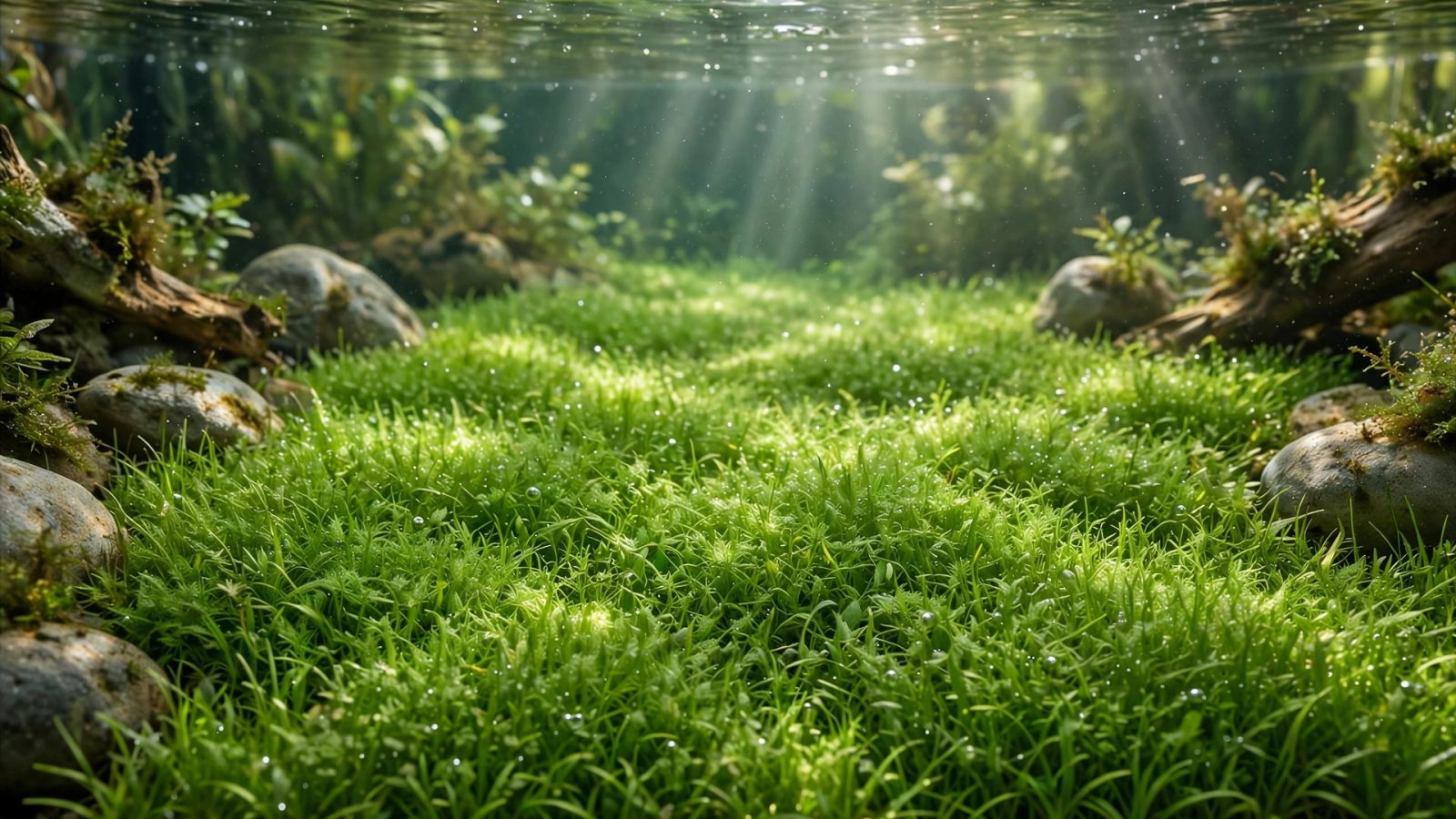
Dwarf hairgrass care is the gateway to the lush green carpet every aquascaper dreams about. Those dense, bright-green lawns in contest photos? More often than not, that is Eleocharis parvula — a tiny grass-like plant that spreads by runners into a seamless meadow across the foreground. It is also the plant behind the most common beginner disappointment in the hobby: the carpet that never carpets.
The gap between dream and reality comes down to expectations and technique. Dwarf hairgrass can carpet without CO2, but it carpets slowly and sparsely; with CO2 and good light it transforms in weeks. This guide gives you honest expectations for both paths, the planting technique that actually works, and the trimming schedule that keeps a carpet dense instead of straggly.
Dwarf Hairgrass Care at a Glance
| Parameter | Recommendation |
|---|---|
| Scientific name | Eleocharis parvula (also E. acicularis) |
| Light | Medium to high (40–60+ PAR for dense carpets) |
| Temperature | 68–78°F (20–26°C) |
| pH | 6.0–7.5 |
| Water hardness | Soft to moderately hard |
| CO2 | Not strictly required, but transformative |
| Fertilizer | Root tabs + liquid; moderate feeder |
| Substrate | Fine substrate essential — aquasoil or fine sand, 1.5–2 inches |
| Growth rate | Moderate with CO2; slow without |
| Placement | Foreground carpet |
| Height | 2–4 inches (trim to taste) |
| Difficulty | Moderate |
CO2 vs. No CO2: Honest Expectations
This is the conversation every dwarf hairgrass guide should start with:
- With CO2 + medium-high light: expect visible runner spread within 2–3 weeks and a dense carpet in 2–3 months. This is the contest-photo path.
- Without CO2 + medium light: expect slow, patchy spread over 4–8 months. You get a pleasant grassy foreground, not a seamless lawn. It still looks good — just different.
- Without CO2 + low light: hairgrass survives but barely spreads. Do not attempt a carpet here; choose dwarf sagittaria or a moss carpet instead.
The low-tech carpet is absolutely achievable — it just demands patience and the right technique. Our carpeting without CO2 guide compares all your options side by side.
Substrate: Fine and Nutritious
Dwarf hairgrass roots are delicate and shallow. Coarse gravel defeats them — the tiny roots cannot grip large pebbles, and runners travel poorly through chunky substrate. You need:
- Aquasoil (best): fine-grained, nutrient-rich, perfect texture for runners. The professional choice.
- Fine sand with root tabs (good): works well if the sand is truly fine-grained. Push root tabs throughout the carpet zone.
- Minimum depth 1.5–2 inches in the foreground. Shallower and runners have nowhere to go.
See our substrate comparison for the full breakdown of planted-tank options.
Planting Technique: The Part Everyone Gets Wrong
Dwarf hairgrass arrives as a dense potted clump or tissue-culture cup. Planting the whole clump as one lump is the classic mistake — the center rots, the edges survive, and you get a donut instead of a carpet. Do this instead:
- Divide aggressively. Tease the clump apart into portions of 5–10 blades each. Yes, it is tedious. Yes, it matters enormously. More planting points = faster, more even coverage.
- Plant in a grid. Using tweezers, push each portion into the substrate about an inch apart across the entire foreground zone. Leave the blades sticking up — only the roots and base go under.
- Trim the blades short (to about an inch) right after planting. This looks alarming but encourages the plant to put energy into runners instead of maintaining tall blades, and reduces transplant shock.
- Flood gently (or plant before flooding in a dry start — see below).
A standard foreground needs 3–6 pots or 2–3 tissue-culture cups when divided properly. Buy more than you think you need; sparse planting is the main reason carpets take forever.
The Dry Start Method
The dry start method (DSM) grows the carpet emersed before flooding the tank, and it is arguably the best way to establish dwarf hairgrass:
- Set up hardscape and moist (not waterlogged) substrate.
- Plant divided hairgrass portions in the damp substrate.
- Mist daily, cover the tank with cling film to hold humidity, and provide 10–12 hours of light.
- After 4–8 weeks of strong emersed growth, flood the tank slowly.
Advantages: unlimited CO2 from the air means explosive growth, no algae competition, and roots establish firmly before water flow disturbs them. Disadvantage: you wait weeks with an empty-looking tank, and some melt occurs after flooding as leaves transition. For low-tech keepers especially, DSM is the closest thing to a cheat code for carpets.
Light and Fertilizer
Medium to high light (40–60+ PAR) drives the dense, compact growth that makes carpets beautiful. In lower light, hairgrass grows taller and sparser — still alive, but leggy rather than lawn-like. A 7–8 hour photoperiod balances growth against algae risk.
Feed both routes: root tabs scattered through the carpet zone every 2–3 months, plus a comprehensive liquid fertilizer for the water column. Hairgrass is a moderate feeder — starved carpets turn yellow from the tips inward. The fertilizer schedule guide gives you a week-by-week dosing routine.
The Trimming Schedule
Regular trimming is what separates a carpet from a meadow:
- First trim: 2–3 weeks after planting (or after flooding, for DSM), cut to ~1 inch. This triggers horizontal runner growth.
- Ongoing: trim every 2–4 weeks, maintaining your target height (1–2 inches for a tight lawn look).
- Always remove cuttings. Loose blades settle into the carpet and rot. Siphon or net thoroughly after every trim.
- Thin occasionally. Very dense carpets can choke their own lower layers — every few months, pull a few plugs to let light and flow reach the base.
Each trim stimulates denser regrowth. A never-trimmed carpet grows tall, flops over, and develops brown underlayers — the opposite of the look you want.
Common Dwarf Hairgrass Problems
Melting after planting
Emersed-to-submersed transition, especially with potted stock. Tissue-culture plants melt less. Trim melted blades, keep conditions stable, and wait for submersed regrowth from the roots — which usually survives.
Yellowing blades
Nutrient deficiency (usually nitrogen or iron) or insufficient light. Increase feeding and check that taller plants are not shading the foreground.
Algae smothering the carpet
The low-tech carpet’s nemesis. Reduce photoperiod, ensure good flow across the foreground, and add Amano shrimp — they graze hairgrass blades without damaging them. Severe cases may need a blackout or a restart of the affected section.
Runners escaping into midground
Normal vigor. Pull unwanted runners monthly, or install a buried barrier strip between foreground and midground zones.
Carpet lifting off the substrate
Root mass too shallow, or gas buildup underneath. Usually indicates substrate too coarse or too shallow — press sections back down and address the underlying cause.
Dwarf Hairgrass vs. Monte Carlo
The two classic carpet plants serve different aesthetics: hairgrass gives a grassy meadow texture; monte carlo gives a clover-like leafy mat. Monte carlo is more forgiving in low-tech setups and stays lower, while hairgrass handles higher flow and gives that windswept lawn look. Many aquascapers use both — hairgrass in open areas, monte carlo around hardscape bases.
Dwarf Hairgrass Species Compared
| Species | Height | Texture | Notes |
|---|---|---|---|
| E. parvula | 2–4 in | Fine, bright green | The standard; best all-rounder |
| E. acicularis | 4–8 in | Fine, darker | Taller; better for midground or larger tanks |
| E. acicularis ‘Mini’ | 1–2 in | Very fine | Ultra-compact; needs high light and CO2 |
For most tanks, E. parvula is the right choice. The ‘Mini’ variety is a high-tech specialist — beautiful but demanding. E. acicularis (standard) suits larger tanks where a taller grass texture is wanted.
Deep Troubleshooting: When Carpets Fail
The carpet that never spreads
Systematic diagnosis: (1) Light below 30 PAR at substrate? Upgrade or accept a different plant. (2) Substrate coarse or shallow? Runners cannot travel. (3) Planted in one clump? Divide and replant in a grid. (4) Tank too new? Biofilm and microfauna that support root health take weeks to establish. Address in order — most failures are light or planting technique.
Carpet grows but looks sparse
Usually insufficient planting density combined with low CO2. The fix is more plant mass (buy more, divide more aggressively) rather than more fertilizer. A sparse carpet rarely “fills in eventually” without intervention — density comes from planting points, not patience alone.
Brown patches in the carpet
Localized die-off from detritus accumulation, gas pockets in the substrate, or allelopathic competition from neighboring plants. Siphon the patch gently, poke the substrate with a skewer to release gas, and replant the bare spot with trimmings.
Carpet pearling but not spreading
Oxygen bubbles (pearling) mean photosynthesis is active — the plant is healthy but putting energy into blade growth rather than runners. Hard trim to 1 inch to redirect energy horizontally.
Cost Planning: Budgeting Your Carpet
Hairgrass carpets cost more in plants than beginners expect. Budget guidelines for a standard foreground:
- 10-gallon: 2–3 pots or 1–2 tissue-culture cups
- 20-gallon long: 4–6 pots or 2–3 tissue-culture cups
- 40-gallon breeder: 6–10 pots or 4–5 tissue-culture cups
- 75-gallon: 10–16 pots or 6–8 tissue-culture cups
Tissue culture gives more planting portions per dollar and arrives pest-free. Under-buying is the false economy — a sparse carpet takes twice as long and often fails, wasting the initial investment.
Hairgrass and Tank Ecology
A dwarf hairgrass carpet is not just decoration — it is a functioning ecosystem component:
- Biological filtration: the dense root mat hosts enormous beneficial bacteria colonies, supplementing your filter. Mature carpets measurably reduce ammonia and nitrite spikes.
- Oxygenation: the root zone releases oxygen into the substrate, preventing anaerobic dead spots that plague deep foregrounds. This is why carpets rarely develop the hydrogen sulfide issues bare deep substrate does.
- Microfauna habitat: copepods, seed shrimp, and other microfauna colonize the carpet base — a constant live-food source for fry and small fish. Breeding tanks with hairgrass carpets produce noticeably better fry survival.
- Nutrient buffering: the carpet absorbs excess nutrients that would otherwise feed algae, stabilizing the tank’s chemistry between water changes.
These ecological functions are why experienced keepers consider a healthy carpet a sign of a mature, stable tank — it is both beautiful and hardworking.
Transitioning from Other Foregrounds
Replacing an existing foreground with hairgrass requires planning:
- From dwarf sagittaria: remove sagittaria runners thoroughly — any missed runner regrows and invades the hairgrass. Expect 2–3 months of pulling volunteers.
- From monte carlo: easier transition; monte carlo lifts out cleanly in mats. The substrate is already carpet-ready.
- From bare substrate: the ideal starting point. Ensure 1.5–2 inches of fine substrate and plant directly.
- Timing: transition in spring when growth is vigorous. The hairgrass establishes faster and outcompetes remnants of the old foreground.
The Low-Tech Carpet Playbook
No CO2? You can still get a hairgrass carpet — you just need to play a different game. The low-tech playbook trades speed for patience and equipment for technique:
- Plant absurdly densely. This is the whole trick. In a high-tech tank, a few pots spread to fill the foreground. Without CO2, runners creep instead of sprinting, so the carpet you plant is nearly the carpet you get. Budget for double or triple the plant mass you think you need — five to eight pots for a 20-gallon foreground is not extravagant, it is the plan.
- Use the dry start. Growing the carpet emersed for four to eight weeks before flooding gives hairgrass unlimited atmospheric CO2 during the critical spreading phase. Flood a filled-in mat and you skip the hardest months of submerged establishment entirely.
- Light it well. Low-tech does not mean low light. Hairgrass still wants medium to medium-high light to stay compact; dim light plus no CO2 gives you tall, sparse blades instead of a lawn.
- Trim early and often. The first trim feels wrong — cutting healthy new growth — but it forces the runners to branch horizontally instead of growing tall. Start trimming once blades reach an inch, and never remove more than a third at once.
- Expect six to twelve months. That is the honest timeline for a no-CO2 hairgrass carpet. If that sounds unbearable, dwarf sagittaria will give you a grassy foreground in half the time — less refined, far more forgiving.
The low-tech carpet is a test of patience, not skill. Keep the substrate fed, the light adequate, and the scissors busy, and the runners do the rest on their own schedule.
The Bottom Line
Dwarf hairgrass care rewards technique over equipment. Divide ruthlessly when planting, give it fine nutritious substrate, trim on schedule, and set honest expectations for your CO2 situation. With CO2 you get a contest lawn in months; without it you get a charming grassy foreground in the better part of a year. Either way, the method is the same — small portions, good substrate, regular haircuts. Master that and the carpet takes care of itself.