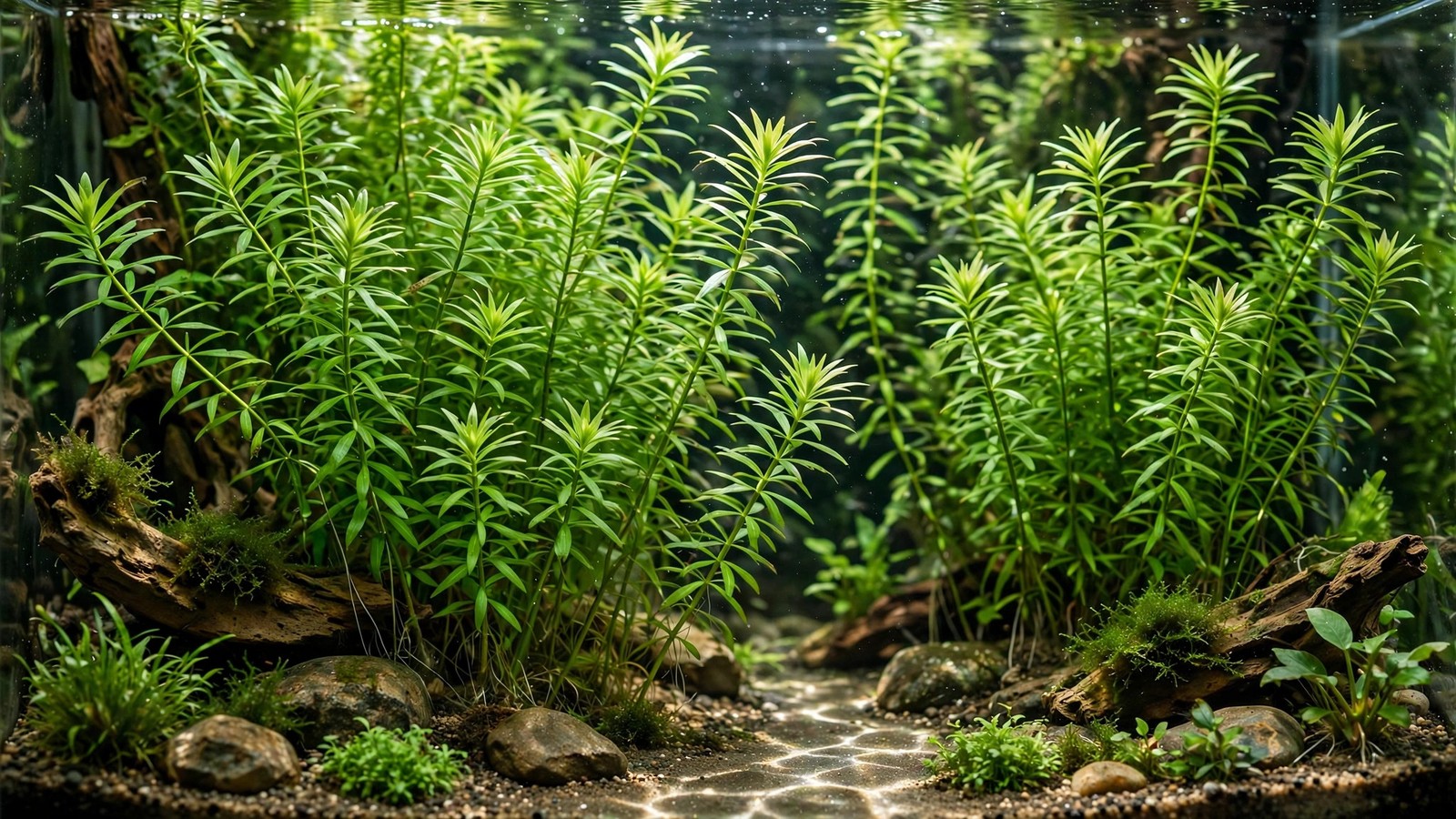
Every hobbyist's first plant, and still one of the most useful. Egeria densa care (sold as anacharis or Brazilian waterweed) is about as simple as aquarium plants get: it grows in almost any water, tolerates cold, needs no CO2, and can be planted or floated. Native to South America, it's a beginner's best friend — and, like all vigorous plants, one to keep out of local waterways.
This guide covers planting and floating, light and temperature tolerance, its role in new tanks and ponds, propagation, and the invasive-species responsibility that comes with such a vigorous plant.
Quick Care Reference
| Parameter | Requirement |
|---|---|
| Light | Low to high (25+ PAR) |
| CO2 | Not required |
| Growth rate | Very fast |
| Placement | Background or floating |
| Difficulty | Very easy |
| Temperature | 50–82°F (10–28°C) |
| pH | 6.0–8.5 |
| Height | 12–40 inches (30–100 cm) |
The Classic Beginner Plant
Egeria densa has been sold in pet shops for generations — often as loose bunches labeled "anacharis" — because it survives conditions that kill nearly everything else. Its whorls of bright green leaves grow on sturdy stems, and it keeps growing in cool water down to 50°F, making it one of the few aquarium plants suitable for unheated tanks and temperate ponds.
It's also a genuine workhorse for water quality: Egeria absorbs ammonia, nitrates, and phosphates aggressively, and it oxygenates water heavily during the day. That's why it's recommended for cycling new tanks and for goldfish setups, where hardy, fast nutrient uptake matters more than aquascaping finesse.
Responsibility note: Egeria densa is invasive in many regions — it has choked waterways on multiple continents. Never release it into the wild, never dump tank water containing fragments into drains leading to waterways, and compost or trash trimmings. The same rule we noted for Hygrophila polysperma applies doubly here given Egeria's cold tolerance.
Planting or Floating: Your Choice
Egeria is unusually flexible. Plant stems an inch deep in the substrate — it roots readily, though never very deeply — or simply let it float. Floating Egeria grows just as well, trailing roots from its nodes, and makes excellent cover for fry and shy fish. Many breeders keep it exclusively floating.
Planted in the background, space stems 1–2 inches apart; it grows tall (up to 3 feet in ideal conditions) so give it vertical room. In ponds, weight bunches or plant in pots of gravel — it will fill the water column fast. It tolerates plain gravel fine; rich substrate isn't necessary, though root tabs don't hurt.
Light, Temperature, and CO2
Light: low to high all work. In low light it grows steadily and stays green; in strong light it grows explosively and develops denser whorls. An 8-hour photoperiod is plenty. It's not picky about spectrum either — basic shop lights grow it fine.
Temperature is where Egeria stands out: it thrives from 50°F to 82°F, tolerating unheated indoor tanks, temperate ponds, and cool basements where tropical plants fail. Above ~82°F growth slows and it can struggle — it's one of the few common plants that prefers it not too warm. For warm tanks above 80°F, hornwort is a better cold-and-warm-tolerant alternative with similar vigor.
CO2 is unnecessary. Egeria grows fast on dissolved CO2 alone and is actually efficient at using bicarbonate, which is part of why it does well in hard, alkaline water that stunts fussier plants.
Fertilizer Needs
Minimal. In stocked tanks, fish waste is usually enough. Egeria is such an aggressive nutrient absorber that it can actually strip a tank of nitrates — if other plants pale while Egeria thrives, the Egeria may be outcompeting them, and you may need to fertilize more or thin the Egeria. Add comprehensive liquid fertilizer if growth slows or older leaves yellow.
It's sensitive to some algaecides and liquid carbon products at high doses — dose conservatively around it, or better yet, rely on its natural vigor instead of chemical algae control.
Trimming and Propagation
Trim by cutting stems anywhere — Egeria doesn't care about nodes the way fussier plants do, though cutting above a whorl gives the tidiest regrowth. It grows inches per week in good conditions, so trim every 1–2 weeks in the growing season. Remove excess entirely rather than replanting everything; it multiplies faster than any tank needs.
Propagation: every cutting roots. Drop a 4-inch piece in water and it grows. This is why it's both beloved and ecologically dangerous — fragments the size of a fingernail can start new colonies, which is exactly why responsible disposal matters.
Troubleshooting Common Problems
Melting or shedding leaves
Newly purchased Egeria sometimes sheds lower leaves while adjusting — usually transient. Persistent melting suggests too-warm water (above 82°F), ammonia in an uncycled tank, or exposure to algaecides/copper. Egeria is copper-sensitive, so check medications and algaecides if it suddenly declines.
Slow or stalled growth
Unusual for Egeria — investigate. Common causes: water too warm, severe nutrient depletion (it's usually the cause of depletion, not the victim, but in very lean tanks even it stalls), or very dim light. In ponds, winter dormancy is normal; it resumes in spring.
Taking over the tank
The standard Egeria experience. Trim ruthlessly, remove whole stems, and consider whether a slower plant suits a display tank better — Egeria is a utility plant, not a fine aquascaping specimen. Its coarser texture suits natural-style and biotope tanks better than manicured Dutch layouts.
Fish eating it
Goldfish, silver dollars, and some cichlids graze Egeria enthusiastically — which is actually a point in its favor for goldfish tanks, since it grows faster than they eat it (usually). If fish strip it bare, switch to tougher plants like Anubias or Java fern, or grow Egeria in a separate refugium as a renewable snack.
Brittle stems breaking apart
Egeria stems snap easily when handled — normal. Fragments root and grow, so breakage during trimming just means more plants. In high-flow tanks, position it out of direct filter outflow to reduce constant fragmentation.
Best Uses: Where Egeria Earns Its Keep
Egeria densa is a utility player. Best deployments: cycling new aquariums (ammonia sponge), goldfish and coldwater tanks (one of few plants that thrives), breeding tanks (floating cover for fry), temperate ponds, quarantine/hospital tanks (hardy, disposable, oxygenating), and algae-fighting duty in any new setup. It's less suited to high-end aquascaping competitions — its coarse texture and explosive growth fight against manicured aesthetics — but for practical fishkeeping it's invaluable.
Pair it with other tough utility plants like hornwort and water wisteria for a bulletproof low-tech background that survives almost anything.
Pond and Outdoor Use
Egeria densa is one of the best oxygenating plants for temperate ponds. Plant weighted bunches in the shallow margins in spring; by midsummer it fills the water column, providing shade, shelter for fry and tadpoles, and serious nutrient uptake that starves blanket weed. In autumn, growth slows; in freezing climates it dies back to the crown and resprouts in spring, though a hard freeze solid through the pot can kill it — in very cold regions, overwinter a bucket of it indoors. Never plant it in natural ponds or waterways connected to wild systems; garden ponds with no outflow are the responsible limit.
Frequently Asked Questions
Is anacharis the same as Egeria densa?
Yes — anacharis is the trade name for Egeria densa (also sold as Brazilian waterweed). "Anacharis" bunches in pet shops are virtually always Egeria densa. A related plant, Elodea canadensis (American waterweed), is similar but less common in the trade and even more cold-hardy.
Can Egeria densa grow floating?
Absolutely — it grows just as well floating as planted, trailing roots from stem nodes. Floating Egeria is excellent fry cover and a great way to hold trimmings. It will shade plants below, so manage the surface coverage in planted tanks.
Does it need substrate?
No. Egeria absorbs most nutrients through its leaves and grows fine floating or weighted without substrate. Planted stems root lightly for anchorage. This makes it ideal for bare-bottom breeding and quarantine tanks. This flexibility makes it perfect for bare-bottom breeding and quarantine setups.
What temperature can Egeria densa handle?
An impressive 50–82°F (10–28°C). It thrives in unheated tanks and temperate ponds, going semi-dormant in cold winters and resuming in spring. Above ~82°F it struggles — keep it out of very warm discus-style tanks. Few aquarium plants match this remarkable temperature tolerance.
Why is my Egeria melting?
Check temperature first (too warm is the common cause), then copper/medication exposure — Egeria is copper-sensitive — then ammonia in new tanks. Brief leaf-shedding after purchase is normal adjustment. Established Egeria rarely melts without a clear cause. Healthy established Egeria is remarkably resilient once the cause is corrected.
Is Egeria densa invasive?
In many regions, yes — it has invaded waterways worldwide, forming dense mats that choke native ecosystems. Never release it or dump tank water containing fragments outdoors. Dispose of trimmings in the trash or compost. Its vigor in the aquarium is exactly what makes it dangerous in the wild.
Bringing It All Together
Egeria densa won't win aquascaping contests, and it doesn't try to. It's the plant you buy by the bunch for a new tank, a goldfish setup, a pond, or a breeding project — and it does the unglamorous work of cleaning water, sheltering fry, and outcompeting algae while asking for nothing. Respect its invasive potential, trim it often, and appreciate the hardest-working cheap plant in the hobby.
Tissue-culture plants are the exception — they’re grown in sterile gel and adapt with minimal melting, which is part of what you’re paying for. Plants bought submersed from another hobbyist’s tank also transition with little melt, since they’re already in the right form.
Which Plants Melt Most (and Least)
Heavy melters (expect significant leaf loss)
- Cryptocorynes — infamous for “crypt melt,” sometimes dropping every leaf after any disturbance. They almost always recover from the roots within weeks.
- Stem plants grown emersed — rotala, ludwigia, and hygrophila often shed lower emersed leaves while the growing tips transition.
- Amazon swords — emersed-grown swords typically lose their broad oval aerial leaves and replace them with longer submersed ribbon leaves.
Light melters
- Anubias, java fern, bucephalandra — slow-growing rhizome plants transition gradually; occasional old-leaf melt but rarely dramatic.
- Vallisneria — usually transitions well, though it dislikes the move itself and may sulk for a week.
- Floating plants — minimal melt since their leaves were already at the air-water interface.
The Acclimation Protocol
Step 1: Quarantine or dip first
Before acclimating to your tank’s conditions, make sure you’re not acclimating pests along with the plant. Run new arrivals through our quarantine and dip protocol — it adds days upfront but prevents months of regret.
Step 2: Float to temperature-match (30 minutes)
Float the bag or container in your tank for 20–30 minutes to equalize temperature. Plants are less temperature-sensitive than fish, but a 10°F shock on top of transplant stress is an avoidable insult.
Step 3: Trim before planting
Remove any leaves that are already damaged, yellowing, or heavily algae-covered — they won’t recover and they’ll rot in your tank, feeding algae. For stem plants, trim off the bottom inch and any emersed leaves that look unlikely to adapt; the plant wastes energy maintaining leaves it’s going to shed anyway. Keep the healthy growing tips — that’s where recovery starts.
Step 4: Plant correctly the first time
Follow our planting guide — right depth, crown exposed on rosettes, rhizomes unburied on epiphytes. Every uprooting and replanting restarts the acclimation clock, so get placement right on the first attempt. Decide where each plant goes before it goes in the water.
Step 5: Run a gentle first week
For the first 7 days after planting:
- Moderate light — run your normal photoperiod but consider dropping intensity 20–30% if your light is dimmable. Blast-level light on a melting plant grows algae on the dying leaves, not recovery.
- Stable CO2 — if you inject CO2, keep it consistent. Fluctuating CO2 during acclimation is a melt accelerator. If you’re low-tech, this doesn’t apply — see growing without CO2.
- Half-strength fertilizer — new plants with damaged leaves can’t use full dosing, and the excess feeds algae. Ramp to full strength over 2–3 weeks per our fertilizer schedule.
- No disturbance — don’t move, trim, or “check on” new plants for at least two weeks. Every touch resets root establishment. This is especially critical for crypts.
Step 6: Remove melt, keep the base
As emersed leaves melt, remove the mushy material promptly — decaying leaves release ammonia and grow fungus that can spread to healthy tissue. But never discard the plant while the crown, rhizome, or roots are firm and alive. A crypt that’s lost every leaf but has firm roots is a plant that’s about to recover, not a dead plant. Give it 3–4 weeks before judging.
Telling Normal Melt From Real Problems
Normal transition melt:
- Affects oldest/emersed leaves first, newest growth last
- New submersed leaves emerge even as old ones dissolve
- Roots and crown stay firm and white/green
- Timeline: 1–4 weeks, then obvious new growth
Concerning melt (see our full melting diagnosis guide):
- New growth also melts or emerges deformed
- Rhizome or crown turns mushy and brown — this is rot, not transition
- Entire plant dissolves within days with no new growth after 4+ weeks
- Melting spreads to established plants that weren’t recently moved
Buying Tips to Minimize Melt
- Buy submersed-grown when available — hobbyist-grown cuttings transition with almost no melt.
- Choose tissue culture for sensitive species — crypts and delicate stems establish far more reliably from sterile cups.
- Avoid plants already melting in the store tank — some melt is normal, but a plant that’s mostly mush at purchase has less energy for recovery.
- Transport carefully — keep plants damp and out of direct sun/heat. A plant that dries out or cooks in a hot car melts far worse than one transported properly.
The First-Month Timeline: What to Expect Week by Week
Knowing what’s normal when removes most acclimation anxiety. Here’s the typical timeline for a healthy plant adapting to a new tank:
Week 1: The quiet week
Almost nothing visible happens. The plant is growing roots you can’t see and assessing its new environment. Some species (vallisneria, stem plants) may start shedding their lowest leaves. This is normal. Resist the urge to “help” — no moving, no extra fertilizer, no light changes. The most common beginner mistake is intervening during a week when the correct action is nothing.
Week 2: Melt peaks
This is when emersed leaves give up in earnest. Crypts may drop everything; swords shed their broad aerial leaves; stem plants lose lower foliage. It looks catastrophic and it’s usually fine. Keep removing mushy material, keep conditions stable, and watch the crown and growing tips — if those are firm and green, recovery is already underway.
Week 3: The turn
New submersed-adapted leaves emerge — smaller, thinner, often a slightly different shade of green than the emersed foliage. Stem plant tips start growing visibly; crypts push tiny curled leaves from the crown; swords unfurl narrow ribbon leaves. This is the moment most beginners exhale for the first time.
Week 4+: Established
New growth outpaces melt, and the plant is functionally yours. You can resume full-strength fertilizer, normal trimming, and stop treating it as fragile. Some slow growers (anubias, bucephalandra) take 6–8 weeks to show obvious progress — that’s their normal speed, not a problem.
Acclimating Different Plant Formats
Tissue-culture cups
Sterile, pest-free, and already adapted to high-humidity (not emersed) growth — tissue cultures melt the least of any format. Rinse the agar gel off gently (leftover gel rots and feeds fungus), split the portion into small plantlets, and plant per our planting guide. They establish slowly for the first two weeks, then accelerate. No dip needed, minimal acclimation stress — this is the premium experience you’re paying for.
Potted plants
Remove the pot and strip away the rockwool completely — leftover rockwool traps debris and rots. Tease the root mass apart gently; if it’s a dense mat, splitting it into 2–3 smaller portions actually establishes faster than planting one big clump (more growing points, better water flow around roots). Potted plants are usually emersed-grown, so expect the standard 2–4 week melt cycle.
Bare-root / bunched stems
Typically sold as weighted bunches. Remove any bands, foam, or weights, strip the lower leaves, and plant stems individually or in small groups. Bunched stems from the store are often already transitioning — check for new submersed growth at the tips, which tells you the plant is mid-adaptation and will settle quickly.
Hobbyist cuttings
Already submersed-grown and the fastest to establish — often showing new growth within days. The main acclimation factor is water-parameter difference between the two tanks. Float to temperature-match, plant promptly, and they’ll usually take off with minimal melt. This is why experienced hobbyists prefer trading cuttings over buying potted plants.
Frequently Asked Questions
Should I use a “plant starter” or transplant fertilizer?
Products marketed for transplant shock are mostly B-vitamins and mild hormones. They don’t hurt, but there’s no strong evidence they help aquarium plants specifically. Stable conditions and patience outperform any bottle. Save the money for more plants.
My new plant melted completely — bare crown, no leaves. Is it dead?
Probably not, if the crown or rhizome is firm. Crypts and swords routinely lose 100% of their leaves and regrow from the base within a month. The test is firmness: firm and pale/green means alive; mushy and brown/black means rot. Give firm-but-leafless plants a full 4 weeks before declaring them dead.
Can I speed up acclimation with extra light or CO2?
No — and trying usually backfires. A melting plant can’t use extra light; the excess just grows algae on its dying leaves. Keep light moderate and CO2 stable (not boosted) during acclimation. Growth speed comes from the plant’s own adaptation timeline, which you can’t rush, only avoid delaying.
Should new plants go straight into my main display tank?
After quarantine/dipping, yes — there’s no benefit to a separate “growing-in” tank for most plants. They acclimate to your water fastest in the tank they’ll live in. The exception is very delicate species going into a tank with boisterous fish; give those a few weeks in a calm corner or breeder box first.
The Patience Rule
The single most important acclimation skill is restraint: plant it right, set gentle conditions, remove decay, and then leave it alone for a month. The hobbyists with the best plant growth aren’t doing something clever in week one — they’re simply not interfering in weeks two through four while the plants do what they’ve evolved to do. Melt looks like failure and feels like failure, but in most cases it’s the visible part of a plant successfully becoming yours.