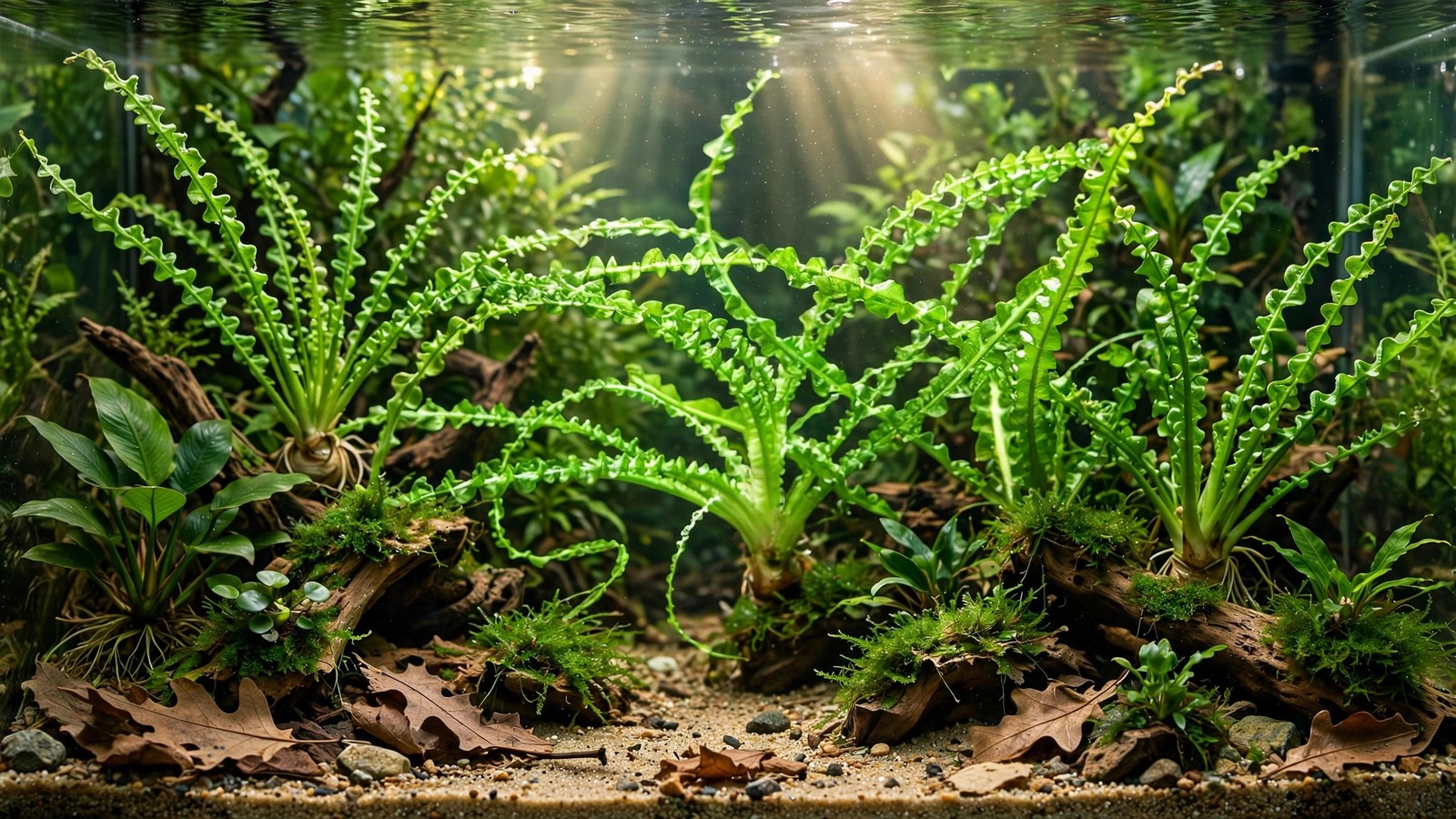
Long, crinkled ribbons rising from a bulb like green Medusa hair — nothing else looks like this. Crinum calamistratum care is about patience with a living sculpture: this West African bulb plant grows extremely slowly into a spectacular specimen of curly, strap-like leaves, hates being moved, and rewards a permanent home with decades of presence. It's the plant you buy once and keep forever.
This guide covers planting the bulb, its glacial growth and what to expect, light and nutrient needs, the cardinal rule against moving it, propagation, flowering, and troubleshooting melt and stalled growth.
Quick Care Reference
| Parameter | Requirement |
|---|---|
| Light | Low to medium (30–50 PAR) |
| CO2 | Not required |
| Growth rate | Very slow |
| Placement | Background (specimen) |
| Difficulty | Easy to moderate |
| Temperature | 72–82°F (22–28°C) |
| pH | 5.5–7.5 |
| Height | 20–40 inches (50–100 cm) |
A Living Sculpture
Crinum calamistratum is less a plant than an installation: a large bulb sends up dozens of narrow, intensely crinkled leaves that can reach 3 feet, curling and twisting as they grow. Each leaf is unique — no two curl the same way — and the overall effect is a fountain of green ribbons that moves hypnotically in the current. It's native to West and Central African streams, where it anchors in sandy substrates with massive root systems.
It's a true specimen plant: one Crinum commands a corner of even a large tank. Aquascapers use it as the gravitational center of nature-style layouts — the thing the whole composition orbits. And it's a commitment: this plant can live for decades, growing slowly more magnificent every year.
Planting the Bulb (And Then Never Moving It)
Plant the bulb with its neck and growing tip exposed above the substrate — bury the bulb body about two-thirds deep, leaving the top third visible. Like all bulb plants — see the Aponogeton crispus planting guidance — a fully buried Crinum rots. Use a deep, nutrient-rich substrate: Crinum develops an enormous root system and feeds heavily through it — aquasoil or a deep sand bed with root tabs is ideal.
Choose the spot as if forever, because it nearly is: Crinum calamistratum famously resents disturbance. Moving an established plant triggers melt, sulking for months, and sometimes decline. Plant it in the background corner where it can grow undisturbed for years, with 12+ inches of clearance — those leaves go everywhere, beautifully.
Light, CO2, and Water
Low to medium light (30–50 PAR) — Crinum evolved in shaded streams and its slow leaves algae-spot under strong light. It does beautifully in the dimmer corners of tanks where fussier plants fail. Eight hours daily max; in Crinum-focused tanks, less is fine.
CO2 is unnecessary — its glacial metabolism barely notices. Water should be warm (72°F+, it sulks in cool tanks), soft to moderately hard, pH 5.5–7.5. Stability is everything: this plant punishes abrupt changes with melt, so keep parameters steady and avoid the temptation to "improve" things around it.
Fertilizer: Feed the Roots Deeply
Crinum is a heavy root feeder with a root system to match — think deep. Place root tabs well under and around the bulb (not touching it) every 2–3 months in inert substrates; in aquasoil, supplement as the soil ages. Comprehensive liquid fertilizer helps, but root nutrition is what drives the big curly leaves.
Because growth is so slow, deficiencies appear over months: gradually yellowing older leaves (nitrogen), pale new growth (iron). Feed consistently rather than reactively — by the time you see hunger, the plant has been hungry for weeks. A well-fed Crinum produces steady new leaves; a starved one simply stops, sitting unchanged for months.
Growth: The Long Game
Set expectations honestly: Crinum calamistratum is one of the slowest aquarium plants. A new bulb may produce just a handful of leaves in its first six months. Year two brings real presence; year three and beyond bring magnificence. This is a plant you buy for what it becomes, not what it is.
The slowness is also its virtue: once established, it needs almost no maintenance. Old leaves occasionally yellow — remove them at the bulb. That's the entire care routine for years. Buy the largest bulb you can afford; with Crinum, you're buying time, and time is the whole plant.
Flowering
Mature, happy Crinums flower — spectacularly. A thick flower stalk rises above the water bearing large, white, lily-like blooms with a sweet fragrance, often opening at night. Flowering needs maturity (usually 2+ years), warm water, good nutrition, and an open top or enough clearance. It's one of the most dramatic blooms in the hobby — a genuine event worth waiting years for.
Propagation
Daughter bulbs form around the mother over years — Crinum is in no hurry about reproduction either. Separate daughters once they're substantial (several leaves, good roots), knowing the disturbance will set both back months. Seed propagation from flowers is possible but a multi-year project. Practically: buy bulbs, wait, and eventually divide. Patience isn't just a virtue with Crinum; it's the entire method.
Troubleshooting Common Problems
Melting after planting or moving
Expected — Crinum melts dramatically when disturbed, sometimes losing all leaves. The bulb is what matters: firm means alive. Keep it planted, maintain stable warm conditions, and wait — regrowth takes weeks to months. This is why you plant it once and never move it.
No growth for months
Normal, especially in year one. But if an established plant stalls completely with deteriorating leaves, check root nutrition (feed it), temperature (warm enough?), and whether something changed (it hates change). A Crinum that's merely slow is healthy; one that's declining needs investigation.
Leaves turning brown or algae-covered
Too much light for its slow leaves, or old age. Move it to a shadier spot (or shade it with taller plants), keep photoperiod ≤8 hours, and remove spent leaves. Nerite snails help with spot algae. Prevention is placement — Crinum belongs in gentle light.
Bulb softening
Buried too deep, damaged, or rotting from poor water quality. Expose the bulb neck, ensure good water quality, and remove any bulb that's soft and foul-smelling. A firm bulb with no leaves is dormant or recovering, not dead — give it months before judging.
Leaves breaking or kinking
The long leaves are delicate — strong direct flow whips them against hardscape, causing kinks. Position out of direct filter blast; gentle ambient current is ideal. Broken leaves don't heal — remove them at the base and let replacements grow.
Aquascaping With Crinum
One Crinum, one corner, done. It's a specimen that needs no companions to justify itself, though it pairs beautifully with dark wood, smooth river stones, and a dark substrate that makes the green ribbons glow. Surround its base with Anubias nana petite or Bolbitis on nearby wood, or a dwarf lily rosette in the substrate beside it, for a layered composition, and keep the foreground simple — a Monte Carlo carpet or bare sand lets the Crinum dominate.
Scale matters: in tanks under 30 gallons, Crinum overwhelms — its leaves reach the surface and sprawl. It's a 40+ gallon plant at maturity. Plan the tank around it, not it around the tank.
Frequently Asked Questions
Why is my Crinum calamistratum not growing?
It's probably growing — just very slowly. New bulbs may produce only a few leaves in six months; that's normal. True stalls with deteriorating leaves point to hunger (feed the roots), cold water (needs 72°F+), or recent disturbance (it sulks for months after moves). Judge in seasons, and never move it to "check."
Can I move an established Crinum?
Avoid it — Crinum famously resents disturbance, often melting completely and sulking for months. If you must move it, keep the maximum root mass intact, replant immediately at the same depth, and expect a long recovery. The golden rule: plant it where it will live for years.
Does Crinum calamistratum need CO2?
No. Its extremely slow metabolism makes CO2 irrelevant — it grows the same glacial pace with or without it. Spend your efforts on rich root nutrition, warm stable water, and appropriate low-medium light instead. Rich root nutrition and stable warm water deliver far better results.
Will it flower in my aquarium?
Mature plants (2+ years) in warm, well-fed conditions can produce spectacular white lily-like blooms on stalks rising above the water. It needs an open top or clearance, and patience. Flowering Crinum is one of the hobby's great achievements — worth the years of waiting.
How big does it get?
Large — leaves reach 20–40 inches, sprawling across the surface in most tanks. It's a background specimen for 40+ gallon tanks; smaller tanks get overwhelmed. Give it a corner with 12+ inches of clearance and plan the aquascape around its mature size, not its nursery size.
Why are the leaves turning brown?
Usually too much light (its slow leaves algae-spot and brown under strong light) or natural aging of old leaves. Provide low-medium light, remove spent leaves at the bulb, and ensure good water quality. New leaves emerging green and curly mean the plant is healthy.
Bringing It All Together
Crinum calamistratum is the opposite of instant gratification: a bulb you plant once, in the right spot, and then watch become magnificent over years. Give it rich deep substrate, gentle light, warm stable water, and above all, leave it alone — and it becomes the living sculpture your tank is built around, flowering spectacularly when it finally decides you're worthy. Some plants you keep; Crinum you inherit to yourself.
Tissue-culture plants are the exception — they’re grown in sterile gel and adapt with minimal melting, which is part of what you’re paying for. Plants bought submersed from another hobbyist’s tank also transition with little melt, since they’re already in the right form.
Which Plants Melt Most (and Least)
Heavy melters (expect significant leaf loss)
- Cryptocorynes — infamous for “crypt melt,” sometimes dropping every leaf after any disturbance. They almost always recover from the roots within weeks.
- Stem plants grown emersed — rotala, ludwigia, and hygrophila often shed lower emersed leaves while the growing tips transition.
- Amazon swords — emersed-grown swords typically lose their broad oval aerial leaves and replace them with longer submersed ribbon leaves.
Light melters
- Anubias, java fern, bucephalandra — slow-growing rhizome plants transition gradually; occasional old-leaf melt but rarely dramatic.
- Vallisneria — usually transitions well, though it dislikes the move itself and may sulk for a week.
- Floating plants — minimal melt since their leaves were already at the air-water interface.
The Acclimation Protocol
Step 1: Quarantine or dip first
Before acclimating to your tank’s conditions, make sure you’re not acclimating pests along with the plant. Run new arrivals through our quarantine and dip protocol — it adds days upfront but prevents months of regret.
Step 2: Float to temperature-match (30 minutes)
Float the bag or container in your tank for 20–30 minutes to equalize temperature. Plants are less temperature-sensitive than fish, but a 10°F shock on top of transplant stress is an avoidable insult.
Step 3: Trim before planting
Remove any leaves that are already damaged, yellowing, or heavily algae-covered — they won’t recover and they’ll rot in your tank, feeding algae. For stem plants, trim off the bottom inch and any emersed leaves that look unlikely to adapt; the plant wastes energy maintaining leaves it’s going to shed anyway. Keep the healthy growing tips — that’s where recovery starts.
Step 4: Plant correctly the first time
Follow our planting guide — right depth, crown exposed on rosettes, rhizomes unburied on epiphytes. Every uprooting and replanting restarts the acclimation clock, so get placement right on the first attempt. Decide where each plant goes before it goes in the water.
Step 5: Run a gentle first week
For the first 7 days after planting:
- Moderate light — run your normal photoperiod but consider dropping intensity 20–30% if your light is dimmable. Blast-level light on a melting plant grows algae on the dying leaves, not recovery.
- Stable CO2 — if you inject CO2, keep it consistent. Fluctuating CO2 during acclimation is a melt accelerator. If you’re low-tech, this doesn’t apply — see growing without CO2.
- Half-strength fertilizer — new plants with damaged leaves can’t use full dosing, and the excess feeds algae. Ramp to full strength over 2–3 weeks per our fertilizer schedule.
- No disturbance — don’t move, trim, or “check on” new plants for at least two weeks. Every touch resets root establishment. This is especially critical for crypts.
Step 6: Remove melt, keep the base
As emersed leaves melt, remove the mushy material promptly — decaying leaves release ammonia and grow fungus that can spread to healthy tissue. But never discard the plant while the crown, rhizome, or roots are firm and alive. A crypt that’s lost every leaf but has firm roots is a plant that’s about to recover, not a dead plant. Give it 3–4 weeks before judging.
Telling Normal Melt From Real Problems
Normal transition melt:
- Affects oldest/emersed leaves first, newest growth last
- New submersed leaves emerge even as old ones dissolve
- Roots and crown stay firm and white/green
- Timeline: 1–4 weeks, then obvious new growth
Concerning melt (see our full melting diagnosis guide):
- New growth also melts or emerges deformed
- Rhizome or crown turns mushy and brown — this is rot, not transition
- Entire plant dissolves within days with no new growth after 4+ weeks
- Melting spreads to established plants that weren’t recently moved
Buying Tips to Minimize Melt
- Buy submersed-grown when available — hobbyist-grown cuttings transition with almost no melt.
- Choose tissue culture for sensitive species — crypts and delicate stems establish far more reliably from sterile cups.
- Avoid plants already melting in the store tank — some melt is normal, but a plant that’s mostly mush at purchase has less energy for recovery.
- Transport carefully — keep plants damp and out of direct sun/heat. A plant that dries out or cooks in a hot car melts far worse than one transported properly.
The First-Month Timeline: What to Expect Week by Week
Knowing what’s normal when removes most acclimation anxiety. Here’s the typical timeline for a healthy plant adapting to a new tank:
Week 1: The quiet week
Almost nothing visible happens. The plant is growing roots you can’t see and assessing its new environment. Some species (vallisneria, stem plants) may start shedding their lowest leaves. This is normal. Resist the urge to “help” — no moving, no extra fertilizer, no light changes. The most common beginner mistake is intervening during a week when the correct action is nothing.
Week 2: Melt peaks
This is when emersed leaves give up in earnest. Crypts may drop everything; swords shed their broad aerial leaves; stem plants lose lower foliage. It looks catastrophic and it’s usually fine. Keep removing mushy material, keep conditions stable, and watch the crown and growing tips — if those are firm and green, recovery is already underway.
Week 3: The turn
New submersed-adapted leaves emerge — smaller, thinner, often a slightly different shade of green than the emersed foliage. Stem plant tips start growing visibly; crypts push tiny curled leaves from the crown; swords unfurl narrow ribbon leaves. This is the moment most beginners exhale for the first time.
Week 4+: Established
New growth outpaces melt, and the plant is functionally yours. You can resume full-strength fertilizer, normal trimming, and stop treating it as fragile. Some slow growers (anubias, bucephalandra) take 6–8 weeks to show obvious progress — that’s their normal speed, not a problem.
Acclimating Different Plant Formats
Tissue-culture cups
Sterile, pest-free, and already adapted to high-humidity (not emersed) growth — tissue cultures melt the least of any format. Rinse the agar gel off gently (leftover gel rots and feeds fungus), split the portion into small plantlets, and plant per our planting guide. They establish slowly for the first two weeks, then accelerate. No dip needed, minimal acclimation stress — this is the premium experience you’re paying for.
Potted plants
Remove the pot and strip away the rockwool completely — leftover rockwool traps debris and rots. Tease the root mass apart gently; if it’s a dense mat, splitting it into 2–3 smaller portions actually establishes faster than planting one big clump (more growing points, better water flow around roots). Potted plants are usually emersed-grown, so expect the standard 2–4 week melt cycle.
Bare-root / bunched stems
Typically sold as weighted bunches. Remove any bands, foam, or weights, strip the lower leaves, and plant stems individually or in small groups. Bunched stems from the store are often already transitioning — check for new submersed growth at the tips, which tells you the plant is mid-adaptation and will settle quickly.
Hobbyist cuttings
Already submersed-grown and the fastest to establish — often showing new growth within days. The main acclimation factor is water-parameter difference between the two tanks. Float to temperature-match, plant promptly, and they’ll usually take off with minimal melt. This is why experienced hobbyists prefer trading cuttings over buying potted plants.
Frequently Asked Questions
Should I use a “plant starter” or transplant fertilizer?
Products marketed for transplant shock are mostly B-vitamins and mild hormones. They don’t hurt, but there’s no strong evidence they help aquarium plants specifically. Stable conditions and patience outperform any bottle. Save the money for more plants.
My new plant melted completely — bare crown, no leaves. Is it dead?
Probably not, if the crown or rhizome is firm. Crypts and swords routinely lose 100% of their leaves and regrow from the base within a month. The test is firmness: firm and pale/green means alive; mushy and brown/black means rot. Give firm-but-leafless plants a full 4 weeks before declaring them dead.
Can I speed up acclimation with extra light or CO2?
No — and trying usually backfires. A melting plant can’t use extra light; the excess just grows algae on its dying leaves. Keep light moderate and CO2 stable (not boosted) during acclimation. Growth speed comes from the plant’s own adaptation timeline, which you can’t rush, only avoid delaying.
Should new plants go straight into my main display tank?
After quarantine/dipping, yes — there’s no benefit to a separate “growing-in” tank for most plants. They acclimate to your water fastest in the tank they’ll live in. The exception is very delicate species going into a tank with boisterous fish; give those a few weeks in a calm corner or breeder box first.
The Patience Rule
The single most important acclimation skill is restraint: plant it right, set gentle conditions, remove decay, and then leave it alone for a month. The hobbyists with the best plant growth aren’t doing something clever in week one — they’re simply not interfering in weeks two through four while the plants do what they’ve evolved to do. Melt looks like failure and feels like failure, but in most cases it’s the visible part of a plant successfully becoming yours.