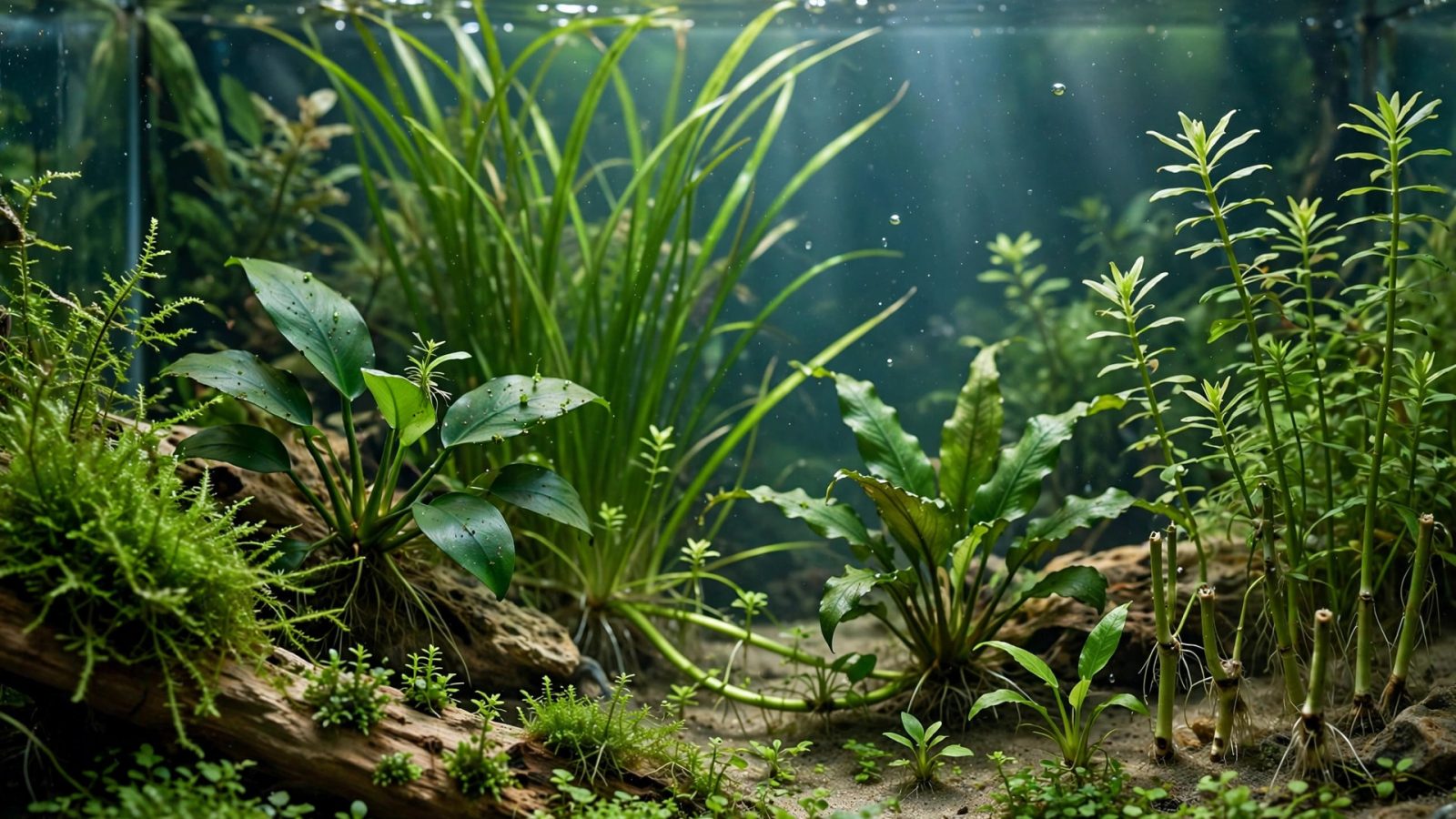
Learning how to propagate aquarium plants is the closest thing the hobby has to free money. A single $8 stem plant becomes ten plants within months; one Amazon sword sends out a runner that becomes five. Every trimming session, every runner, every plantlet is a new plant you don’t have to buy — and understanding the five propagation methods means you’ll never pay full price to fill a tank again.
Different plants propagate in completely different ways, and matching the method to the plant is the whole skill. Here’s each method, which plants it works for, and exactly how to do it.
Method 1: Stem Cuttings (Easiest)
Works for: all stem plants — rotala, ludwigia, hygrophila, bacopa, water wisteria, moneywort, hornwort.
This is propagation at its simplest, and it’s the same technique as trimming stem plants:
- Cut a healthy stem, making sure your cutting is at least 3–4 inches long with several leaf nodes.
- Strip the leaves from the bottom 1–2 inches of the cutting — buried leaves rot and can cause the stem base to melt.
- Push the bare stem section into the substrate with planting tweezers, deep enough that it won’t float up (see how to plant aquarium plants if they keep escaping).
- The cutting grows roots from the buried nodes within 1–2 weeks and continues growing as an independent plant.
The original stem doesn’t go to waste either — cut just above a leaf node and it typically sprouts two new side shoots. One stem becomes three plants: the replanted top plus two branches on the base. Repeat every few weeks and a single purchase becomes a background wall within two months.
Tips: take cuttings from the healthiest top growth, not leggy lower stems. Cuttings root faster under good light. Some hobbyists float cuttings for a few days until roots appear, then plant — this works but planted-directly cuttings establish faster in our experience.
Method 2: Runners and Stolons
Works for: vallisneria, dwarf sagittaria, chain swords (echinodorus tenellus), marsilea, and most carpeting plants.
Runner plants send out horizontal stems (stolons) along or just under the substrate surface, with a new plantlet forming at intervals. The plant does the propagation work for you — your job is management:
- Let the runner extend until the new plantlet has 3–4 leaves and visible roots of its own.
- If you want the plantlet where it is, do nothing — it will root itself and eventually the connecting runner withers naturally.
- If you want to move it, cut the runner on both sides of the plantlet with scissors, gently lift the plantlet with its roots, and replant it with tweezers wherever you want it.
To encourage runner production (for filling a carpet faster), keep the parent plant healthy and the substrate nutritious — runners are a sign of a thriving plant with energy to spare. To control runners (dwarf sagittaria invading your foreground, vallisneria crossing the tank), pull unwanted runners during water changes, tracing each back to its source.
Never separate a plantlet before it has its own roots — a rootless plantlet usually melts. Patience for one extra week makes the difference between a transplant that thrives and one that dissolves.
Method 3: Rhizome Division
Works for: anubias, java fern, bucephalandra, and cryptocorynes (which divide at the crown).
Rhizome plants grow from a thick horizontal stem (the rhizome) that creeps along wood, rock, or substrate surface. Division is straightforward:
- Remove the plant from the tank (or work in place for large specimens).
- Identify a natural division point — a section of rhizome with at least 4–5 healthy leaves and some roots attached.
- Cut the rhizome with a clean, sharp blade. A clean cut heals faster than a tear; sterilize the blade first if you’re doing many divisions.
- Attach each division to wood, rock, or substrate surface as you would a new plant. Never bury the rhizome — it rots underground.
Anubias and java fern are slow growers, so divisions take months to look like full plants — this is a patience method, not a quick-fill method. But a single large anubias purchased today becomes three or four plants that would cost $10–15 each at retail. For the full care picture, see our Java Fern care guide.
Method 4: Adventitious Plantlets
Works for: java fern (plantlets on leaf tips), Amazon swords (plantlets on flower spikes), java moss (fragments), anubias (occasional plantlets).
Some plants spontaneously grow baby plants on their leaves or flower stalks — no intervention needed until harvest:
Java fern plantlets
Mature java fern leaves develop tiny plantlets — complete miniature ferns with leaves and roots — along their edges and tips. This is most common on older leaves and is actually a stress response as much as a reproductive one; heavily plantlet-covered leaves are often worth removing anyway. When a plantlet has 4–5 leaves and visible roots (about half an inch), gently pluck or cut it from the parent leaf and attach it to wood or rock. Each one becomes a full plant within months.
Amazon sword flower spikes
Healthy Amazon swords occasionally send a long spike to the surface that produces small plantlets instead of (or alongside) flowers. Let the plantlets develop until they have several leaves and roots, then cut the spike and plant each one in the substrate with a root tab nearby. A single spike can yield 5–10 new swords.
Moss fragments
Java moss propagates from any fragment — every trimming is potential new moss. Press trimmings onto wood or rock, secure with thread or glue, and keep them in place for 2–3 weeks until they attach. Our Java Moss care guide covers attachment methods in detail.
Method 5: Seeds and Bulbs (Slowest, Most Rewarding)
Works for: red tiger lotus and other bulb plants (daughter bulbs), cryptocoryne (rarely, seeds), and a few stem plants that flower above water.
Bulb plants like red tiger lotus periodically produce daughter bulbs — small bulbs that form attached to the parent. Gently separate them once they’re marble-sized, and plant each one half-buried in the substrate (never fully buried — bulbs rot underground). Each daughter bulb grows into a full lotus plant.
True seed propagation is rare in aquariums because most aquarium plants are grown submersed and rarely flower underwater. If a plant does flower (anubias flowers are common), seeds require emersed conditions to germinate — interesting as an experiment, impractical as a propagation strategy. For filling tanks, stick to methods 1–4.
Propagation Speed Ranking
From fastest to slowest for filling a tank:
- Stem cuttings — weeks to visible results; the workhorse method
- Runners — weeks to months; automatic once the parent is happy
- Adventitious plantlets — months; free but on the plant’s schedule
- Rhizome division — months; limited by slow parent growth
- Bulbs/seeds — months to a year; satisfying but not practical for filling
Propagating Specific Popular Plants
Water wisteria (Hygrophila difformis)
The beginner’s propagation playground. Snip any stem, strip the lower leaves, plant the cutting — it roots in days. Wisteria also propagates from single leaves left floating; each leaf grows roots and a new plantlet. It’s nearly impossible to fail with wisteria, which is why it’s the recommended first propagation species.
Java fern
Wait for the plantlets that form on old leaf edges — tiny ferns complete with leaves and roots. Once a plantlet has 4–5 leaves and visible roots (usually 1–2 inches tall), gently pluck or cut it from the mother leaf and attach it to hardscape with thread or glue. Don’t rush: plantlets removed too early often stall. A single java fern leaf can produce a dozen plantlets over its life.
Anubias
Rhizome division only, and patience is mandatory — anubias grows slowly, so divisions take months to look like real plants. Cut the rhizome with a sharp blade, ensuring each piece has at least 3–4 leaves and some roots. Let the cut end callus for a few hours before attaching. Expect 2–3 months before the division shows confident new growth.
Amazon sword
Mature swords send up a long flower spike that often reaches the surface. If left alone, the spike develops adventitious plantlets at nodes along its length — tiny swords complete with roots. Once a plantlet has several leaves and inch-long roots, snip it from the spike and plant it. One spike can yield 5–10 new swords. (Trim the spike if you’d rather the mother plant put energy into leaves instead.)
Cryptocoryne
Crypts propagate via underground runners, sending up daughter plants around the mother. Don’t separate them too early — wait until the daughter has 4–5 leaves of its own, then gently dig and sever the runner. Warning: disturbing crypts often triggers crypt melt in both mother and daughter. Propagate crypts when you can leave both undisturbed for a month afterward.
Dwarf sagittaria and vallisneria
Runner factories. These send out horizontal stolons that surface as new plants inches from the parent. For fastest carpeting, let runners spread naturally; for controlled propagation, snip the runner once the daughter has roots and replant it where you want it. A single vallisneria can colonize a 4-foot tank in a year via runners alone.
Red tiger lotus
Grows from a bulb that splits over time — mature bulbs develop daughter bulbs attached to the parent. Separate them carefully during a rescape, ensuring each has roots. Lotus also flowers readily in good conditions; the flowers are beautiful but energy-expensive, so remove them if your goal is leaf propagation rather than seeds.
Common Propagation Failures (and Fixes)
- Cuttings rot instead of rooting: the cutting was too small (no energy reserves), the water is too cold, or leaves were buried and rotted first. Use longer cuttings, strip all buried leaves, and keep water at 74–78°F.
- Rhizome division melts: the cut section was too small or the cut wasn’t clean. Each division needs multiple leaves, roots, and a clean (not crushed) cut. Sterilize the blade between cuts.
- Plantlets stall after separation: separated too early. The rule: if it doesn’t have its own functional roots yet, it’s not ready. Patience here saves months of stalled growth.
- Runners produce weak daughters: the mother plant is nutrient- or light-limited and can’t provision offspring. Fix the mother’s conditions first — propagation multiplies health and weakness.
- Everything propagates except what you want: some species just propagate slowly (anubias, bucephalandra) while others explode (wisteria, hornwort). Match your expectations to the species’ biology, not your enthusiasm.
Selling and Trading Your Propagations
Once propagation outpaces your tank space — and it will — the hobby’s trading economy awaits:
- Local fish clubs are the best outlet: monthly auctions and swaps where healthy homegrown plants command good prices or trade value. Club members pay premium for pest-free, submersed-grown stock.
- Online marketplaces (r/AquaSwap, Facebook groups, eBay) work well for rarer species. Ship in breather bags with a damp paper towel, never in standing water (which sloshes and damages leaves).
- Price realistically: common stems go for a few dollars per bunch; rare bucephalandra or tissue-culture-grade specimens command much more. Check recent sold listings, not asking prices.
- Quarantine your sale stock. Selling pest snails along with your plants destroys your reputation fast. Dip before you ship — your buyers will thank you with repeat business.
Many hobbyists fund their entire aquarium hobby from propagation sales. It starts with one stem cutting that rooted.
Setting Up a Propagation Workflow
Once you have multiple tanks (or one tank and big ambitions), systematize it:
- Keep a “grow-out” area — a corner of your main tank, a spare nano tank, or even a bucket with a light — where cuttings and plantlets develop undisturbed until they’re substantial enough to place properly.
- Trim on schedule — every trimming session is a propagation session. Replant the best tops, grow out the rest.
- Label everything — six months later you won’t remember which crypt is which. A piece of tape on the grow-out tank saves endless confusion.
- Quarantine new acquisitions before adding them to your propagation stock — one batch of pest snails or algae in your grow-out tank contaminates everything downstream. See how to quarantine aquarium plants.
Propagation changes the economics of the hobby completely. That $60 plant order becomes a one-time investment instead of a recurring expense, and within a year most hobbyists have more plants than tanks — which is exactly how the trading, selling, and endless aquascaping experiments begin. Start with stem cuttings this week; everything else follows naturally.